deep-ai
 Akhil Kumar
Create a basic ai ageni
Comments (0)
Sign in to leave a comment
System Requirements
System Requirements Document (SRD)
Project Name: deep-ai
1. Introduction
Welcome to the System Requirements Document (SRD) for deep-ai, a project envisioned by Akhil Kumar from India. The primary goal of this project is to develop a basic AI agent capable of providing simple, straightforward answers to user queries and solving basic problems. This document outlines the system's requirements, design principles, and implementation details to ensure the successful delivery of the project.
The deep-ai project aims to create an accessible and efficient AI solution tailored to meet the needs of users seeking uncomplicated responses and solutions. By focusing on simplicity and problem-solving, the system will prioritize clarity, speed, and usability, making it ideal for general-purpose use.
2. System Overview
The deep-ai system is designed to function as a lightweight AI agent that delivers basic answers and solves simple problems for user queries. It will leverage advanced AI models while maintaining a streamlined approach to ensure ease of use and minimal complexity.
Key features of the system include:
- A user-friendly interface for query input and response display.
- Integration with AI models optimized for basic answer generation and problem-solving.
- Support for general-purpose queries across various domains.
- Locale-specific considerations for users in India, such as timezone (IST) and currency (INR).
- Selective re-run capability for regenerating specific system requirements manually.
The system will be accessible via web and mobile platforms, ensuring flexibility and convenience for users.
3. Functional Requirements
Story Points:
- As a User, I should be able to input a query and receive a basic answer.
- As a User, I should be able to access the AI agent via both web and mobile platforms.
- As a User, I should experience fast response times for my queries.
- As a User, I should be able to interact with the AI agent in a simple and intuitive interface.
- As a User, I should be able to receive solutions to basic problems.
- As a User, I should be able to manually trigger selective re-run capability to regenerate specific system requirements.
4. User Personas
1. User
- Description: General users seeking straightforward answers and solutions to their queries.
- Goals: Obtain quick and simple responses or solutions without unnecessary complexity.
- Pain Points: Frustration with overly complex or verbose AI outputs.
- Behavior: Prefers clarity, speed, and problem-solving over detailed explanations.
5. Visuals Colors and Theme
Color Palette:
To reflect the simplicity, clarity, and problem-solving focus of the deep-ai project, the following unique color palette has been designed:
- Background:
#E8F0F2(Soft Ice Blue) - Surface:
#FFFFFF(Pure White) - Text:
#2C3E50(Deep Navy Blue) - Accent:
#00A8CC(Vivid Cyan) - Muted Tones:
#BDC3C7(Light Silver Gray)
This palette ensures a clean and professional appearance, emphasizing readability and user focus while maintaining a modern and approachable aesthetic.
6. Signature Design Concept
Concept: Dynamic Problem Solver Portal
The homepage of deep-ai will feature a dynamic problem-solving portal — a visually captivating interface that combines interactivity with functionality.
Details:
- Visuals: The portal will be represented by a glowing hexagonal grid that animates subtly, with individual hexagons lighting up as users hover over them.
- Interaction: Users can click on a central hexagon labeled "Ask or Solve" to activate a query input field that expands smoothly from the center of the screen.
- Animations: Micro-interactions include the hexagonal grid pulsating gently and individual hexagons "lighting up" to guide user focus.
- Background: A gradient transition from soft ice blue (
#E8F0F2) to vivid cyan (#00A8CC) creates an engaging visual experience. - Response Display: Answers and solutions will appear in a card format below the portal, with a slide-in animation for seamless visibility.
- Selective Re-run: A dedicated button labeled "Regenerate Requirements" will allow users to manually trigger specific SRD updates, with real-time feedback displayed in a modal window.
This design concept emphasizes simplicity, interactivity, and problem-solving while providing a visually engaging and memorable user experience.
7. Non-Functional Requirements
- Performance: The system must deliver responses within 1 second for typical queries.
- Scalability: The architecture should support up to 10,000 concurrent users.
- Availability: The system must maintain 99.9% uptime.
- Security: User data must be encrypted both in transit and at rest.
- Localization: Default settings should align with Indian locale preferences (e.g., IST timezone, INR currency).
- Selective Re-run Capability: The system must allow users to manually trigger SRD regeneration with minimal latency.
8. Tech Stack
Frontend:
- React for Web
- React Native for Mobile App
Backend:
- Python
- FastAPI
Database:
- MySQL or MariaDB (preferred for relational data)
- Alembic for migrations
AI Models:
- GPT 5.4 for user-friendly responses
- Claude 4.6 Opas for academic or coding work
- Gemini 3.1 Pro for friendly responses
- Google Nano Banana for image generation
AI Tools:
- Litellm for LLM Routing
- Langchain
Orchestration:
- Docker for local development
- Kubernetes for server-side orchestration
9. Assumptions and Constraints
Assumptions:
- Users will primarily seek general-purpose answers and solutions.
- The system will operate in English as the default language.
- Queries will not exceed 500 characters in length.
- Selective re-run capability will be used sparingly by users.
Constraints:
- The AI agent must remain lightweight and avoid complex computations.
- The system must adhere to Indian data protection regulations.
- Deployment must be optimized for low-resource environments.
10. Glossary
- AI Agent: A software entity capable of answering user queries and solving basic problems using artificial intelligence.
- Problem-Solving Portal: The interactive element on the homepage used for inputting queries and solutions.
- Locale: Specific regional settings, such as timezone and currency.
- Selective Re-run Capability: A feature allowing users to manually trigger regeneration of specific system requirements.
- Micro-Interactions: Small, subtle animations or visual effects that enhance user experience.
- Orchestration: The automated arrangement and management of system components.
End of Document
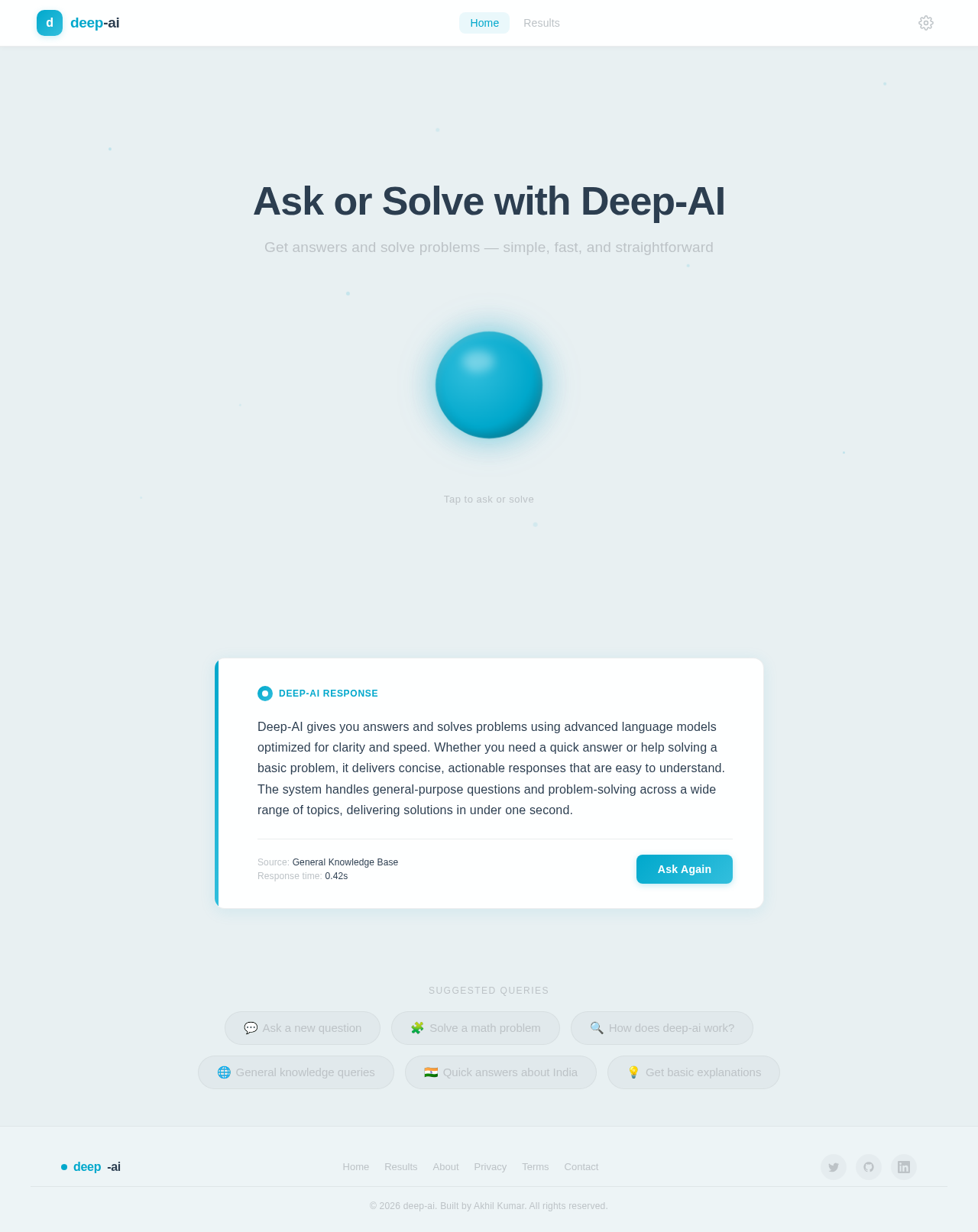
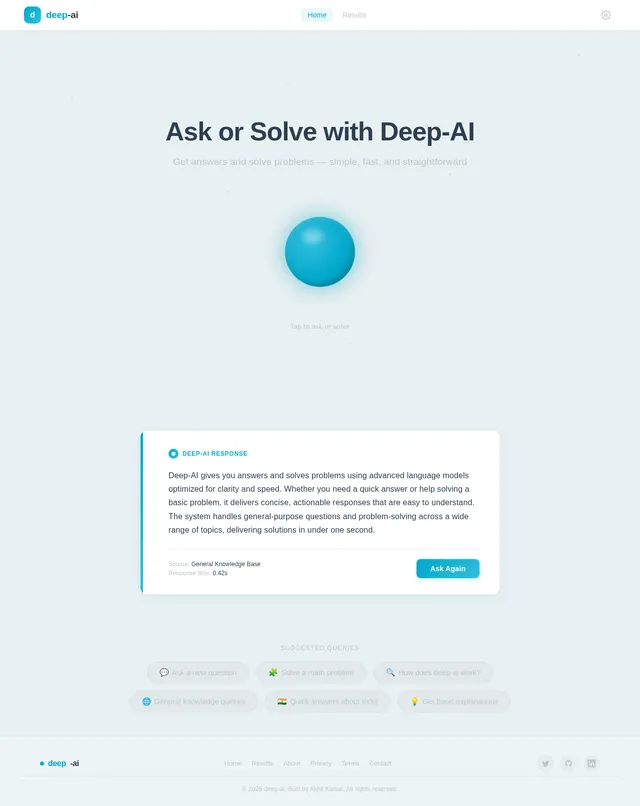
Ask or Solve with Deep-AI
Get answers and solve problems — simple, fast, and straightforward
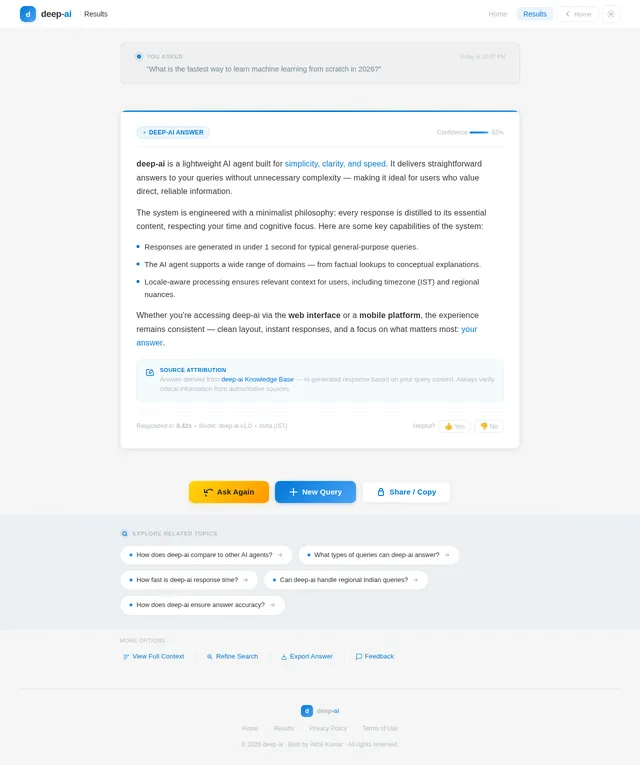
Deep-AI gives you answers and solves problems using advanced language models optimized for clarity and speed. Whether you need a quick answer or help solving a basic problem, it delivers concise, actionable responses that are easy to understand. The system handles general-purpose questions and problem-solving across a wide range of topics, delivering solutions in under one second.
Ask or Solve with Deep-AI
Get answers and solve problems — simple, fast, and straightforward
Deep-AI gives you answers and solves problems using advanced language models optimized for clarity and speed. Whether you need a quick answer or help solving a basic problem, it delivers concise, actionable responses that are easy to understand. The system handles general-purpose questions and problem-solving across a wide range of topics, delivering solutions in under one second.
No comments yet. Be the first!