dawn-magazine
 Iggy Kosovskiy
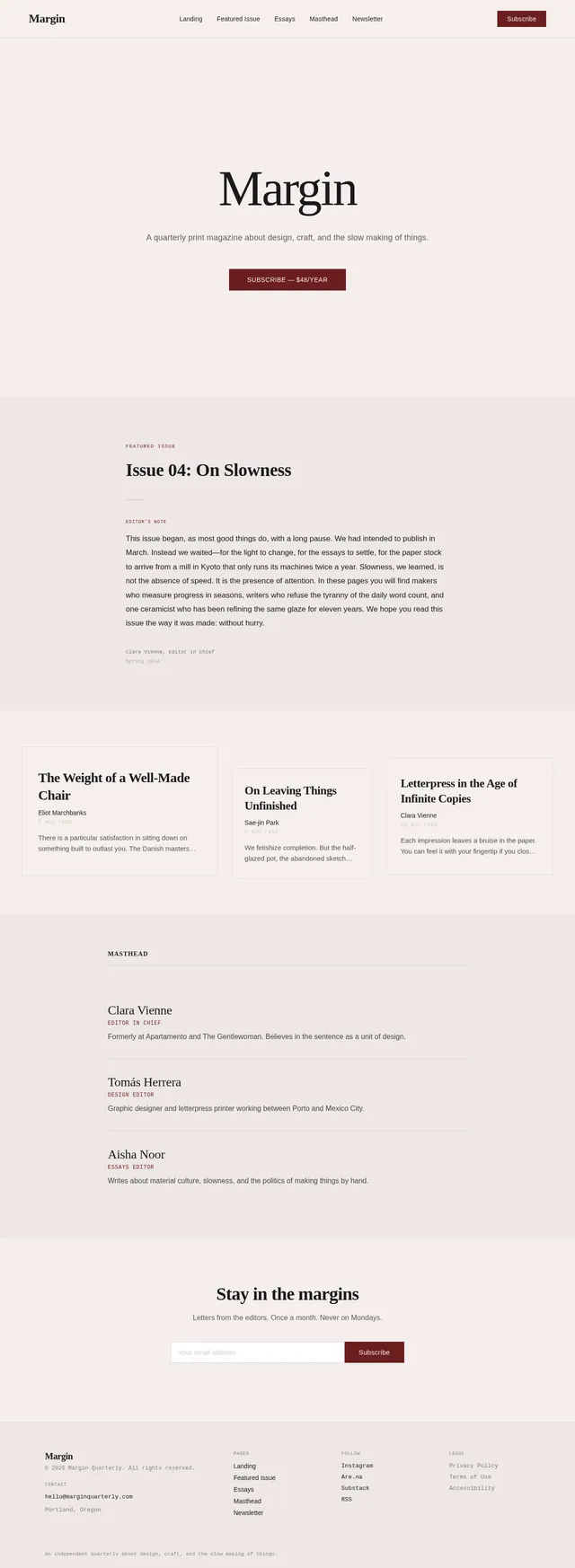
Build a landing page for "Margin" — an independent quarterly print magazine about design, craft, and the slow making of things. Style: editorial, restrained, confident. Think Apartamento meets The New Yorker. A reader, not a marketing site. Typography: serif display (Fraunces or similar) for headlines, clean sans-serif (Inter) for body, monospace for metadata and issue numbers. Palette: warm cream background (#F5EEEC), near-black text (#1A1A1A), single accent in deep oxblood (#6B1F1F). No gradients. No drop shadows. No rounded corners on cards. Sections in order: 1. Hero — magazine title set large in serif, tagline beneath, small "Subscribe — $48/year" link 2. Featured issue — "Issue 04: On Slowness" with an editor's note (3 short paragraphs of real copy, not lorem ipsum) 3. Three essay previews in an asymmetric magazine grid — each with title, author, reading time, and a 2-line excerpt 4. Masthead — meet the editors (3 names, roles, one-line bios) 5. Newsletter signup — single email field, "Subscribe" button, small line of copy beneath Tone: generous whitespace, left-aligned, never centered for body. Feels like flipping through a printed quarterly, not scrolling a tech site.
Comments (0)
Sign in to leave a comment
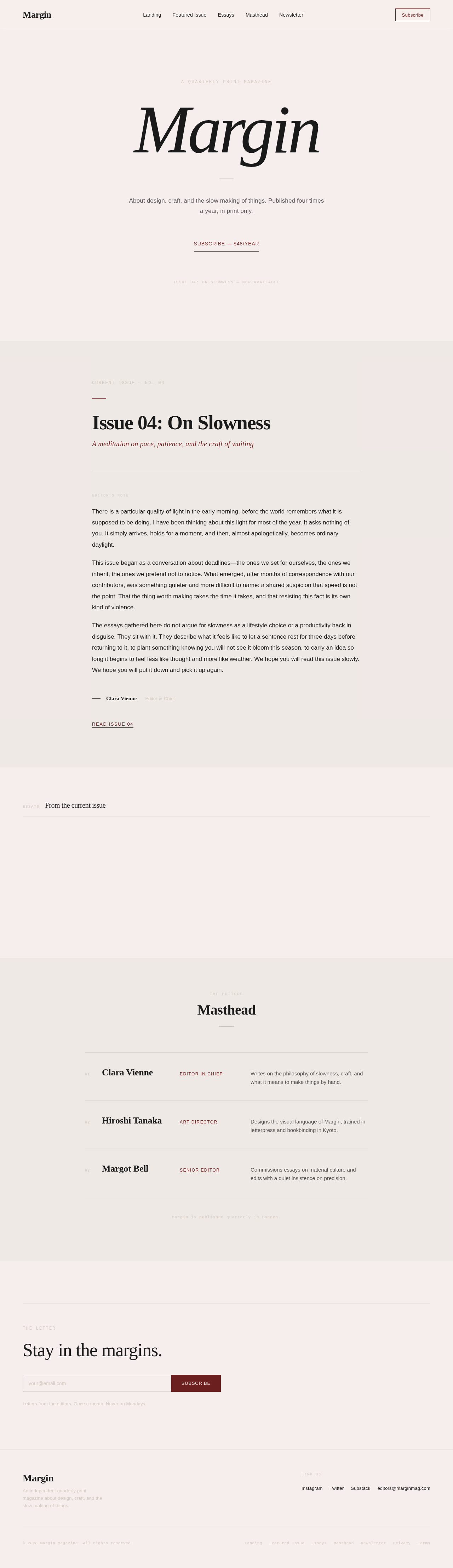
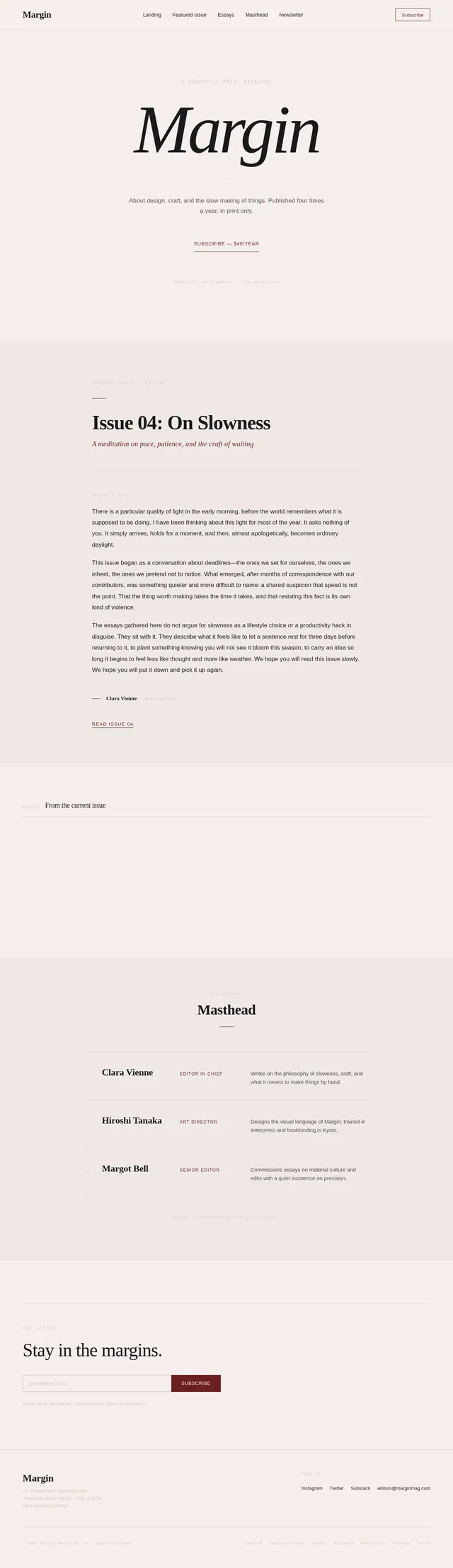
Margin
About design, craft, and the slow making of things. Published four times a year, in print only.
Subscribe — $48/yearIssue 04: On Slowness — Now Available
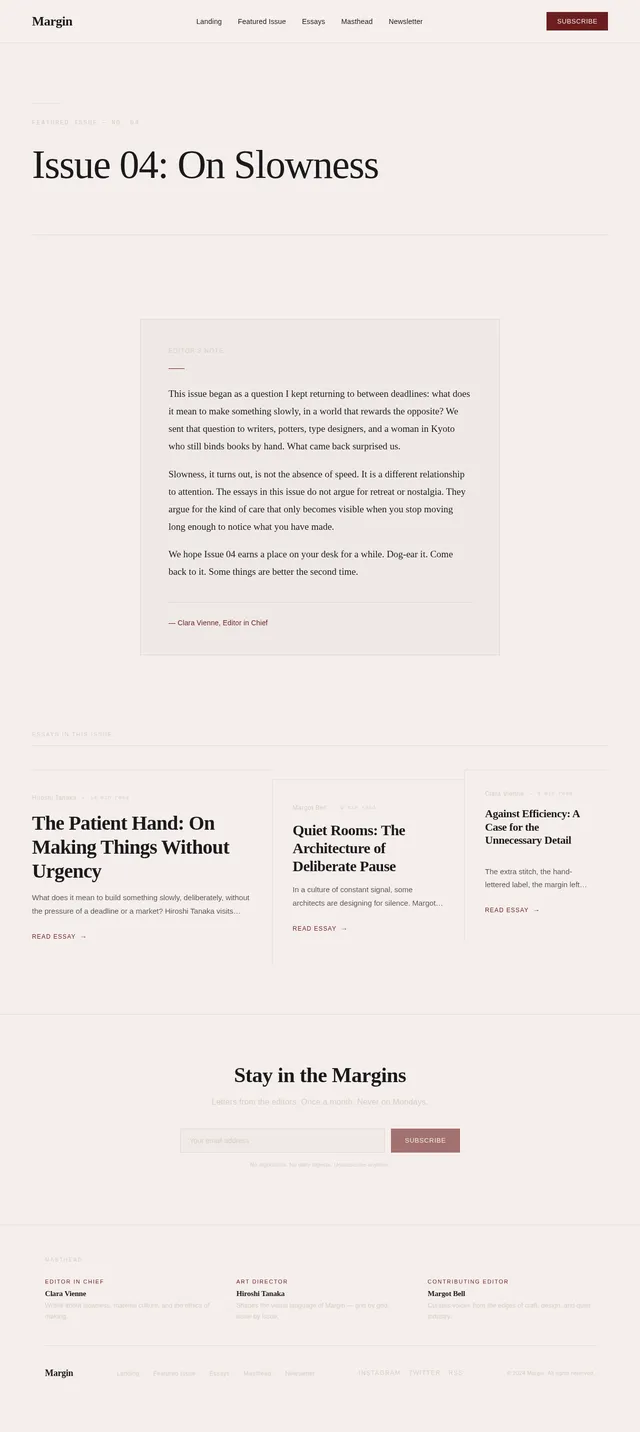
Issue 04: On Slowness
A meditation on pace, patience, and the craft of waiting
Editor's NoteThere is a particular quality of light in the early morning, before the world remembers what it is supposed to be doing. I have been thinking about this light for most of the year. It asks nothing of you. It simply arrives, holds for a moment, and then, almost apologetically, becomes ordinary daylight.
This issue began as a conversation about deadlines—the ones we set for ourselves, the ones we inherit, the ones we pretend not to notice. What emerged, after months of correspondence with our contributors, was something quieter and more difficult to name: a shared suspicion that speed is not the point. That the thing worth making takes the time it takes, and that resisting this fact is its own kind of violence.
The essays gathered here do not argue for slowness as a lifestyle choice or a productivity hack in disguise. They sit with it. They describe what it feels like to let a sentence rest for three days before returning to it, to plant something knowing you will not see it bloom this season, to carry an idea so long it begins to feel less like thought and more like weather. We hope you will read this issue slowly. We hope you will put it down and pick it up again.
From the current issue
The Patience of the Potter's Wheel
There is a moment in every throwing session when you stop fighting the clay. The wheel slows, your hands relax, and something shifts — the form begins to find itself rather than being forced.
Read Essay→Against Optimization
We have mistaken efficiency for virtue. The fastest route is not always the right one, and the shortest sentence rarely carries the most meaning. Slowness, I want to argue, is a form of respect.
Read Essay→Margins and the Space to Think
A book without margins is a book that does not trust its reader. White space is not empty — it is where your thoughts go when the author's leave off. It is where the conversation begins.
Read Essay→Masthead
Clara Vienne
Editor in ChiefWrites on the philosophy of slowness, craft, and what it means to make things by hand.
Hiroshi Tanaka
Art DirectorDesigns the visual language of Margin; trained in letterpress and bookbinding in Kyoto.
Margot Bell
Senior EditorCommissions essays on material culture and edits with a quiet insistence on precision.
Stay in the margins.
Letters from the editors. Once a month. Never on Mondays.
No comments yet. Be the first!