culinary-arts-facs
 patrik zex
لدي متجر على منصة https://www.teacherspayteachers.com/ و اعد منتجات تعليمية للمدارس الامريكية و الكندية احدى مبيعاتي ,و هي المنتجات التالية Culinary Arts Bundle | FACS Sub Plans, Kitchen Lab Roles & Recipe Math Culinary Food Costing Worksheets | Recipe Cost and Menu Pricing Food Storage & FIFO Inventory Audit | Culinary Arts Receiving Activities Food Plating Practice | Culinary Arts Worksheets & Lab Checklists for FACS Kitchen Order Ticket Activity | Culinary Arts Restaurant Workflow Simulation قم بفحص و تحليل هدا النيش و ثم استخراج القاسم المشترك بين هده المنتجات و اعداد تبصر لما هو مطلوب

Comments (0)
Sign in to leave a comment
System Requirements
System Requirements Document for culinary-arts-facs
1. Introduction
This document specifies culinary-arts-facs, a first-party niche-analysis dossier for a Teacher-Author who runs a store on Teachers Pay Teachers (TPT) and produces educational products for American and Canadian schools.
The product intent is derived directly from the seller's request: examine and analyze the culinary-arts niche represented by her five listed products, extract the common denominator shared across those products, and produce insight into what is required for that niche. The dossier is not a storefront, not a marketplace, and not a curriculum product; it is an analytical read of the seller's own catalog and market position, presented with the visual authority of a working professional kitchen.
The audience is the Teacher-Seller (Curriculum Author) herself — a seller-analyst who wants a sharp, credible read of her own niche rather than a soft brochure. The dossier is publicly readable (no account required) so it can be shared, referenced, and revisited without friction.
2. System Overview
culinary-arts-facs is a four-page, first-party web dossier that presents:
- A public Landing poster that frames the dossier and its purpose.
- A Niche Analysis page that examines the culinary-arts niche across the five listed products.
- A Common Denominator page that states the shared instructional and market pattern extracted across those products.
- A Niche Insights page that presents what is required for the niche.
Actors. The only accepted active human persona is the Teacher-Seller (Curriculum Author). Teachers Pay Teachers is a typed non-persona actor: it is the external marketplace where the seller's products are sold and the domain context for the analysis. It is not a destination owned by this product, and no TPT account, listing, or sales operation is performed inside this dossier.
Accepted behavior. The dossier analyzes the five named products, extracts their shared common denominator, and produces niche insight. All five product names are treated as authoritative catalog facts and are preserved verbatim throughout the dossier.
Ownership. All four pages are application-owned custom pages with access_requirement: none. No application identity, login, or account management is introduced, because no accepted journey requires durable private state, a commitment, an entitlement, or a value transfer bound to a specific participant.
Narrow exclusions. This product does not sell, list, upload, price, or deliver the five products; those operations remain with Teachers Pay Teachers. It does not create new curriculum, worksheets, or lab materials. It does not manage the seller's TPT account, payouts, or promotions.
2a. Product Interpretation and Delivery Boundary
The seller's request is an analytical one, not a transactional one. She already sells on Teachers Pay Teachers; what she asked for is a read of her own niche — an examination of the five products she named, the shared denominator running through them, and the insight that follows for what the niche requires.
Accordingly, the delivery boundary is:
- Current (in scope): a first-party, publicly readable dossier with four pages — Landing, Niche Analysis, Common Denominator, Niche Insights — presenting the niche analysis, the extracted common denominator, and the resulting insight.
- External (owned by Teachers Pay Teachers): the marketplace itself — buyer browsing, purchase, download, seller membership tiers, commission and transaction economics, promotions, and marketing tools. These are context for the analysis, not capabilities of this product.
- Future (not current): any expansion of the dossier beyond the five named products, any interactive catalog tooling, and any account-bound or personalized analysis. These are recorded in Section 11 as future horizons and are excluded from current pages and acceptance.
Access is deliberately open. The dossier is a reference read, not a private workspace, so no identity establishment or verification is required to use it.
2b. Source Content Inventory
The reference directive for https://www.teacherspayteachers.com/ declares uses: ["domain_context"] only. It is not a content_source, so no Source Content Inventory is produced. The verified platform observations (marketplace type, buyer/seller/organization roles, resource types, membership and financial terms, scale, founding) are used solely as domain context for the niche analysis and are not reproduced as product content.
2c. Page Content and Component Coverage
Landing
- Information / state: The dossier's identity and purpose. A poster-scale Anton headline stack reading CULINARY / ARTS / FACS / NICHE / DOSSIER, with "CULINARY ARTS" set in tomato-red at display scale and the remaining words in ink. A single supporting line stating that the dossier examines five culinary-arts and FACS products sold to American and Canadian schools and extracts their shared core.
- Primary action: "READ THE ANALYSIS →" — a hard-edged rectangle with a 3px ink border and a 4px offset ink shadow, navigating to Niche Analysis.
- Supporting actions: None. The Landing carries no marquee, no secondary navigation, and no form.
- Domain entities: Dossier; the five product names; the American and Canadian school audience.
- Component responsibilities:
- Poster headline block — renders the five-word Anton stack flush-left, filling the paper column edge to edge, with the red words physically dominating the first read.
- Ticket rail — the persistent vertical tomato-red spine occupying the right 38% of the composition, listing the five product names in Archivo uppercase 15px rotated 90°, each on its own punched-hole ticket with a docket number 01–05.
- Diagonal mustard band — a 6px mustard horizontal band cutting diagonally across the bottom third, carrying "FIVE PRODUCTS · ONE KITCHEN · ONE SHARED CORE" in Archivo SemiBold uppercase.
- Entry button — the only interactive element on the page.
- States:
- Loading: static poster; no data fetch, so no skeleton is required.
- Empty: not applicable — the Landing content is fixed.
- Success: the poster renders fully and the entry button navigates to Niche Analysis.
- Error / recovery: if the destination route fails, the button remains visible and re-activatable; no partial state is shown.
Niche Analysis
- Information / state: The niche examination across the five listed products. A dense poster grid of five product cards in a 2-3 asymmetric arrangement. Each card is a hard-edged rectangle with a coloured header bar, the product title in Anton, and three data rows in tabular alignment: Format, Grade band, Skill cluster. A schematic station map of a professional kitchen — flat vector rectangles and circles in ink, tomato-red, and mustard — serves as the page backdrop. A recipe-costing grid rendered as a real printed table with tabular Archivo numerals, 2px ink rules above and below, and right-aligned cost columns, appears as an evidence artefact.
- Primary action: Read the five product cards and the costing evidence table.
- Supporting actions: Hover a product card to flip its header bar from ink to tomato-red and slide the card 6px left with a hard 0ms shadow swap. The ticket rail highlights the active product as the reader scrolls.
- Domain entities: Product (five instances); Format; Grade band; Skill cluster; station zone; costing row (ingredient, quantity, unit cost, extended cost).
- Component responsibilities:
- Marquee ticker — a top-of-page ticker scrolling the five product names in Archivo uppercase, 40s linear infinite, pausing on hover.
- Product card grid — five cards in 2-3 asymmetric arrangement, each with a coloured header bar, Anton title, and three tabular data rows.
- Station map backdrop — flat vector kitchen station zones in ink/red/mustard, with circular coded category dots as the only circular elements.
- Costing table — printed-table treatment with tabular numerals and right-aligned cost column.
- Ticket rail — persistent right spine, active product highlighted on scroll.
- States:
- Loading: the marquee and card grid render immediately from static content; the costing table renders with its rules in place.
- Empty: not applicable — all five products are fixed catalog facts.
- Success: all five cards, the station map, and the costing table render; the active product is highlighted in the rail.
- Error / recovery: if a card's data row is unavailable, the row renders with an explicit unavailable marker rather than a blank cell; the remaining cards and the table remain readable.
Common Denominator
- Information / state: The shared instructional and market pattern extracted across the five products, set as one full-bleed tomato-red band with the shared denominator in 96px Anton spanning the entire viewport width. Supporting evidence is presented as a printed table with tabular Archivo numerals and 2px ink rules, showing which of the five products exhibit each shared element.
- Primary action: Read the stated common denominator and its supporting evidence table.
- Supporting actions: The ticket rail remains present and highlights the active product context.
- Domain entities: Common denominator; shared element; product (five instances); evidence row.
- Component responsibilities:
- Full-bleed red band — carries the common denominator at 96px Anton across the full viewport width.
- Evidence table — printed-table treatment mapping each shared element to the products that exhibit it, with tabular numerals and 2px ink rules.
- Diagonal mustard band — a 6px mustard strip cutting across the section boundary carrying a single uppercase phrase.
- Ticket rail — persistent right spine.
- States:
- Loading: static; the red band and evidence table render together.
- Empty: not applicable — the denominator is derived from the five fixed products.
- Success: the denominator band and the full evidence table render.
- Error / recovery: if an evidence row cannot be resolved, it renders with an explicit unresolved marker; the denominator statement itself remains visible.
Niche Insights
- Information / state: What is required for the niche, presented as a numbered list — 01, 02, 03 in 64px tomato-red numerals — each item flush-left with a 2px rule above it, like a printed agenda. Each item states the requirement and the reasoning drawn from the analysis and the common denominator.
- Primary action: Read the numbered insight items.
- Supporting actions: The ticket rail remains present; each insight item may reference the product or shared element it derives from.
- Domain entities: Insight item; requirement; supporting rationale; referenced product or shared element.
- Component responsibilities:
- Numbered agenda list — 64px red numerals, 2px rule above each item, flush-left alignment.
- Insight body — Archivo body text at 17px, line-height 1.55, measure 62–68ch.
- Ticket rail — persistent right spine.
- States:
- Loading: static; the numbered list renders in order.
- Empty: not applicable — the insight set is derived from the accepted analysis.
- Success: all numbered insight items render with their rules and numerals.
- Error / recovery: if an insight's supporting reference cannot be resolved, the item still renders with its statement and an explicit note that the reference is unavailable.
3. Functional Requirements
FR-1 — Analyze the culinary-arts niche across the five listed products As a Teacher-Seller (Curriculum Author), I should be able to read a niche analysis that examines the culinary-arts niche represented by my five listed products, so that I can see my own catalog read back to me as a market position.
- Provenance: explicit
- Trigger / input: The reader opens the Niche Analysis page.
- Observable result: Five product cards render in a 2-3 asymmetric poster grid, each carrying the exact product name, a coloured header bar, and three tabular data rows (Format / Grade band / Skill cluster); a schematic kitchen station map renders as the page backdrop; a recipe-costing grid renders as a printed table with tabular numerals and right-aligned cost columns.
- Access state: Publicly readable; no identity required.
- Failure / recovery: If a card's data row is unavailable, that row renders an explicit unavailable marker rather than a blank; the remaining cards and the costing table stay readable.
- Continuation: The reader can move to the Common Denominator page via the ticket rail or the page's onward link.
- Acceptance: All five exact product names appear: Culinary Arts Bundle | FACS Sub Plans, Kitchen Lab Roles & Recipe Math; Culinary Food Costing Worksheets | Recipe Cost and Menu Pricing; Food Storage & FIFO Inventory Audit | Culinary Arts Receiving Activities; Food Plating Practice | Culinary Arts Worksheets & Lab Checklists for FACS; Kitchen Order Ticket Activity | Culinary Arts Restaurant Workflow Simulation.
FR-2 — Extract the common denominator shared across the five products As a Teacher-Seller (Curriculum Author), I should be able to read the common denominator extracted across my five products, so that I can see the single shared core that unifies my catalog.
- Provenance: explicit
- Trigger / input: The reader opens the Common Denominator page.
- Observable result: One full-bleed tomato-red band carries the shared denominator in 96px Anton spanning the viewport width; a printed evidence table maps each shared element to the products that exhibit it, with tabular numerals and 2px ink rules above and below.
- Access state: Publicly readable; no identity required.
- Failure / recovery: If an evidence row cannot be resolved, it renders an explicit unresolved marker; the denominator statement remains visible.
- Continuation: The reader can move to the Niche Insights page via the ticket rail or the page's onward link.
- Acceptance: The denominator is stated as a single shared core, and every shared element in the evidence table is traceable to at least one of the five named products.
FR-3 — Produce insight into what is required for the niche As a Teacher-Seller (Curriculum Author), I should be able to read insight into what is required for the culinary-arts educational-product niche, so that I can act on a clear read of what the niche demands next.
- Provenance: explicit
- Trigger / input: The reader opens the Niche Insights page.
- Observable result: A numbered agenda list renders — 01, 02, 03 in 64px tomato-red numerals — each item flush-left with a 2px rule above it, stating a requirement and the reasoning drawn from the analysis and the common denominator.
- Access state: Publicly readable; no identity required.
- Failure / recovery: If an insight's supporting reference cannot be resolved, the item still renders its statement with an explicit note that the reference is unavailable.
- Continuation: The reader can return to the Niche Analysis or Common Denominator pages via the ticket rail.
- Acceptance: Each insight item states a requirement and names the product or shared element it derives from.
FR-4 — Frame the dossier on a public entry poster As a Teacher-Seller (Curriculum Author), I should be able to land on a public poster that frames the dossier and its purpose, so that I and anyone I share it with immediately understand what the analysis covers.
- Provenance: required_inference
- Trigger / input: The reader opens the Landing page.
- Observable result: A poster-scale Anton headline stack (CULINARY / ARTS / FACS / NICHE / DOSSIER) renders flush-left in the paper column, with "CULINARY ARTS" in tomato-red at display scale; the ticket rail occupies the right 38% with the five product names rotated 90° on punched docket tickets numbered 01–05; a 6px mustard band cuts diagonally across the bottom third carrying "FIVE PRODUCTS · ONE KITCHEN · ONE SHARED CORE"; a single hard-edged "READ THE ANALYSIS →" button sits at the bottom-left of the paper column.
- Access state: Publicly readable; no identity required.
- Failure / recovery: If the onward route fails, the button remains visible and re-activatable; no partial state is shown.
- Continuation: Activating the button navigates to Niche Analysis.
- Acceptance: The Landing carries no marquee, no centred headline-plus-subtext-plus-button composition, and no secondary navigation.
FR-5 — Navigate the dossier through the persistent ticket rail As a Teacher-Seller (Curriculum Author), I should be able to navigate the dossier through a persistent ticket rail listing my five products, so that the navigation itself reads as my product list.
- Provenance: required_inference
- Trigger / input: The reader scrolls any page after the Landing.
- Observable result: The vertical tomato-red spine on the right 38% lists the five product names in Archivo uppercase 15px rotated 90°, each on a punched-hole ticket with a docket number 01–05; the active product is highlighted as the reader scrolls.
- Access state: Publicly readable; no identity required.
- Failure / recovery: If the active-product highlight cannot be resolved, the rail still renders all five tickets in order without a highlight.
- Continuation: Selecting a ticket keeps the reader within the dossier's pages.
- Acceptance: All five exact product names appear in the rail, numbered 01–05, in the order listed by the seller.
FR-6 — Read the costing evidence as a printed table As a Teacher-Seller (Curriculum Author), I should be able to read the recipe-costing evidence as a real printed table, so that the food-cost math in my niche is shown with the credibility of a working kitchen document.
- Provenance: required_inference
- Trigger / input: The reader reaches the costing artefact on the Niche Analysis page.
- Observable result: A table renders with tabular Archivo numerals, 2px ink rules above and below, and right-aligned cost columns, with no card chrome.
- Access state: Publicly readable; no identity required.
- Failure / recovery: If a costing row is unavailable, the row renders an explicit unavailable marker; the table's rules and remaining rows stay intact.
- Continuation: The reader continues to the product cards or onward to the Common Denominator page.
- Acceptance: Numerals are tabular and the cost column is right-aligned.
4. User Personas
Teacher-Seller (Curriculum Author)
Product context. She runs a store on Teachers Pay Teachers and creates educational products for American and Canadian schools. Her catalog includes five culinary-arts and FACS products: Culinary Arts Bundle | FACS Sub Plans, Kitchen Lab Roles & Recipe Math; Culinary Food Costing Worksheets | Recipe Cost and Menu Pricing; Food Storage & FIFO Inventory Audit | Culinary Arts Receiving Activities; Food Plating Practice | Culinary Arts Worksheets & Lab Checklists for FACS; and Kitchen Order Ticket Activity | Culinary Arts Restaurant Workflow Simulation. She sells into a marketplace where buyers are educators who browse, purchase, and download resources, and where sellers operate as Teacher-Authors or Publishers under Basic or Premium membership terms.
Primary goal. To get a sharp, credible read of her own culinary-arts niche: what her five products collectively represent, what single shared core runs through them, and what the niche requires next.
Distinct accepted responsibilities.
- She initiates the analysis by naming the five products that define the niche.
- She reads the niche examination and expects each of her five products to be represented accurately and individually.
- She reads the extracted common denominator and expects it to be traceable back to her actual products.
- She reads the resulting insight and expects it to state what is required, not merely describe what exists.
Relevant inputs or decisions. The five product names are her input and the boundary of the analysis. Her decision point is whether the extracted common denominator and the resulting insight match her own read of the market — which determines whether she acts on the dossier or revises it.
Interactions with other accepted participants. Her only counterparty in this product is the marketplace itself: Teachers Pay Teachers, where the products are sold and where the buyer, seller, and organization roles and the membership economics live. The dossier reads that marketplace as context; it does not act on it. No other human participant is affected by the dossier's state.
Observable success. She can open the dossier, see all five of her products named exactly and examined individually, read a single stated common denominator supported by an evidence table, and read a numbered set of requirements for the niche — all without creating an account or logging in.
What makes this role's work different. She is not a buyer browsing for classroom materials and not a curriculum consumer; she is the author of the catalog under examination. Her work is diagnostic and self-referential: the subject of the analysis is her own product set, and the value of the dossier is the credibility of the read, not the volume of content. That is why the dossier is built as a vocational, operational document — a working-line read — rather than a classroom-facing brochure.
5. Core User Flows
Flow 1 — Read the niche analysis across the five products
- Starting context: The Teacher-Seller opens the dossier at the Landing page. No account is required and none exists.
- On the Landing, she reads the poster headline stack — CULINARY / ARTS / FACS / NICHE / DOSSIER — with "CULINARY ARTS" in tomato-red dominating the first read, and the mustard band line "FIVE PRODUCTS · ONE KITCHEN · ONE SHARED CORE".
- She sees the ticket rail on the right 38%, listing her five products as punched docket tickets numbered 01–05, rotated 90°.
- She activates "READ THE ANALYSIS →", the only interactive element on the Landing.
- Observable result: The Niche Analysis page opens. A marquee ticker at the top scrolls the five product names in Archivo uppercase at 40s linear infinite, pausing on hover.
- She reads the five product cards in the 2-3 asymmetric poster grid. Each card carries the exact product name in Anton, a coloured header bar, and three tabular data rows: Format, Grade band, Skill cluster.
- She hovers a product card. Observable result: the card's header bar flips from ink to tomato-red and the card slides 6px left with a hard 0ms shadow swap.
- She reads the recipe-costing grid rendered as a printed table — tabular Archivo numerals, 2px ink rules above and below, right-aligned cost columns — against the schematic kitchen station map backdrop.
- Failure / recovery: If one card's data row is unavailable, that row shows an explicit unavailable marker instead of a blank cell; the other cards and the costing table remain readable, and she can continue.
- Continuation: She moves to the Common Denominator page via the ticket rail or the page's onward link.
Flow 2 — Read the extracted common denominator
- Starting context: The Teacher-Seller is on the Niche Analysis page, having read the five product cards.
- She selects the onward link or the relevant ticket in the rail.
- Observable result: The Common Denominator page opens with one full-bleed tomato-red band carrying the shared denominator in 96px Anton across the entire viewport width.
- She reads the printed evidence table below the band, which maps each shared element to the products that exhibit it, with tabular numerals and 2px ink rules.
- Failure / recovery: If an evidence row cannot be resolved, it renders an explicit unresolved marker; the denominator statement itself remains visible and she can continue.
- Continuation: She moves to the Niche Insights page via the ticket rail or the page's onward link.
Flow 3 — Read the insight into what the niche requires
- Starting context: The Teacher-Seller is on the Common Denominator page, having read the shared core.
- She selects the onward link or the relevant ticket in the rail.
- Observable result: The Niche Insights page opens with a numbered agenda list — 01, 02, 03 in 64px tomato-red numerals — each item flush-left with a 2px rule above it.
- She reads each item, which states a requirement for the niche and the reasoning drawn from the analysis and the common denominator.
- Failure / recovery: If an insight's supporting reference cannot be resolved, the item still renders its statement with an explicit note that the reference is unavailable.
- Continuation: She returns to the Niche Analysis or Common Denominator pages via the ticket rail to re-check the evidence behind any insight.
Flow 4 — Revisit the dossier and share it
- Starting context: The Teacher-Seller returns to the dossier later, or shares its address with a colleague or collaborator.
- Observable result: The Landing page opens directly with no login prompt, no account creation step, and no gated content.
- She navigates by the ticket rail, which persists on every page after the Landing and highlights the active product as she scrolls.
- Failure / recovery: If the onward route from the Landing fails, the "READ THE ANALYSIS →" button remains visible and re-activatable; no partial state is shown.
- Continuation: She re-reads any page in the dossier in any order, since the four pages are independently reachable and none depends on a prior step.
6. Visuals Colors and Theme
Muse: Paula Scher. Headline: Typography as kitchen architecture — a niche dossier built like a restaurant ticket rail.
The direction is authoritative for this section. It is translated into concrete tokens below.
Colour tokens — light mode
| Role | Hex | Use |
|---|---|---|
| Background (paper ground) | #F2EDE4 | Page ground; reads as a printed ticket pad, not a SaaS page |
| Surface | #FFFFFF | Card and table surfaces |
| Text (ink) | #111111 | All body and headline type; 2px rules; 3px button borders; 4px offset shadows |
| Primary (tomato-red) | #E23A1E | Section bands, ticket rail, active states, the single hot accent |
| Accent (mustard) | #F2B705 | Secondary block; the common-denominator highlight and data callouts; diagonal bands |
| Muted (grey-brown) | #6B6560 | Metadata, timestamps, file-format labels |
| Category (deep teal) | #0E6B63 | Third coded category colour in the niche map (station zones) only — never as a gradient |
Proportion: 60% paper ground, 25% ink, 10% red, 5% mustard. No gradients, no glass, no soft shadows — flat ink on flat colour blocks.
Typography
- Headings: Anton, all-caps, single weight, tightly tracked at
-0.02em, stacked into 2–4 word columns that fill the frame edge to edge. Hierarchy comes from scale and colour, not weight. - Body: Archivo Regular, 17px, line-height 1.55, measure 62–68ch.
- Labels and ticket numbers: Archivo SemiBold, uppercase,
0.14emletterspacing, like a docket header. - Numerals in data tables: Archivo tabular figures, 24px, right-aligned like a price column.
Type scale (1.5 modular, poster scale): 140 / 96 / 64 / 40 / 24 / 17 / 15. Display 140–96px (Anton, all-caps, tracking -0.02em). Section heads 64px. Sub-heads 40px. Body 17px. Micro-labels 15px.
Radius / shape language: Hard edges only — zero border-radius anywhere. Blocks are rectangles that butt directly against each other, like poster panels glued edge to edge. Rules are 2px solid ink or 6px solid tomato-red, used as horizontal dividers and as the ticket-rail spine. Diagonal bands (a 4–6° skewed red or mustard strip) cut across section boundaries. Circular elements are allowed only as coded category dots in the niche map. Buttons are rectangles with a 3px ink border and a hard offset shadow (4px 4px 0 #111111) — no blur, no lift.
Spacing rhythm: A visible 12-column poster grid, asymmetric: content sits in columns 1–7; a tall red ticket rail occupies columns 8–12 as a running vertical spine. Sections are separated by full-bleed colour-block bands rather than whitespace.
Imagery style: Typography IS the imagery — no stock photos of food, no clipart, no classroom photography. Supporting visuals are: (1) a schematic station map of a professional kitchen drawn as flat vector rectangles and circles in ink/red/mustard, used as the Niche Analysis backdrop; (2) a FIFO date-label motif — stacked rotated rectangles with "USE FIRST" / "RECEIVED" / "EXPIRES" in Archivo caps — used as section markers; (3) a recipe-costing grid rendered as a real table with tabular numerals, used as a hero-adjacent artefact; (4) hand-drawn-feeling asterisks and arrows in tomato-red as the only decorative marks. If a photograph ever appears it is high-contrast, duotone ink/red, cropped tight to a single object (a whisk, a clipboard, a ticket rail) and treated as a poster panel with type overprinted.
7. Signature Design Concept
The first screen is a poster, not a hero.
The full viewport is divided by a hard vertical rule at 62%. The left side is warm paper #F2EDE4 carrying a nine-line Anton headline stacked flush-left, filling the column edge to edge — CULINARY / ARTS / FACS / NICHE / DOSSIER — with the words "CULINARY ARTS" set in tomato-red #E23A1E at 140px and the rest in ink #111111 at 96px, so the red words physically dominate the first read.
The right side is a solid tomato-red block #E23A1E containing the vertical ticket rail: the five product names in Archivo uppercase 15px, rotated 90°, each on its own punched-hole ticket with a docket number 01–05, stacked top to bottom.
There is no centred headline, no subtext paragraph, no button in the middle, no gradient, and no blob. The only interactive element is a hard-edged rectangle at the bottom-left of the paper column reading "READ THE ANALYSIS →" with a 3px ink border and a 4px offset ink shadow.
A 6px mustard #F2B705 horizontal band cuts diagonally across the bottom third of the whole composition, carrying the line "FIVE PRODUCTS · ONE KITCHEN · ONE SHARED CORE" in Archivo SemiBold uppercase.
This concept recomposes only accepted content — the dossier's identity, the five product names, and the single entry action. It introduces no new behavior, page, or destination.
8. Interaction Model & Motion Direction
Interaction Model: Animated Motion Tempo: expressive Hero Dimensionality: flat
Landing Hero Motion Brief
- Focal subject: The poster composition itself — the Anton headline stack in the paper column and the tomato-red ticket rail carrying the five product dockets.
- Input → transformation → outcome thesis: On load, each line of the Anton headline slides up 24px and snaps into place (no bounce, 180ms,
cubic-bezier(0.2, 0.8, 0.2, 1)), staggered line by line, so the headline assembles like a ticket being printed; the mustard diagonal band then cuts across the bottom third carrying its phrase. The outcome is a fully composed poster with the single "READ THE ANALYSIS →" button available. - Motion vocabulary: Staggered word reveals; colour-block wipes where a red band sweeps left-to-right across a section on scroll-in; hard cuts only — no parallax, no blur, no fade-to-transparent. Everything is a cut, not a dissolve.
- Composed first frame: The paper column with the headline stack partially assembled and the red ticket rail already solid, so the first frame is legible even before motion completes.
- Reduced-motion state: All reveals resolve immediately to their final positions; the poster renders fully composed with no stagger, no wipe, and no marquee.
Motion reserved for Niche Analysis onward. The marquee ticker — scrolling the five product names in Archivo uppercase, 40s linear infinite, pausing on hover — runs on the Niche Analysis page only. It does not run on the Landing hero.
Card hover: On a product card, the header bar flips from ink to tomato-red and the card slides 6px left with a hard 0ms shadow swap.
9. Non-Functional Requirements
- NFR-1 — Public readability. Every page in the dossier is readable without an account, login, or any identity step. Provenance: required_inference; rationale: the dossier is a reference read with no durable private state, commitment, entitlement, or value transfer bound to a participant.
- NFR-2 — Exact product naming. The five product names appear verbatim and are never abbreviated, reordered, or paraphrased in the product cards, the ticket rail, or the marquee ticker. Provenance: explicit; rationale: the seller named these products as the boundary of the analysis.
- NFR-3 — Flat rendering discipline. No gradients, no glassmorphism, no frosted panels, no soft or blurred shadows, and no border-radius anywhere in the interface. Provenance: explicit (creative direction); rationale: the printed-poster register depends on flat ink on flat colour blocks.
- NFR-4 — Typography constraint. Anton for headings and Archivo for body, labels, and numerals; no Inter, Roboto, Poppins, DM Sans, Nunito, or any rounded geometric sans. Provenance: explicit (creative direction).
- NFR-5 — Palette constraint. The palette is paper
#F2EDE4, ink#111111, tomato-red#E23A1E, mustard#F2B705, muted#6B6560, with deep teal#0E6B63permitted only as a coded category colour in the niche map. No blue–indigo primary or accent (#0057FF,#2563EB,#6366F1family). Provenance: explicit (creative direction). - NFR-6 — Legibility at poster scale. Body text holds a 62–68ch measure at 17px with 1.55 line-height; tabular numerals are used in all data tables and cost columns are right-aligned. Provenance: explicit (creative direction).
- NFR-7 — Motion restraint on the entry. No marquee or scroll-driven motion runs on the Landing hero; motion begins on the Niche Analysis page. Provenance: explicit (creative direction).
- NFR-8 — Reduced-motion support. All staggered reveals, colour-block wipes, and the marquee ticker resolve to their final state when the reader prefers reduced motion. Provenance: required_inference; rationale: motion is decorative and must not gate access to the analysis.
- NFR-9 — Static content integrity. The dossier's analysis, denominator, and insight content is fixed at build time; no runtime data source, marketplace API, or seller account integration is required to render any page. Provenance: required_inference; rationale: the analysis is derived from the five named products and the marketplace domain context, not from live seller data.
10. Tech Stack
- Frontend: React, with a component structure that maps to the four pages and their shared ticket-rail component.
- Styling: CSS with custom properties for the palette and type-scale tokens; no component library that imposes border-radius, soft shadows, or a default blue palette.
- Fonts: Anton and Archivo, self-hosted or loaded from a font service, with the tabular-figures variant of Archivo enabled for data tables.
- Content: Static content modules holding the five product records, the common-denominator statement and its evidence rows, and the numbered insight items.
- Build and delivery: Standard static build output served as a static site; no server-side session, database, or authentication service is required.
- Storage: None. The dossier holds no user data and no mutable state.
- Containerization: Docker with docker-compose for local development and preview builds. Kubernetes is not required, since the delivery is a static site with no orchestration needs.
11. Assumptions and Constraints
Assumptions
- A-1 — The five product names supplied by the seller are the complete and current boundary of the niche analysis. [Assumption — narrow, source-bounded]
- A-2 — The analysis, common denominator, and insight content are authored as fixed content for the dossier, derived from the five named products and the Teachers Pay Teachers domain context. [Assumption — narrow, source-bounded]
- A-3 — The dossier is publicly readable and requires no account, because no accepted journey creates durable private state, a commitment, an entitlement, or a value transfer bound to a participant. [Assumption — narrow, source-bounded]
- A-4 — The seller's store operations on Teachers Pay Teachers — listing, pricing, selling, downloading, membership tiers, commissions, promotions, and marketing tools — remain entirely with that platform and are not reproduced here. [Assumption — narrow, source-bounded]
Constraints
- C-1 — The five product names must appear verbatim and in the seller's listed order in the ticket rail, numbered 01–05.
- C-2 — No blue–indigo primary or accent colour may be used; the palette is paper, ink, tomato-red, and mustard only, with deep teal permitted solely as a coded category colour in the niche map.
- C-3 — Anton and Archivo are the only typefaces; no rounded geometric sans is permitted.
- C-4 — Zero border-radius, no soft drop shadows, no glassmorphism, no gradient blobs.
- C-5 — No centred headline-plus-subtext-plus-button hero composition.
- C-6 — No stock photography of food, classrooms, students, or teachers, and no clipart of chefs' hats or whisks.
- C-7 — No marquee or motion on the Landing hero; motion is reserved for the Niche Analysis page onward.
- C-8 — The generic indigo/blue-on-white SaaS template is forbidden for this project.
Future horizons (not current scope)
- F-1 — Expanding the dossier beyond the five currently named products.
- F-2 — Interactive catalog tooling over the seller's product set.
- F-3 — Account-bound or personalized analysis for the seller.
These are recorded as future horizons only. They are excluded from current pages, current functional requirements, and current acceptance.
12. Glossary
- Culinary Arts / FACS — The subject domain of the seller's products: culinary arts instruction and Family & Consumer Sciences, taught in American and Canadian middle- and high-school settings.
- Niche — The specific market segment formed by the seller's five culinary-arts and FACS educational products and the teachers who buy them.
- Common denominator — The single shared instructional and market pattern extracted across the five listed products.
- Niche insight — A stated requirement for the culinary-arts educational-product niche, derived from the analysis and the common denominator.
- Teacher-Seller (Curriculum Author) — The accepted active human persona: the store owner who creates educational products for American and Canadian schools and sells them on Teachers Pay Teachers.
- Teachers Pay Teachers (TPT) — The external online marketplace for educational resources where the seller's products are sold. A typed non-persona actor and the domain context for the analysis; not a destination owned by this product.
- Ticket rail — The persistent vertical tomato-red spine on the right 38% of every page after the Landing, listing the five products as punched docket tickets numbered 01–05, rotated 90°, highlighting the active product on scroll.
- Docket number — The 01–05 identifier assigned to each product ticket in the rail, in the seller's listed order.
- Station map — The schematic flat-vector map of a professional kitchen's station zones, drawn in ink, tomato-red, and mustard, used as the Niche Analysis page backdrop.
- FIFO — First In, First Out; the food-storage rotation principle referenced by the seller's Food Storage & FIFO Inventory Audit product and used as a date-label motif for section markers.
- Costing grid — The recipe-costing table rendered as a real printed table with tabular Archivo numerals, 2px ink rules, and right-aligned cost columns.
- Poster grid — The visible 12-column asymmetric layout in which content occupies columns 1–7 and the ticket rail occupies columns 8–12.
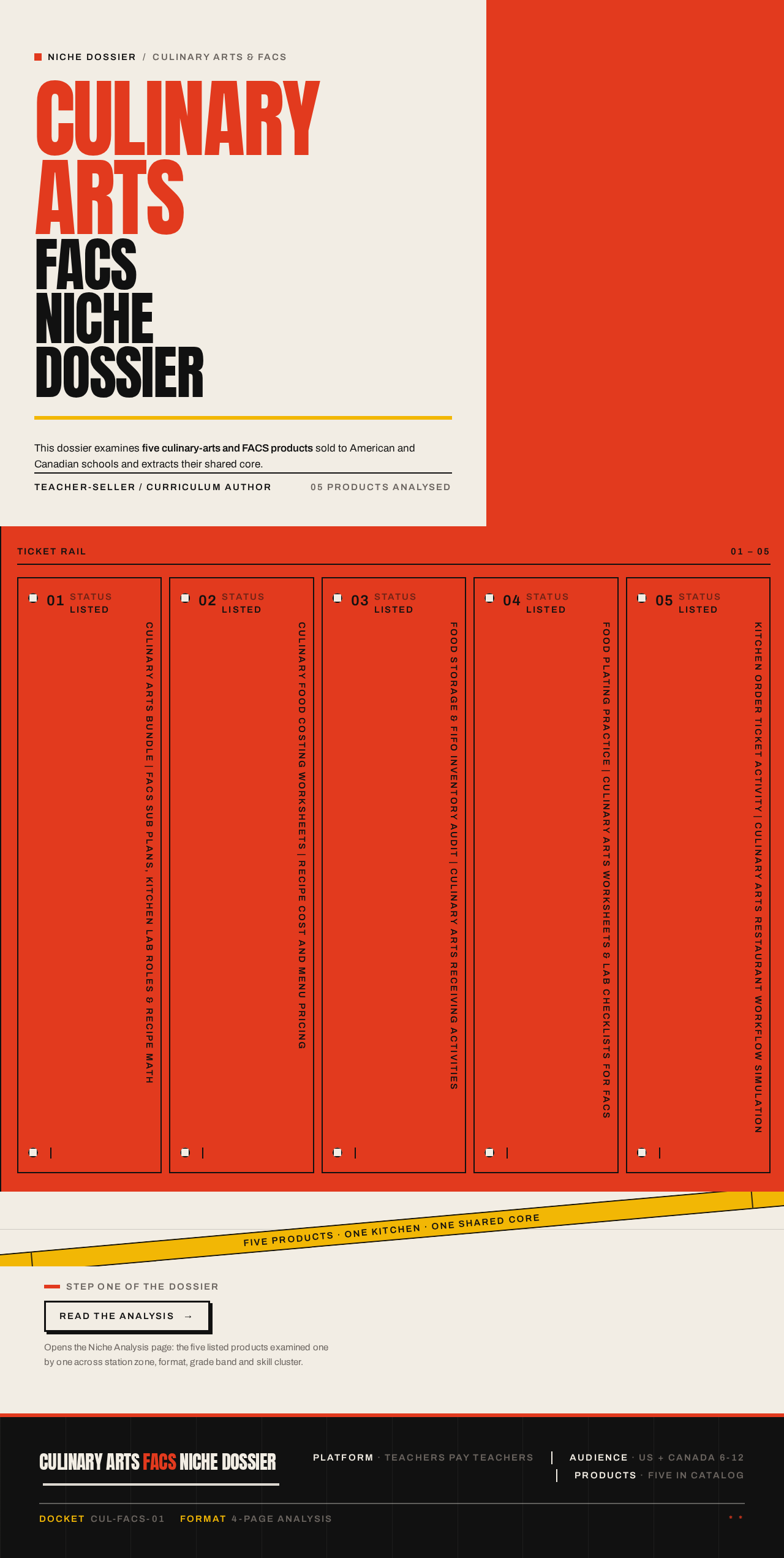
Niche Dossier
CulinaryArtsFACSNicheDossier
This dossier examines five culinary-arts and FACS products sold to American and Canadian schools and extracts their shared core.
- 01Culinary Arts Bundle | FACS Sub Plans, Kitchen Lab Roles & Recipe MathStatuslisted
- 02Culinary Food Costing Worksheets | Recipe Cost and Menu PricingStatuslisted
- 03Food Storage & FIFO Inventory Audit | Culinary Arts Receiving ActivitiesStatuslisted
- 04Food Plating Practice | Culinary Arts Worksheets & Lab Checklists for FACSStatuslisted
- 05Kitchen Order Ticket Activity | Culinary Arts Restaurant Workflow SimulationStatuslisted
FIVE PRODUCTS · ONE KITCHEN · ONE SHARED CORE
Niche Dossier
CulinaryArtsFACSNicheDossier
This dossier examines five culinary-arts and FACS products sold to American and Canadian schools and extracts their shared core.
- 01Culinary Arts Bundle | FACS Sub Plans, Kitchen Lab Roles & Recipe MathStatuslisted
- 02Culinary Food Costing Worksheets | Recipe Cost and Menu PricingStatuslisted
- 03Food Storage & FIFO Inventory Audit | Culinary Arts Receiving ActivitiesStatuslisted
- 04Food Plating Practice | Culinary Arts Worksheets & Lab Checklists for FACSStatuslisted
- 05Kitchen Order Ticket Activity | Culinary Arts Restaurant Workflow SimulationStatuslisted
FIVE PRODUCTS · ONE KITCHEN · ONE SHARED CORE
No comments yet. Be the first!