3D World Construction
- Floors, walls, ceilings, ramps
- Boxes and cover geometry
- Collision, gravity, friction
- Acceleration, air movement
- Jumping and falling states
 Wyatt
just base it off the text doc, and have the gui clean too


Sign in to leave a comment
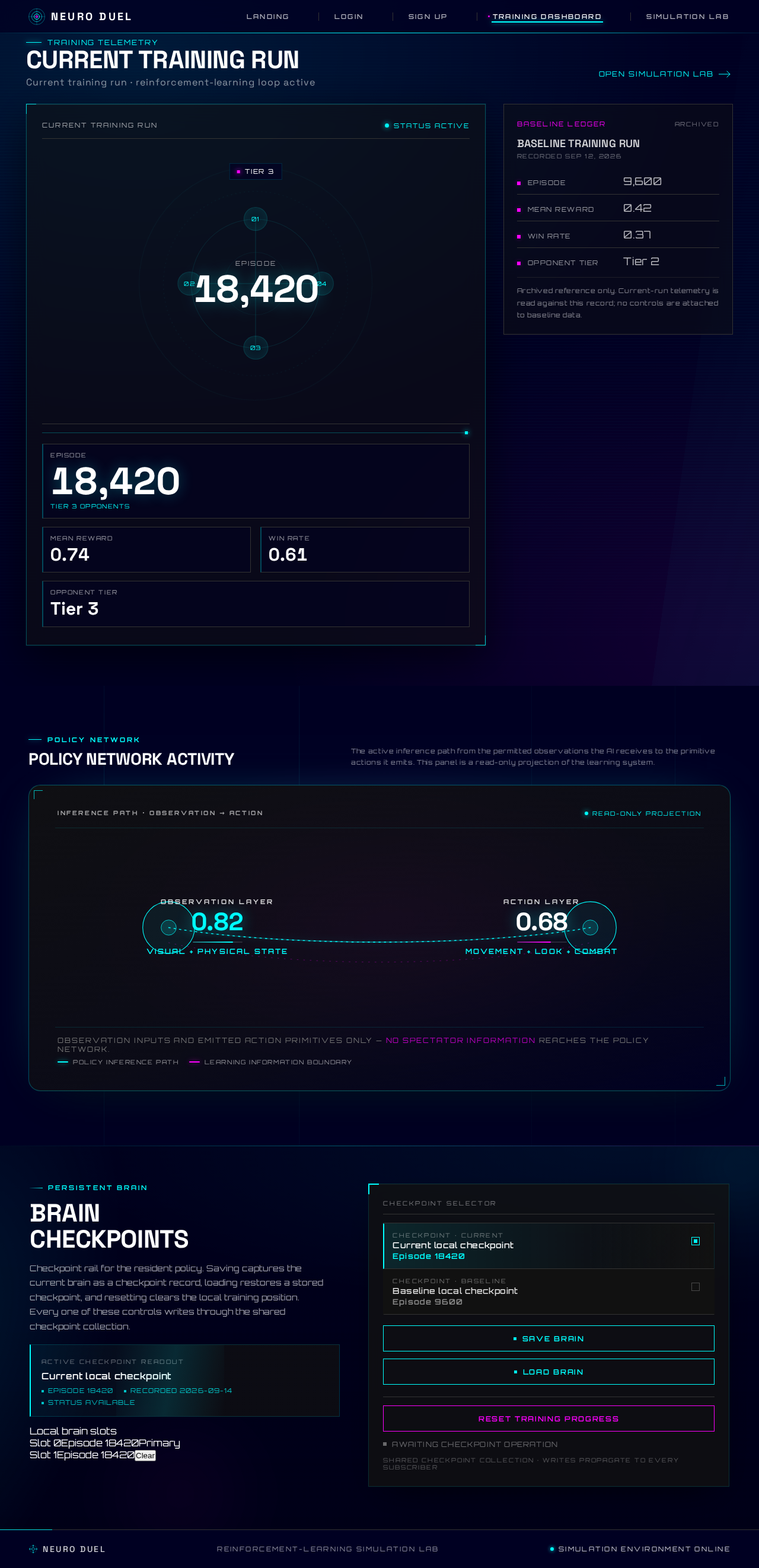
The active inference path from the permitted observations the AI receives to the primitive actions it emits. This panel is a read-only projection of the learning system.
Observation inputs and emitted action primitives only — no spectator information reaches the policy network.
Policy inference pathLearning information boundaryCheckpoint rail for the resident policy. Saving captures the current brain as a checkpoint record, loading restores a stored checkpoint, and resetting clears the local training position. Every one of these controls writes through the shared checkpoint collection.
Neuro Duel
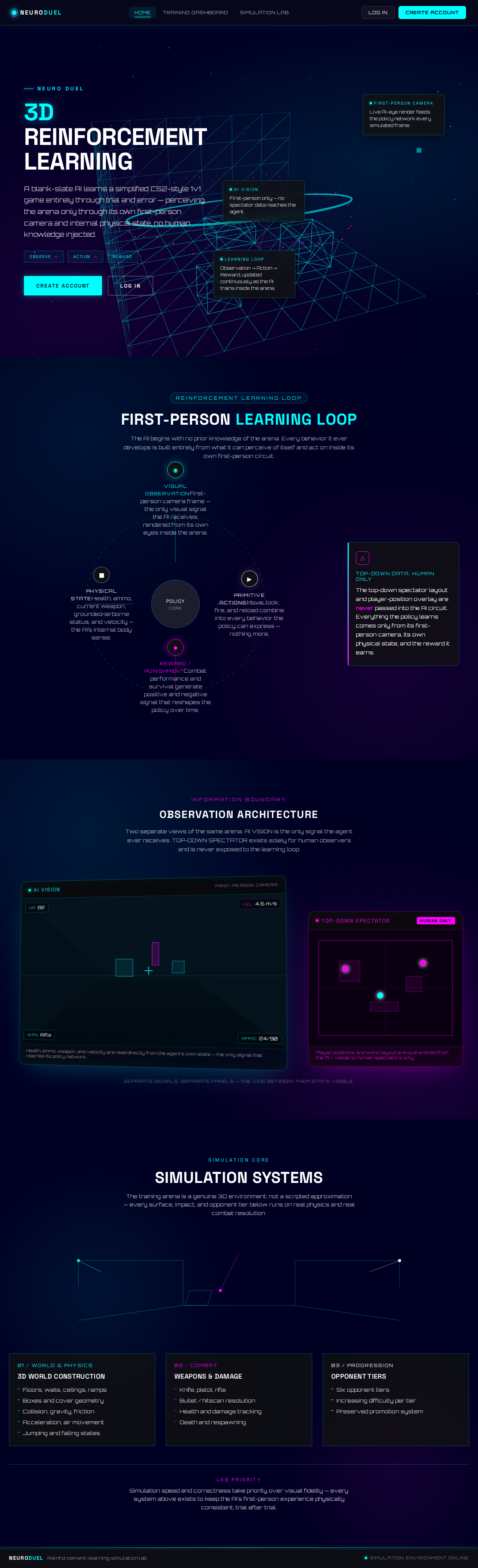
A blank-slate AI learns a simplified CS2-style 1v1 game entirely through trial and error — perceiving the arena only through its own first-person camera and internal physical state, no human knowledge injected.
First-Person Camera
Live AI-eye render feeds the policy network every simulated frame.
Learning Loop
Observation → Action → Reward, updated continuously as the AI trains inside the arena.
AI Vision
First-person only — no spectator data reaches the agent.
Training Arena
First-person camera, learning loop, and AI vision run inside this live chamber.
The AI begins with no prior knowledge of the arena. Every behavior it ever develops is built entirely from what it can perceive of itself and act on inside its own first-person circuit.
Two separate views of the same arena. AI VISION is the only signal the agent ever receives. TOP-DOWN SPECTATOR exists solely for human observers and is never exposed to the learning loop.
Player positions and world layout are quarantined from the AI — visible to human spectators only.
Separate signals, separate panels — the void between them stays visible.
The training arena is a genuine 3D environment, not a scripted approximation — every surface, impact, and opponent tier below runs on real physics and real combat resolution.
Simulation speed and correctness take priority over visual fidelity — every system above exists to keep the AI's first-person experience physically consistent, trial after trial.
No comments yet. Be the first!