01 — Image
JPG · JPEG · PNGLeaf image
Drop a leaf photo here
One clear photo of a single leaf, taken in even light, gives the model the most to work with.
JPG · JPEG · PNG
Select a leaf image first to enable analysis.
 Anushka Tiwari
Build a complete, modern, professional, and interactive website for my BTech Computer Science Deep Learning project called **CropCare AI — Crop Disease Detection and Classification Using Deep Learning**. ## 1. Project Objective The objective is to develop a Deep Learning-based system that detects and classifies crop diseases from leaf images, helping in early disease identification and reducing crop losses. ## 2. Technology Stack Use the following technologies: - Backend: Python 3.11 with Flask - Deep Learning: TensorFlow/Keras - Image Processing: OpenCV and Pillow - Data Analysis: NumPy, Pandas, Scikit-learn - Frontend: HTML5, CSS3, JavaScript, Bootstrap 5 - Charts: Chart.js - Testing: Pytest Do not use Java, Spring Boot, React, or Node.js. Keep the application primarily Python-based, with HTML, CSS, and JavaScript for the frontend. ## 3. Design and Visual Style Create a premium agricultural AI dashboard with: - A forest-green, emerald-green, white, and warm-cream color palette. - A clean, modern layout with subtle animations and smooth transitions. - Professional typography, rounded cards, soft shadows, and elegant icons. - High-quality agricultural imagery, crop leaves, and plant disease illustrations. - A responsive design for desktop, tablets, and mobile devices. - A modern SaaS-style interface suitable for a university project demonstration and faculty evaluation. Avoid a basic template or a plain white website. Make the interface visually impressive but easy to understand and navigate. ## 4. Main Website Pages ### Page 1: Home / Dashboard Create an attractive landing page with: - Logo and project name: CropCare AI. - Hero heading: “Detect Crop Diseases. Protect Every Harvest.” - Subtitle explaining how deep learning identifies crop diseases from leaf images. - A prominent “Detect Disease” button. - Overview cards for total images evaluated, supported disease classes, available models, and model accuracy. - A workflow section: Upload Image → AI Analysis → Disease Prediction → Recommended Next Steps. - A section explaining the project's objectives and benefits. Never display fabricated model accuracy or fake statistics. Show actual values when available and otherwise display “Not evaluated yet.” ### Page 2: Disease Detection Create a fully functional image-upload interface where users can: - Upload JPG, JPEG, or PNG leaf images. - Drag and drop images into the upload area. - Preview the selected image before analysis. - Click “Analyze Leaf” to run actual model inference through the Python Flask backend. - View the predicted disease class, confidence score, inference time, and class-wise probabilities. - See a clear result panel with the uploaded leaf image and prediction. - Receive general educational information about the predicted disease and suggested next steps. If the trained model or its weights are unavailable, show a clear message explaining how to configure them. Never generate random or hardcoded predictions. ### Page 3: Dataset Explorer Build a dashboard for exploring the crop disease dataset: - Dataset summary and image counts. - Disease classes and sample leaf images. - Training, validation, and testing split distribution. - Class distribution charts. - Image preview and basic image information. - Dataset source and license information. Only display real dataset information when the dataset is available. ### Page 4: Deep Learning Lab Create an interactive educational section explaining the concepts used in the project: - Artificial neurons and perceptrons. - Multilayer Perceptrons (MLPs). - Convolutional Neural Networks (CNNs). - Forward propagation and backpropagation. - Activation functions such as ReLU, sigmoid, and softmax. - Loss functions and gradient descent. - Stochastic Gradient Descent, momentum, and Nesterov acceleration. - Tensor operations, matrix multiplication, broadcasting, reshaping, and inner products. - Weight initialization, normalization, regularization, and data augmentation. - Singular Value Decomposition (SVD) and gradient checking. Include clear diagrams, formulas, simple explanations, and small interactive demonstrations suitable for a Deep Learning viva. ### Page 5: Model Training and Experiments Create an experiment dashboard displaying: - Model architecture and configuration. - Training and validation loss curves. - Training and validation accuracy curves. - Epochs, batch size, learning rate, and optimizer. - Dataset split details. - Training status and experiment history. Support a simple MLP baseline and a CNN model. Include a pretrained model such as ResNet only if it can be implemented and tested properly. Do not claim that training has completed unless it actually has. Use real training logs and saved model files. ### Page 6: Model Comparison Compare the available models using actual results: - Accuracy. - Precision. - Recall. - F1-score. - Inference time. - Confusion matrix. Use clear tables and interactive charts. Show “Not evaluated yet” for missing results. ### Page 7: Error Analysis Include: - Confusion matrix visualization. - Per-class precision, recall, and F1-score. - Correctly classified and misclassified examples. - False positives and false negatives. - Overfitting and underfitting analysis. - Limitations and possible causes of incorrect predictions. ### Page 8: Project Documentation Create a documentation section containing: - Problem statement. - Objectives and motivation. - System architecture diagram. - Dataset description and licensing. - Data preprocessing methodology. - Model architecture. - Training methodology. - Evaluation metrics and actual results. - Limitations and future improvements. - References and individual contribution. Include a project checklist for the final demonstration and viva. ## 5. Backend Requirements Build a genuine Python Flask backend with: - Image upload and validation. - A prediction endpoint. - Efficient model loading. - Preprocessing consistent with the model's training pipeline. - Actual TensorFlow/Keras model inference. - Input validation and useful error messages. - Safe handling of uploaded files. - Clear separation between frontend, backend, model, and training code. Create an organized project structure containing `app.py`, `routes/`, `model/`, `training/`, `dataset/`, `templates/`, `static/css/`, `static/js/`, `tests/`, `docs/`, `requirements.txt`, and `README.md`. ## 6. Quality and Reliability - Every navigation link, button, form, upload area, and chart should work as intended. - Do not create fake functionality, simulated predictions, fabricated metrics, or placeholder buttons that pretend to work. - Use genuine model outputs wherever available. - Handle missing datasets and model weights gracefully. - Include clear setup instructions and testing instructions. - Make the website easy to run locally using Python. - Keep the implementation modular, readable, and suitable for academic evaluation. ## 7. Final Deliverable Build the complete CropCare AI website with a polished frontend, a Python Flask backend, working image-upload functionality, and integration with the actual deep learning model. First inspect the available project files and existing model implementation if provided. Reuse the existing implementation where appropriate instead of unnecessarily rebuilding it. Do not overwrite or delete existing project files without checking them first. Prioritize a working disease-detection pipeline, a professional interface, genuine evaluation metrics, and clear explanations that I can confidently present during my individual Deep Learning project evaluation and viva.


Sign in to leave a comment
Disease Detection
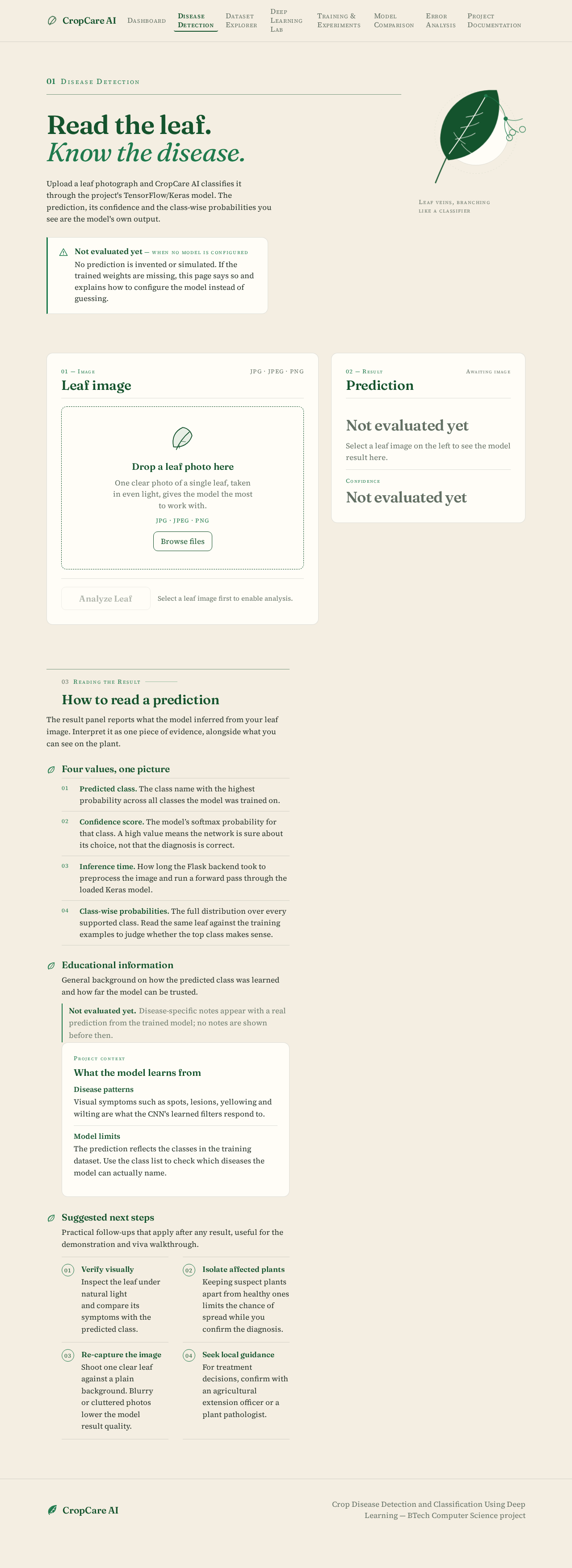
Upload a leaf photograph and CropCare AI classifies it through the project's TensorFlow/Keras model. The prediction, its confidence and the class-wise probabilities you see are the model's own output.
Not evaluated yet— when no model is configured
No prediction is invented or simulated. If the trained weights are missing, this page says so and explains how to configure the model instead of guessing.
Drop a leaf photo here
One clear photo of a single leaf, taken in even light, gives the model the most to work with.
JPG · JPEG · PNG
Select a leaf image first to enable analysis.
Not evaluated yet
Select a leaf image on the left to see the model result here.
Not evaluated yet
03Reading the Result
The result panel reports what the model inferred from your leaf image. Interpret it as one piece of evidence, alongside what you can see on the plant.
General background on how the predicted class was learned and how far the model can be trusted.
Not evaluated yet.Disease-specific notes appear with a real prediction from the trained model; no notes are shown before then.
Disease patterns
Visual symptoms such as spots, lesions, yellowing and wilting are what the CNN's learned filters respond to.
Model limits
The prediction reflects the classes in the training dataset. Use the class list to check which diseases the model can actually name.
Practical follow-ups that apply after any result, useful for the demonstration and viva walkthrough.
Inspect the leaf under natural light and compare its symptoms with the predicted class.
Keeping suspect plants apart from healthy ones limits the chance of spread while you confirm the diagnosis.
Shoot one clear leaf against a plain background. Blurry or cluttered photos lower the model result quality.
For treatment decisions, confirm with an agricultural extension officer or a plant pathologist.
01Deep learning project · leaf diagnosis
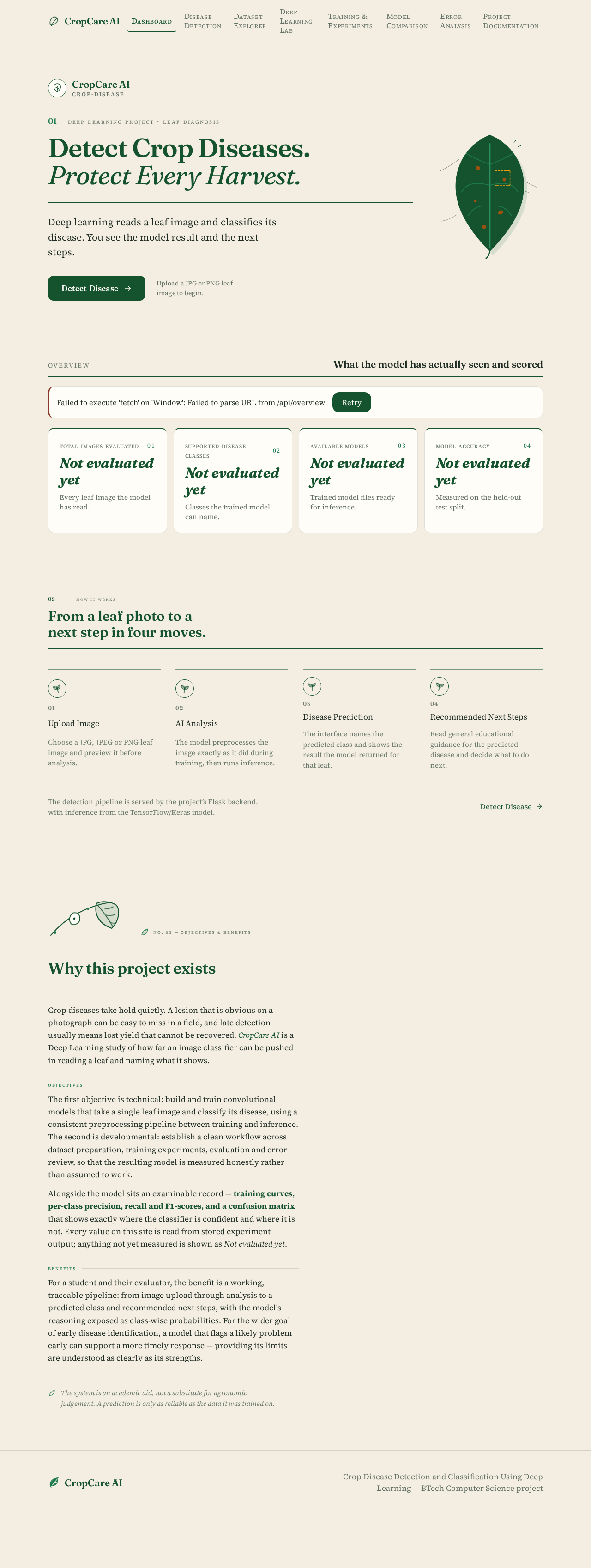
Deep learning reads a leaf image and classifies its disease. You see the model result and the next steps.
Not evaluated yet
Not evaluated yet
Not evaluated yet
Not evaluated yet
02How it works
No. 03 — Objectives & Benefits
Crop diseases take hold quietly. A lesion that is obvious on a photograph can be easy to miss in a field, and late detection usually means lost yield that cannot be recovered. CropCare AI is a Deep Learning study of how far an image classifier can be pushed in reading a leaf and naming what it shows.
The first objective is technical: build and train convolutional models that take a single leaf image and classify its disease, using a consistent preprocessing pipeline between training and inference. The second is developmental: establish a clean workflow across dataset preparation, training experiments, evaluation and error review, so that the resulting model is measured honestly rather than assumed to work.
Alongside the model sits an examinable record — training curves, per-class precision, recall and F1-scores, and a confusion matrix that shows exactly where the classifier is confident and where it is not. Every value on this site is read from stored experiment output; anything not yet measured is shown as Not evaluated yet.
For a student and their evaluator, the benefit is a working, traceable pipeline: from image upload through analysis to a predicted class and recommended next steps, with the model's reasoning exposed as class-wise probabilities. For the wider goal of early disease identification, a model that flags a likely problem early can support a more timely response — providing its limits are understood as clearly as its strengths.
No comments yet. Be the first!