coral-game
 Vikrant Yadav
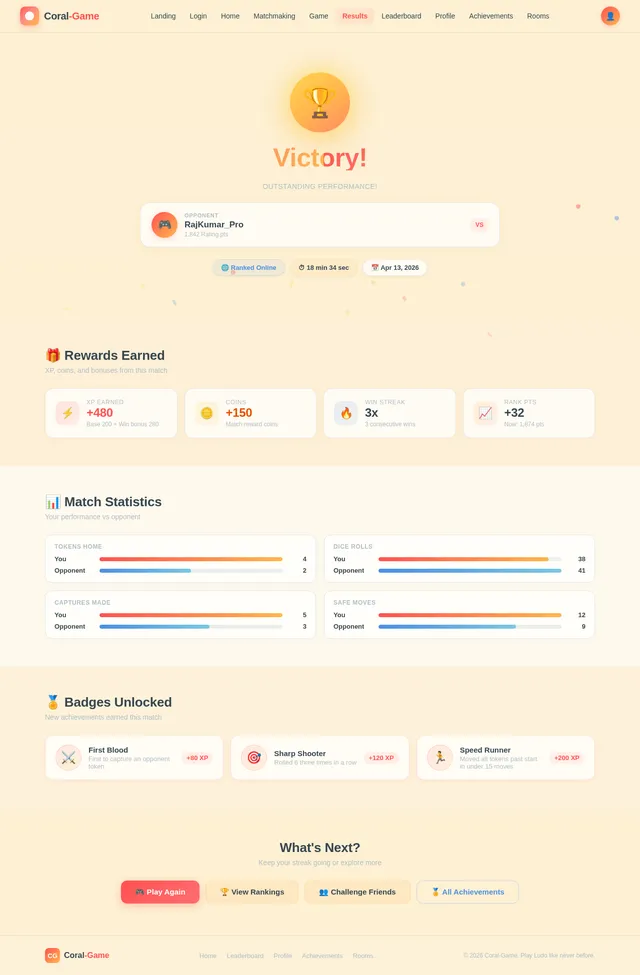
1. 📌 Overview The Ludo Multiplayer Game is a mobile/web-based gaming application that allows users to play the classic Ludo game in real-time with friends or other online players globally. 2. 🎯 Objectives Provide a smooth and engaging multiplayer Ludo experience Enable real-time gameplay with low latency Support social interactions (chat, invites) Ensure fair gameplay with anti-cheat mechanisms 3. 👥 Target Audience Casual gamers (age 10–40) Friends/family groups Competitive online players 4. 🔑 Key Features 🎮 4.1 Game Modes Online Multiplayer (2–4 players) Play with Friends (Private Room) Offline Mode (vs AI) Quick Match (random players) 🌐 4.2 Multiplayer System Real-time synchronization using WebSockets Matchmaking system based on skill/level Reconnect feature (resume game after disconnect) 👤 4.3 User Account System Sign up/login (Email, Google, Guest login) Profile (username, avatar, stats) Player levels & XP system 🎲 4.4 Gameplay Mechanics Standard Ludo rules (dice roll, token movement) Turn-based system Safe zones, kill mechanics Win condition: All tokens reach home 💬 4.5 Social Features In-game chat (text/emojis) Friend list & invites Voice chat (optional – advanced feature) 🏆 4.6 Rewards & Progression Coins/points system Daily rewards Leaderboard (global & friends) Achievements & badges 💰 4.7 Monetization In-app purchases (coins, skins, themes) Ads (rewarded videos, interstitials) Premium version (no ads, exclusive features) 🎨 4.8 UI/UX Simple, colorful, intuitive interface Smooth animations (dice roll, token movement) Responsive design (mobile-first) 5. ⚙️ Technical Requirements 🖥️ Frontend Framework: React Native / Flutter Real-time updates using WebSockets Animations for gameplay 🗄️ Backend Node.js / Firebase Real-time database (Firebase / Socket.io) Matchmaking server ☁️ Infrastructure Cloud hosting (AWS / Firebase) Load balancing for multiplayer scaling 6. 📊 Metrics & KPIs Daily Active Users (DAU) Match completion rate Average session duration Retention rate (Day 1, Day 7) Revenue per user 7. 🚨 Risks & Challenges Network latency issues Cheating or hacking Server scalability during peak usage Player drop-offs mid-game 8. 🔐 Security Secure authentication Anti-cheat logic Data encryption (HTTPS) 9. 🗺️ Roadmap Phase 1 (MVP) Basic gameplay Online multiplayer Simple UI Login system Phase 2 Chat & social features Leaderboard & rewards Improved matchmaking Phase 3 Voice chat Advanced AI Tournaments & events 10. 📱 Platforms Android iOS Web (optional) 11. 🧪 Testing Unit testing Multiplayer stress testing Beta testing with users 12. 📦 Future Enhancements Custom game rules 3D Ludo board Live tournaments with cash rewards Spectator mode

Comments (0)
Sign in to leave a comment
System Requirements
System Requirements Document (SRD) for FND Ludo
1. Introduction
The FND Ludo is a multiplayer gaming platform designed to provide an engaging and seamless experience for users who enjoy the classic board game, Ludo. This document outlines the system requirements for the development and deployment of FND Ludo, ensuring that it meets the expectations of its target audience while maintaining technical robustness and scalability.
The project is tailored for a global audience, with a particular focus on users in India (IN), where Ludo is a culturally significant and widely loved game. The system will support real-time gameplay, social interactions, and a variety of game modes to cater to casual gamers, competitive players, and friends/family groups.
2. System Overview
FND Ludo is a mobile-first, cross-platform application that allows users to play Ludo in real-time with friends, family, or other players worldwide. The system will feature:
- Real-time Multiplayer Gameplay: Low-latency synchronization using WebSockets.
- Social Features: In-game chat, friend invites, and leaderboards.
- Fair Play: Anti-cheat mechanisms to ensure a level playing field.
- Monetization: In-app purchases, ads, and a premium version with exclusive features.
- Selective Re-run Capability: A feature allowing users to regenerate specific sections of the SRD based on their needs.
The system will be built using modern technologies like React Native for the frontend and Python with FastAPI for the backend, ensuring a scalable and maintainable architecture.
3. Functional Requirements
- As a User, I should be able to play Ludo online with random players.
- As a User, I should be able to create or join private rooms to play with friends.
- As a User, I should be able to play offline against AI.
- As a User, I should be able to log in using email, Google, or as a guest.
- As a User, I should be able to view and edit my profile, including username, avatar, and stats.
- As a User, I should be able to earn coins and XP for completing games.
- As a User, I should be able to chat with other players in-game using text and emojis.
- As a User, I should be able to view leaderboards and achievements.
- As a User, I should be able to purchase in-game items like skins and themes.
- As an Admin, I should be able to monitor and manage user activity to prevent cheating.
- As a User, I should be able to trigger selective re-run capability to regenerate specific sections of the SRD.
4. User Personas
4.1 Casual Gamers
- Age Range: 10–40
- Motivation: Entertainment, relaxation, and social interaction.
- Key Features: Quick matches, simple UI, and offline mode.
4.2 Competitive Players
- Age Range: 18–35
- Motivation: Skill-based competition and leaderboard rankings.
- Key Features: Matchmaking, XP system, and achievements.
4.3 Friends and Family Groups
- Age Range: All ages
- Motivation: Social bonding and fun.
- Key Features: Private rooms, in-game chat, and voice chat.
5. Visuals Colors and Theme
Color Palette
The FND Ludo will feature a vibrant and playful color scheme to reflect the fun and engaging nature of the game:
- Background: #F5F7FA (Soft Sky Blue)
- Surface: #FFD966 (Golden Yellow)
- Text: #2E3A59 (Deep Navy Blue)
- Accent: #FF6F61 (Bright Coral Red)
- Muted Tones: #A3B4C4 (Muted Steel Blue)
This palette ensures a visually appealing and user-friendly interface that resonates with the target audience.
6. Signature Design Concept
The "Dynamic Ludo Universe" Experience
The homepage of FND Ludo will feature a vivid, interactive Ludo universe that immerses users in the game world. Here's how it works:
- 3D Animated Ludo Board: The homepage will showcase a rotating, 3D Ludo board floating in space, with tokens and dice that animate in real-time.
- Interactive Navigation: Users can click on different areas of the board to access features like "Play Online," "Private Rooms," or "Leaderboards."
- Dynamic Background: The background will feature a gradient sky that shifts between soft blues and warm yellows, creating a sense of time progression.
- Micro-Interactions: Hovering over tokens will trigger animations like bouncing or glowing, while dice rolls will produce satisfying sound effects.
- Gamified Onboarding: New users will be guided through the app via an interactive tutorial integrated into the Ludo board.
This design will make FND Ludo instantly captivating and provide an unforgettable first impression.
7. Non-Functional Requirements
- Performance: The system must support up to 10,000 concurrent players with minimal latency.
- Scalability: The backend should handle peak loads during tournaments or events.
- Security: All user data must be encrypted, and anti-cheat mechanisms must be robust.
- Localization: Support for multiple languages, starting with English and Hindi.
- Accessibility: The UI must comply with WCAG 2.1 standards.
- Selective Re-run Capability: The SRD system must allow users to regenerate specific sections without affecting the entire document.
8. Tech Stack
Frontend
- React Native for mobile applications.
- WebSockets for real-time updates.
Backend
- Python with FastAPI for API development.
- WebSockets for multiplayer synchronization.
Database
- MySQL for relational data (e.g., user profiles, game stats).
- MongoDB for NoSQL data (e.g., chat logs).
- Alembic for database migrations.
AI Models
- GPT 5.4 for user-friendly responses in chat.
- Google Nano Banana for generating custom avatars.
Infrastructure
- Docker and Kubernetes for containerization and orchestration.
- AWS for cloud hosting and load balancing.
9. Assumptions and Constraints
- The game will initially target Android and iOS platforms, with a web version as a future enhancement.
- Internet connectivity is required for online gameplay.
- Offline mode will have limited features compared to online modes.
- The MVP will focus on random matchmaking, with private rooms added in Phase 2.
- Selective re-run capability will be implemented to allow users to regenerate specific SRD sections.
10. Glossary
- MVP: Minimum Viable Product.
- WebSockets: A protocol for real-time communication between client and server.
- XP: Experience Points, used to track player progress.
- WCAG: Web Content Accessibility Guidelines.
- RDBMS: Relational Database Management System.
- Selective Re-run Capability: A feature allowing users to regenerate specific sections of the SRD without affecting the entire document.
This updated SRD reflects the new app name, FND Ludo, and incorporates the selective re-run capability as requested. Let me know if further adjustments are needed!
No comments yet. Be the first!