cool-system
 Saharsh OG
Act as an award-winning creative director, luxury technology brand designer, Apple product page designer, and senior UI/UX architect. Create a premium, futuristic website for SpecAura. ABOUT SPECAURA SpecAura is a technology advisory platform that helps students, gamers, creators, and professionals choose the right laptop, PC, or workstation based on their needs, workload, and budget. DESIGN GOAL Do NOT create a generic startup website. Do NOT create a SaaS template. Do NOT use stock startup illustrations. Do NOT use cartoon graphics. The website should feel like a combination of: - Apple Product Launch - ASUS ROG Premium Showcase - Tesla Product Experience - Luxury Technology Brand - High-End Gaming Hardware Commercial VISUAL STYLE - Dark premium theme - Black and deep graphite background - Glassmorphism accents - Cinematic lighting - Premium typography - Smooth animations - High-end visual storytelling - Large sections with breathing room - Luxury technology aesthetic IMAGERY Use realistic high-resolution images of: - Premium laptops - Mechanical keyboards - RAM modules - SSDs - Motherboards - Gaming setups - Creator workstations IMPORTANT: Use real, photorealistic technology imagery. Do not use low-quality renders. Do not use abstract blobs. Do not use cartoon-style 3D objects. Avoid visible brand logos. ANIMATIONS Every section should animate smoothly. - Scroll reveal animations - Parallax effects - Floating hardware elements - Image zoom effects - Smooth transitions - Premium hover interactions - Cinematic movement The website should feel alive and interactive. HOMEPAGE STRUCTURE SECTION 1 — HERO Full-screen hero section. Large premium laptop image floating in a dark environment. Headline: Buy Technology With Confidence. Subheadline: Personalized laptop and PC recommendations based on your needs, workload, and budget. CTA: Get My Recommendation SECTION 2 — THE PROBLEM Show consumers overwhelmed by choices. Display dozens of laptops and confusing specifications. Headline: Technology Has Become Too Complicated. SECTION 3 — HOW IT WORKS 1. Tell us your budget. 2. Tell us your requirements. 3. Receive personalized recommendations. Interactive visual process. SECTION 4 — WHO WE HELP Students Gamers Creators Developers Professionals Large visual cards with premium imagery. SECTION 5 — TECHNOLOGY SHOWCASE Show realistic images of RAM, SSDs, keyboards, displays, and workstations. Use subtle motion and premium animations. SECTION 6 — WHY SPECAURA Clear personalized recommendations. No confusing specifications. Trusted guidance. Better purchasing decisions. SECTION 7 — FUTURE VISION Technology experiences. Gaming community. Workshops. Hands-on hardware exploration. Present this as a future roadmap, not the current product. SECTION 8 — FINAL CTA Dark cinematic section. Premium laptop image. Headline: Your Next Device Shouldn't Be A Guess. CTA: Get Started TYPOGRAPHY Modern. Minimal. Premium. Technology-focused. The entire experience should feel like a technology company worth millions of dollars, not a student project. Prioritize aesthetics, realism, trust, and premium visual storytelling.


Comments (0)
Sign in to leave a comment
Project Tasks21
Implement Navbar for Recommendations
As a frontend developer, implement the Navbar section for the Recommendations page. This component may already exist from a previous page — reuse if available. Uses useState for `scrolled` and `menuOpen` state, with a useEffect scroll listener (passive, cleaned up on unmount) that toggles the `nv-scrolled` class on the `<header>` element. Renders a logo with `nv-logo-mark` and `nv-logo-glyph` spans, a `<ul class='nv-links'>` mapping over 4 categories (Students, Gamers, Creators, Professionals) each linking to /Recommendations, a CTA anchor with an arrow span, and a hamburger `<button>` with 3 `<span>` children that toggles `nv-open`. Includes a `<div class='nv-mobile'>` drawer that conditionally adds `nv-mobile-open` and renders mobile nav links plus a mobile CTA. Apply Navbar.css (5607 chars) for styling.
Setup DB Models and Migrations
As a Backend Developer, define MySQL/MariaDB database models and Alembic migrations for the SpecAura platform. Models to include: UserSession (session_id, persona, budget, requirements, created_at), RecommendationResult (session_id, product_data JSON, ai_response, created_at), Product (name, vendor, specs JSON, price_inr, category [laptop/pc/workstation], created_at). Run alembic init and create initial migration scripts. Add seed data for sample products across personas (student, gamer, creator, professional). Ensure INR currency field handling.
Setup Global Theme Design System
As a Frontend Developer, establish the global design system and theme configuration for SpecAura. This includes: creating a CSS variables file or theme config with all SRD-specified colors (primary: #1A1A1A, primary_light: #2E2E2E, secondary: #FF4500, accent: #FFD700, highlight: #FFA500, bg: #000000, surface: rgba(26,26,26,0.8), text: #FFFFFF, text_muted: #B0B0B0, border: rgba(255,255,255,0.2)); setting up global typography (modern, minimal, premium, tech-focused fonts); configuring global animation defaults for framer-motion; establishing shared CSS reset and base styles; setting up @react-three/fiber and @react-three/drei as shared 3D rendering context; configuring shared lucide-react icon defaults. This is a prerequisite for all frontend section tasks (0f4725a2, 1884ead2, 44168b6a, 7fff94eb, c4d049ad, cba9ddd5, f0f84235).
Build Consultation Booking Form
As a Frontend Developer, implement a consultation booking form/modal component for SpecAura. This includes: a BookConsultation modal or page with fields for name, email, phone (Indian format), persona selection (Student/Gamer/Creator/Professional), preferred date/time picker, and notes; form validation with user-friendly error messages; integration with the consultation booking API via the shared API client; budget fields displayed in INR; success/confirmation state with booking ID shown; framer-motion animated modal open/close; premium dark glassmorphism styling consistent with the design system. Note: depends on backend consultation API (tmp_consultation_api) and shared API client layer (1db97d4c). This component should be reusable and triggered from CTAs across Home and Recommendations pages.
Setup Environment Configuration
As a DevOps Engineer, establish environment configuration management for the SpecAura platform. This includes: creating .env.example files for both frontend and backend with all required variables (DATABASE_URL, LITELLM_API_KEY, GPT_MODEL, FRONTEND_URL, BACKEND_URL, etc.); configuring docker-compose environment variable injection; setting up separate .env files for development, staging, and production environments; documenting all required env vars in README; ensuring secrets are never committed to version control via .gitignore rules. Note: AI API keys for LiteLLM/GPT-5.4 routing must be included.
Implement RecommendationsHero for Recommendations
As a frontend developer, implement the RecommendationsHero section for the Recommendations page. Uses @react-three/fiber Canvas with useFrame animation loop, @react-three/drei Float/Environment/Html components, framer-motion motion/useInView/AnimatePresence, lucide-react icons (Cpu, Zap, Monitor, HardDrive), and THREE.js primitives. Renders a 3D island scene via `IslandBase` component built from THREE.MeshStandardMaterial primitives: a cylindrical island platform (cylinderGeometry args [3.2,2.6,0.5,32]), tapered underside, a glowing torus rim ring with emissiveIntensity 0.9 (#FFD700/#FFA500), and accent path spokes at 60° intervals. Four `islandBuildings` (Filters, Compare, Details, Your Pick) are positioned in 3D space with unique color/emissive values and targetAnchor IDs (#rf-root, #rcmp-root, #rd-root, #rcta-root) for scroll-to navigation. `specHighlights` array drives 4 UI cards (Processor, Performance, Display, Storage). Apply RecommendationsHero.css (11050 chars).
Implement RecommendationsFilters for Recommendations
As a frontend developer, implement the RecommendationsFilters section for the Recommendations page. Uses useState and useMemo for filter state management, framer-motion AnimatePresence/motion for animated transitions, and lucide-react icons (SlidersHorizontal, ChevronDown, X). Renders a `MorphingCount` badge component using AnimatePresence with initial/animate/exit variants (opacity, y: 8→0, scale 0.9→1) keyed by `total + '-' + activeCount`. Implements `FilterChip` pill buttons with `whileTap={{ scale: 0.94 }}` and `aria-pressed` toggling `rf-chip-active` class with an `rf-chip-active-dot` span. Implements `BudgetSlider` with MIN_BUDGET=400/MAX_BUDGET=8000, a percentage-computed `rf-slider-fill` div, 5 `budgetPresets`, and a `formatMoney` helper that returns '$8,000+' at 8000. Filter data arrays: 8 brands, 9 processors, 8 GPUs, 8 use cases. Apply RecommendationsFilters.css (10500 chars) with section id `rf-root`.
Implement RecommendationsComparison for Recommendations
As a frontend developer, implement the RecommendationsComparison section for the Recommendations page. Uses useState, useRef, and useCallback, plus framer-motion AnimatePresence/motion and lucide-react icons (Cpu, Monitor, HardDrive, Weight, Zap, Plus, Check, ArrowRight, ChevronLeft, ChevronRight). Renders 3 products (MacBook Pro 16" M4 Max at $3,499, ASUS ROG Zephyrus G16 at $2,899, Dell XPS 17 9730 at $3,249) each with rank badge, vendor, price, pros/cons arrays, and a `specs` object. Three `specCategories` (Performance [CPU,GPU,RAM], Storage & Display [SSD,Display], Physical [Weight,Battery,Ports]) each with emoji icons. Three view modes keyed 'specs', 'procon', 'prices' toggled via tab UI. Supports carousel navigation via ChevronLeft/ChevronRight for mobile. Apply RecommendationsComparison.css (15437 chars) with section id `rcmp-root`.
Implement RecommendationsDetails for Recommendations
As a frontend developer, implement the RecommendationsDetails section for the Recommendations page. Uses useState and useCallback with framer-motion AnimatePresence/motion for accordion and carousel animations, and a large lucide-react icon set (ChevronDown, Monitor, Keyboard, MonitorCheck, Cpu, Star, Shield, Clock, Headphones, Package, Check, Image, Zap, HardDrive, Camera, Palette, Wrench, Award, ThumbsUp, MessageSquare, AlertTriangle). Renders the 'Nebula Pro X1' product with AMD Ryzen 9 7945HX / RTX 4070 specs, an 8-row spec table, a 5-slide carousel (caption + icon + color per slide: aluminum unibody, RGB keyboard, OLED display, I/O ports, vapor chamber cooling) with navigation controls, and a features accordion with 6+ items (Factory-Calibrated OLED, Vapor Chamber Cooling, Thunderbolt 4 Docking, Per-Key RGB Keyboard, Wi-Fi 6E + 2.5G Ethernet, etc.). Apply RecommendationsDetails.css (15978 chars) with section id `rd-root`.
Implement RecommendationsCTA for Recommendations
As a frontend developer, implement the RecommendationsCTA section for the Recommendations page. Uses useState, useRef, useMemo, and Suspense with @react-three/fiber Canvas/useFrame, @react-three/drei Float/Environment/MeshDistortMaterial, and framer-motion motion/AnimatePresence. Renders a `LaptopModel` 3D component inside a Float wrapper (speed=1.2, rotationIntensity=0.08, floatIntensity=0.3): base deck (boxGeometry [2.4,0.12,1.65]), keyboard deck chamfer, a 6×12 grid of individual key meshes (boxGeometry [0.1,0.015,0.1]) each positioned via `col * 0.13` offsets, a trackpad mesh, a screen/lid mesh (rotation [1.85,0,0]), screen bezel, and a screen display plane using MeshDistortMaterial (color #0f1923, emissive #0a1628). The group ref animates with `Math.sin(state.clock.elapsedTime * 0.25) * 0.15` Y-rotation and `Math.sin(elapsedTime * 0.4) * 0.12` Y-position. Apply RecommendationsCTA.css (11520 chars) with section id `rcta-root`.
Implement Footer for Recommendations
As a frontend developer, implement the Footer section for the Recommendations page. This component may already exist from a previous page — reuse if available. Renders a static footer with `ftr-glow` decorative div, a brand block containing `ftr-mark` ('SA') and `ftr-brand-name` ('SpecAura') spans plus a tagline paragraph. Renders 5 social icon links using lucide-react (Twitter, Instagram, Youtube, Linkedin, Github at size=18, strokeWidth=1.75) inside `ftr-socials`. Renders a `ftr-links-grid` with 3 link columns: Platform (3 links), Personas (4 links: Students/Gamers/Creators/Professionals), Company (3 links). Dynamic `year` computed via `new Date().getFullYear()`. Apply Footer.css (4281 chars).
Build Recommendations API Endpoint
As a Backend Developer, implement the FastAPI endpoint(s) for generating personalized laptop/PC recommendations. This includes: POST /api/v1/recommendations accepting user persona (student/gamer/creator/professional), budget (INR), and requirements as input; integrating with LiteLLM for routing to GPT-5.4 to generate user-friendly recommendation responses; returning structured product recommendation data (name, specs, price, pros/cons, match score). Also implement GET /api/v1/recommendations/{session_id} for retrieving cached results. Validate input with Pydantic models. Note: Frontend tasks (RecommendationsFilters, RecommendationsHero, RecommendationsComparison, RecommendationsDetails, RecommendationsCTA) depend on this API for real data integration.
Build Frontend API Client Layer
As a Frontend Developer, implement a shared API client layer for the SpecAura frontend to communicate with the FastAPI backend. Create an api/ directory with: a base axios/fetch client configured with base URL from env variables; a recommendationsApi module with submitRequirements(persona, budget, requirements) and getRecommendations(sessionId) methods; request/response TypeScript interfaces matching backend Pydantic schemas (UserSession, RecommendationResult, Product); error handling with user-friendly messages; loading state management hooks (useRecommendations). This client is needed by RecommendationsFilters, RecommendationsComparison, and RecommendationsDetails sections.
Build Consultation Booking API
As a Backend Developer, implement FastAPI endpoints for the consultation booking feature. This includes: POST /api/v1/consultations accepting name, email, phone, persona (student/gamer/creator/professional), preferred_date, preferred_time, and notes; GET /api/v1/consultations/{booking_id} to retrieve booking details; PATCH /api/v1/consultations/{booking_id}/confirm for confirmation; Pydantic models for request/response validation; email notification stub (log to console for now, with hook for SMTP later); store bookings in DB with status (pending/confirmed/cancelled). Ensure all price/budget fields use INR. Frontend sections that will consume this API: any CTA or booking form sections on Home and Recommendations pages.
Build Products Catalog API
As a Backend Developer, implement FastAPI endpoints for the product catalog to support frontend comparison and detail sections. Includes: GET /api/v1/products?category=laptop|pc|workstation&persona=student|gamer|creator|professional&budget_min=&budget_max= (budget in INR); GET /api/v1/products/{product_id} for detailed product info; response schemas include name, vendor, specs (JSON), price_inr, category, persona_tags, pros, cons, match_score. Ensure all prices are returned in INR. Supports RecommendationsComparison and RecommendationsDetails frontend sections. Depends on DB models and migrations being in place.
Setup CORS and API Middleware
As a Backend Developer, configure FastAPI middleware for the SpecAura API. This includes: CORS middleware configured for frontend origin(s) (dev: localhost:3000, prod: specaura.in); request logging middleware for structured JSON logs; global error handler middleware returning consistent error response schemas (code, message, details); rate limiting middleware (e.g., slowapi) to protect recommendation and consultation endpoints; request ID header injection for tracing. Ensure middleware is ordered correctly in the FastAPI app startup.
Implement INR Currency Utilities
As a Frontend Developer, create shared INR currency formatting utilities for the SpecAura frontend. This includes: a formatINR(amount) helper that formats numbers as Indian Rupees (e.g., ₹1,25,000) using Indian numbering system (lakhs/crores); a parseBudgetINR(value) helper for converting slider/input values to INR amounts; budget preset constants aligned with Indian price brackets (e.g., ₹30,000 / ₹50,000 / ₹75,000 / ₹1,00,000 / ₹1,50,000+) replacing the existing dollar presets; update BudgetSlider MIN_BUDGET and MAX_BUDGET to INR equivalents; a displayPrice component for consistent price rendering across RecommendationsComparison and RecommendationsDetails. Note: All existing dollar/USD references in frontend components must be replaced with INR. Ensures SRD requirement that India/INR is the default currency.
Integrate LiteLLM GPT Routing
As an AI Engineer, integrate LiteLLM for LLM routing to GPT-5.4 to power personalized technology recommendations. Implement a RecommendationService class that: constructs persona-specific system prompts (student/gamer/creator/professional), formats user budget (INR) and requirements into LLM-friendly context, calls LiteLLM with GPT-5.4 model routing, parses structured JSON responses into ProductRecommendation schemas, implements retry logic and fallback handling, and caches results by session_id. Configure LiteLLM with API keys via environment variables. Ensure responses are user-friendly and avoid technical jargon per SRD.
Integrate Consultation Booking E2E
As a Tech Lead, verify the end-to-end integration between the Consultation Booking frontend form (tmp_consultation_booking_frontend) and the backend Consultation API (tmp_consultation_api). Ensure: form data (name, email, phone, persona, date/time, notes) flows correctly to POST /api/v1/consultations; booking confirmation ID is returned and displayed; INR budget fields are handled correctly throughout; loading and error states are gracefully handled; the booking modal/form is correctly triggered from CTA buttons on both Home and Recommendations pages; email notification stub is triggered. Dependency note: This integration task depends on both the frontend booking form and backend consultation API tasks.
Integrate Products API Frontend
As a Tech Lead, verify the end-to-end integration between the Products Catalog backend API (tmp_products_api) and the frontend RecommendationsComparison (7fff94eb) and RecommendationsDetails (cba9ddd5) sections via the shared API client (1db97d4c). Ensure: product data from GET /api/v1/products is correctly rendered in the comparison table and detail accordion; all prices display in INR using the currency utilities (tmp_inr_currency_util); persona and budget filter parameters from RecommendationsFilters (0f4725a2) correctly query the products API; loading and error states are handled gracefully in both sections.
Integrate Recommendations Page E2E
As a Tech Lead, verify the end-to-end integration between the Recommendations page frontend sections and the backend Recommendations API. Ensure: user budget/persona/requirements from RecommendationsFilters flow correctly to POST /api/v1/recommendations; AI-generated product data from LiteLLM/GPT-5.4 populates RecommendationsComparison and RecommendationsDetails sections; filter state updates trigger API re-fetches and UI updates; loading and error states are handled gracefully across all sections; RecommendationsHero 3D island navigation correctly scrolls to section anchors; CTA in RecommendationsCTA links correctly. Note: depends on backend API (tmp_backend_recommendations_api), AI integration (tmp_ai_llm_integration), and frontend API client (tmp_frontend_api_client). Frontend section task IDs: 0f4725a2, 1884ead2, 7fff94eb, c4d049ad, cba9ddd5.
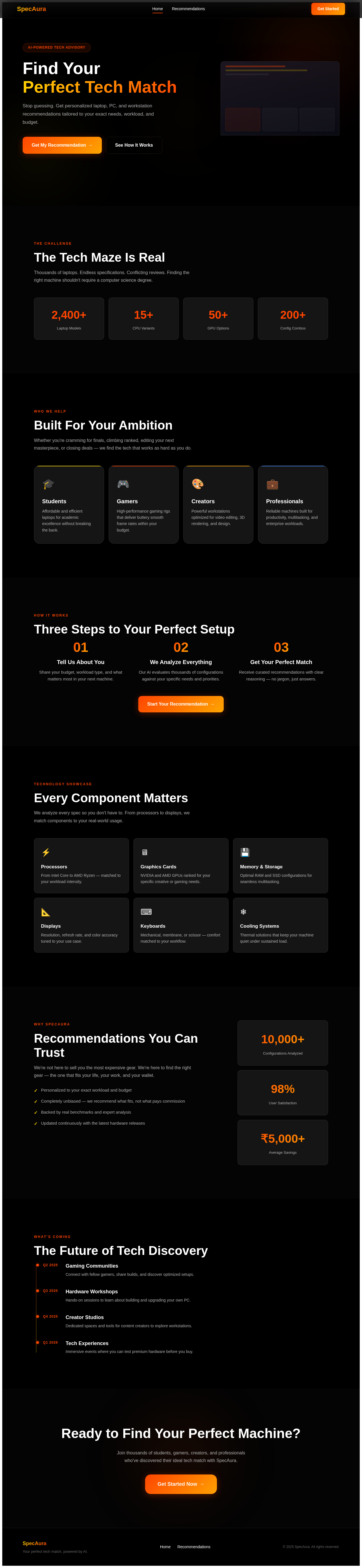
Find Your
Perfect Tech Match
Stop guessing. Get personalized laptop, PC, and workstation recommendations tailored to your exact needs, workload, and budget.
The Tech Maze Is Real
Thousands of laptops. Endless specifications. Conflicting reviews. Finding the right machine shouldn't require a computer science degree.
Built For Your Ambition
Whether you're cramming for finals, climbing ranked, editing your next masterpiece, or closing deals — we find the tech that works as hard as you do.
Students
Affordable and efficient laptops for academic excellence without breaking the bank.
Gamers
High-performance gaming rigs that deliver buttery smooth frame rates within your budget.
Creators
Powerful workstations optimized for video editing, 3D rendering, and design.
Professionals
Reliable machines built for productivity, multitasking, and enterprise workloads.
Three Steps to Your Perfect Setup
Tell Us About You
Share your budget, workload type, and what matters most in your next machine.
We Analyze Everything
Our AI evaluates thousands of configurations against your specific needs and priorities.
Get Your Perfect Match
Receive curated recommendations with clear reasoning — no jargon, just answers.
Every Component Matters
We analyze every spec so you don't have to. From processors to displays, we match components to your real-world usage.
Processors
From Intel Core to AMD Ryzen — matched to your workload intensity.
Graphics Cards
NVIDIA and AMD GPUs ranked for your specific creative or gaming needs.
Memory & Storage
Optimal RAM and SSD configurations for seamless multitasking.
Displays
Resolution, refresh rate, and color accuracy tuned to your use case.
Keyboards
Mechanical, membrane, or scissor — comfort matched to your workflow.
Cooling Systems
Thermal solutions that keep your machine quiet under sustained load.
Recommendations You Can Trust
We're not here to sell you the most expensive gear. We're here to find the right gear — the one that fits your life, your work, and your wallet.
- ✓Personalized to your exact workload and budget
- ✓Completely unbiased — we recommend what fits, not what pays commission
- ✓Backed by real benchmarks and expert analysis
- ✓Updated continuously with the latest hardware releases
The Future of Tech Discovery
Gaming Communities
Connect with fellow gamers, share builds, and discover optimized setups.
Hardware Workshops
Hands-on sessions to learn about building and upgrading your own PC.
Creator Studios
Dedicated spaces and tools for content creators to explore workstations.
Tech Experiences
Immersive events where you can test premium hardware before you buy.
Ready to Find Your Perfect Machine?
Join thousands of students, gamers, creators, and professionals who've discovered their ideal tech match with SpecAura.
Get Started Now →
No comments yet. Be the first!