cedar-food
 Diya Trivedi
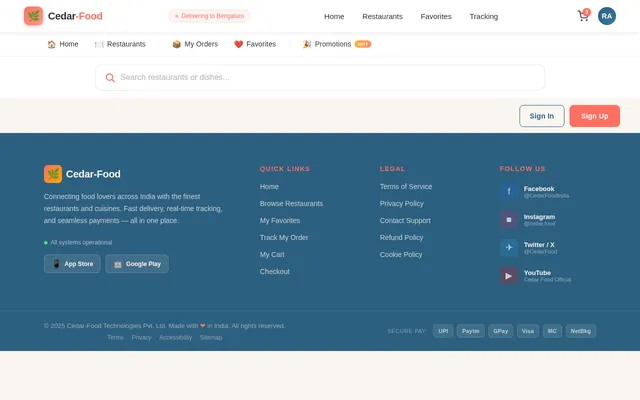
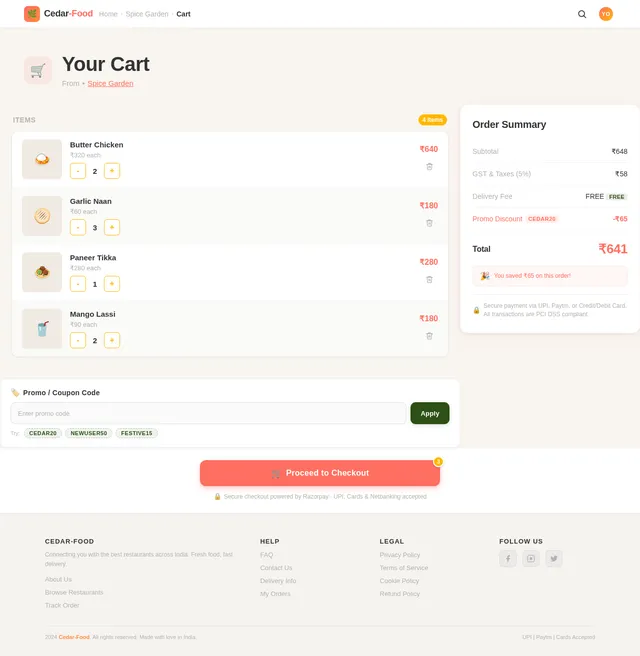
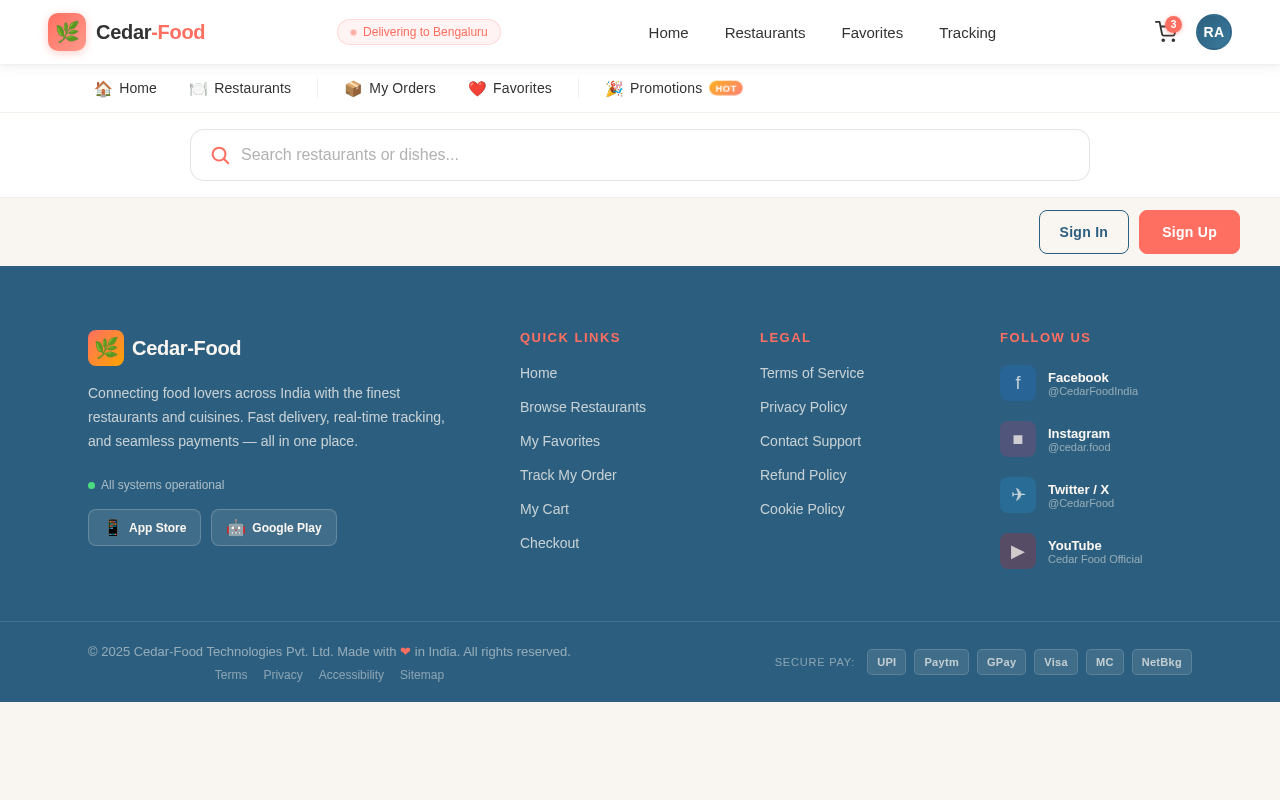
build a food delivery website
Comments (0)
Sign in to leave a comment
System Requirements
System Requirements Document (SRD) for Cedar-Food
1. Introduction
Welcome to the System Requirements Document (SRD) for Cedar-Food, a food delivery website designed to streamline the ordering experience for users in India. This document outlines the system's purpose, features, and technical specifications to ensure a seamless development process. Cedar-Food aims to provide a robust platform for users to browse menus, place orders, and enjoy a smooth delivery experience, catering to multiple restaurants and cuisines.
2. System Overview
Cedar-Food is a web-based platform that connects users with a variety of restaurants, enabling them to explore menus, customize orders, and track deliveries in real-time. The system will cater to three primary user personas: customers, restaurant owners, and delivery personnel. The platform will be optimized for both desktop and mobile devices, ensuring accessibility and convenience for all users.
Key features include:
- User-friendly interface for browsing and ordering food.
- Real-time order tracking and notifications.
- Secure payment gateway integration.
- Restaurant management tools for menu updates and order handling.
- Delivery personnel tracking and task management.
The system will adhere to locale-specific requirements, such as supporting INR currency, Indian time zones (IST), and regional languages where applicable.
3. Functional Requirements
User Stories:
- As a User, I should be able to browse restaurants and their menus.
- As a User, I should be able to search for specific dishes or cuisines.
- As a User, I should be able to place an order and make payments securely.
- As a User, I should be able to track my order in real-time.
- As a User, I should be able to save my favorite restaurants and dishes.
- As a Restaurant Owner, I should be able to manage my menu and update availability.
- As a Restaurant Owner, I should be able to view and manage incoming orders.
- As a Delivery Personnel, I should be able to view assigned delivery tasks.
- As a Delivery Personnel, I should be able to update the delivery status.
4. User Personas
1. Customer
- Description: End-users who browse the platform to order food.
- Goals: Find restaurants, place orders, and track deliveries.
- Pain Points: Long delivery times, unclear order status, and limited payment options.
2. Restaurant Owner
- Description: Business owners who list their restaurants on the platform.
- Goals: Manage menus, handle orders, and track business performance.
- Pain Points: Difficulty updating menus, managing high order volumes, and ensuring timely deliveries.
3. Delivery Personnel
- Description: Individuals responsible for delivering orders to customers.
- Goals: Efficiently complete delivery tasks and update order statuses.
- Pain Points: Navigational challenges, unclear task assignments, and delays.
5. Visuals Colors and Theme
Color Palette:
- Background: #F9F5F0 (Warm Beige)
- Surface: #FFFFFF (Pure White)
- Text: #333333 (Deep Charcoal)
- Accent: #FF6F61 (Spicy Coral)
- Muted Tones: #B2B2B2 (Soft Gray)
This palette reflects a warm, inviting aesthetic, aligning with the comfort and joy of food delivery.
6. Signature Design Concept
Interactive Food Journey Map
The Cedar-Food homepage will feature an Interactive Food Journey Map, a visually stunning and immersive experience. Users will see a dynamic map of their city, with animated restaurant icons scattered across it. Each icon will pulsate gently, inviting users to click and explore.
- Animations: When a user hovers over a restaurant icon, it will expand slightly and display a preview of the restaurant's name, cuisine type, and a featured dish.
- Transitions: Clicking on an icon will zoom into the restaurant's profile, with a smooth transition that mimics opening a menu.
- Micro-interactions: As users scroll through the restaurant's menu, dishes will "slide in" from the side with subtle bounce effects.
- Color Shifts: The map background will subtly change hues based on the time of day (e.g., warm oranges for morning, cool blues for evening).
- Interactive Features: Users can filter restaurants directly on the map by cuisine, rating, or delivery time, with real-time updates.
This concept ensures Cedar-Food stands out as an innovative and visually engaging platform.
7. Non-Functional Requirements
- Performance: The website should load within 3 seconds on a standard 4G connection.
- Scalability: The system must support up to 100,000 concurrent users.
- Security: All user data must be encrypted, and the payment gateway must comply with PCI DSS standards.
- Localization: Support for INR currency and Indian time zones (IST).
- Accessibility: The platform must comply with WCAG 2.1 Level AA standards.
8. Tech Stack
Frontend:
- React for Web
Backend:
- Python
- FastAPI
Database RDBMS:
- MySQL (with Alembic for migrations)
AI Models:
- GPT 5.4 for user-friendly responses
- Google Nano Banana for image generation
AI Tools:
- Litellm for LLM Routing
- Langchain
Orchestration:
- Docker
- docker-compose
- Kubernetes
9. Assumptions and Constraints
Assumptions:
- Users will primarily access the platform via mobile devices.
- Restaurants will provide accurate and up-to-date menu information.
- Delivery personnel will have access to smartphones with GPS functionality.
Constraints:
- The platform must comply with Indian data protection regulations.
- Payment gateway integration must support popular Indian payment methods (e.g., UPI, Paytm, credit/debit cards).
10. Glossary
- Cedar-Food: The name of the food delivery platform.
- User: End-users who browse and order food on the platform.
- Restaurant Owner: Business owners who manage their restaurant profiles and orders.
- Delivery Personnel: Individuals responsible for delivering food orders.
- PCI DSS: Payment Card Industry Data Security Standard.
- WCAG: Web Content Accessibility Guidelines.
- IST: Indian Standard Time.
- UPI: Unified Payments Interface.
No comments yet. Be the first!