Invoice Analysis
Extracts invoice number, customer, amount, currency, dates, terms, tax, PO and line items — flagging duplicates, missing data and inconsistencies.
 Rijul Rr
Build CASHFLOW AI, a production-quality global SaaS for AI-powered accounts receivable and collections. TAGLINE: Your AI employee for getting invoices paid. CORE PROMISE: Connect invoices. CASHFLOW AI identifies who needs attention, prioritizes collections, explains why, drafts personalized reminders, schedules follow-ups, tracks responses, detects and reconciles payments, and escalates exceptions. AI handles routine work; humans handle exceptions. TARGET: Start with Indian B2B SMEs: manufacturers, wholesalers, distributors, textile, packaging, electronics, machinery and B2B services. Architecture must be global from day one with configurable countries, currencies, languages, tax/locale/payment/messaging settings. CORE AGENTS: 1. AI Orchestrator — coordinates agents, selects next action and enforces workflow. 2. Invoice Agent — imports and understands invoices; extracts invoice number, customer, amount, currency, dates, terms, tax, PO and line items; detects duplicates/missing data/inconsistencies. 3. Customer Intelligence Agent — persistent customer profile containing payment history, average delay, reminders, conversations, disputes, promises, preferred channel/language and importance. 4. Collections Agent — determines WHO SHOULD WE CONTACT TODAY using amount, overdue days, payment behavior, promises, disputes, risk, customer importance and company policy. Output ACT TODAY / FOLLOW UP / WATCH. 5. Risk Agent — predicts invoices/accounts likely to become collection problems and provides explainable reasons. 6. Communication Agent — drafts personalized collection messages using customer, invoice, relationship, language, region, channel, tone and policies. Avoid threats, harassment, false legal claims or aggressive language unless explicitly configured and lawful. 7. Follow-up Agent — tracks conversations and schedules follow-ups using customer history, amount, overdue days, policy, working hours and holidays. 8. Payment Agent — detects incoming payments through future payment/bank/accounting integrations. 9. Reconciliation Agent — matches invoice/payment/customer/balance; detects partial, over, under, duplicate and ambiguous payments. 10. Policy Agent — enforces approval thresholds, communication restrictions, schedules, escalation rules and company policy. 11. Exception Agent — surfaces only unusual/high-risk situations for humans. 12. Regional Intelligence Agent — configures locale, currency, language, date/number format, payment methods, invoice fields, holidays, working hours, business terminology and verified regional rules. 13. Analytics Agent — provides collection, payment and AI performance insights. HUMAN CONTROL: All outbound communication is approval-based in MVP. Every action follows: AI Recommendation → Policy Check → Risk Check → Auto-allowed? → Execute OR Human Approval. Never allow AI to transfer money, change bank details, approve its own high-risk actions, delete financial records, modify audit logs or bypass company policies. BUSINESS MEMORY: Company memory: policies, terms, tone, approvals, working hours, holidays, region, currency, language, segments. Customer memory: behavior, conversations, promises, disputes, language/channel, relationship notes. Invoice memory: status, amount, due date, communications, payments, disputes, follow-ups and collection history. MVP FLOW: Sign up → Company onboarding → Select country/currency → CSV invoice import → AI analyzes invoices → Customer intelligence → Risk analysis → Collection prioritization → AI message draft → Human approval → Follow-up scheduler → Mock payment → Reconciliation → Invoice paid → Update customer payment behavior → Next action MVP FEATURES: Landing page, authentication, onboarding, country/currency, CSV import with column mapping and preview, customers, invoices, dashboard, overdue prioritization, mock agents, AI recommendation cards, message drafting, approval workflow, follow-up scheduler, activity timeline, automation rules, analytics, demo data and pricing/paywall placeholder. MVP DEMO: Use realistic fictional businesses such as ABC Industries, XYZ Textiles, Global Packaging, Nova Electronics and Metro Machinery. No real financial data required. DASHBOARD: Show total outstanding, total overdue, due this week, potentially collectible, action required, collections performance, today's exceptions and AI briefing. Example: GOOD MORNING ₹47.2L outstanding ₹8.4L overdue 23 invoices need attention ACT TODAY card: Customer, amount, overdue days, priority, explainable reason, recommendation, draft message, Approve & Send, Edit, Dismiss. INVOICE PAGE: Invoice number, customer, amount, currency, issue/due dates, days overdue, status, payment history, communication timeline, AI recommendation, risk, draft message, follow-up schedule, notes and audit trail. CUSTOMER PAGE: Outstanding, overdue, average payment time, payment reliability, disputes, recent communications and timeline: Invoice → Reminder → Response → Promise → Payment. AUTOMATION: Simple visual rules, e.g. invoice 3 days overdue → generate reminder → if below configured threshold and policy allows, send; otherwise request approval. Keep rules configurable. ANALYTICS: Outstanding, overdue, collection rate, average days to payment, DSO where applicable, recovery rate, overdue trend, collected payments, AI follow-ups, human approvals and payment behavior. Track internal metrics: activation, usage, value collected after AI intervention, retention, MRR, churn, AI cost/customer and gross margin. Only claim “Money recovered with CASHFLOW AI” when supported by actual tracked payment data. AI: Use a modular provider abstraction. Do not hard-code one AI vendor. Interfaces: LanguageModelProvider ImageGenerationProvider EmbeddingProvider OCRProvider All AI calls server-side. Never expose API keys. LLM must use controlled backend tools/functions such as: get_invoice() get_customer() get_payment_history() create_draft_message() schedule_followup() request_human_approval() mark_payment_as_matched() Never allow unrestricted SQL/database commands from the LLM. DATABASE: Supabase/Postgres with: companies, users, company_members, profiles, customers, customer_contacts, customer_preferences, customer_memory, invoices, invoice_items, invoice_status_history, payments, payment_matches, reconciliation_events, communications, communication_templates, collection_tasks, followups, ai_recommendations, ai_decisions, ai_agent_runs, automation_rules, approval_requests, regional_configs, currencies, exchange_rates, locales, subscriptions, plans, credits, credit_transactions, shared_reports, analytics_events, audit_logs, app_settings. Use Row Level Security and strict tenant isolation. STORAGE: Private Supabase Storage, signed URLs for invoices, documents, payment files and reports. TECH STACK: Next.js + React + TypeScript + Tailwind CSS Supabase/PostgreSQL/Auth/Storage n8n for appropriate deterministic automation Vercel or equivalent hosting PostHog or equivalent analytics Modular AI and OCR providers SECURITY: Authentication, authorization, RLS, encryption in transit, secure secrets, server-side API calls, audit logs, signed URLs, rate limits, abuse prevention and tenant isolation. Never expose API keys, private invoices, financial data or internal agent instructions. ERROR HANDLING: Every workflow needs retries, timeouts, failure states, human fallback and audit records. Never silently make risky assumptions. INTEGRATIONS: Architect adapters for Gmail, Outlook, WhatsApp Business, SMS, Slack, QuickBooks, Xero, Zoho Books, Tally, ERP, payment gateways and bank feeds, but DO NOT require them in V1. V1 uses mock sending and mock integrations. PRICING: Make pricing configurable in admin. Initial experiment: Starter ₹1,499/month Business ₹4,999/month Pro ₹12,999/month Support independent international pricing; do not simply convert INR to USD. Usage limits should account for invoices, customers, AI runs, automated messages, OCR and integrations. DEVELOPMENT ORDER: 1 Frontend 2 Auth 3 Onboarding 4 Supabase schema 5 CSV import 6 Dashboard 7 Customer/invoice model 8 Mock agents 9 AI recommendation cards 10 Message generation 11 Human approval 12 Follow-up system 13 Regional configuration 14 Audit logs 15 Analytics 16 Real LLM 17 Real email 18 Payment/reconciliation integrations 19 Controlled autonomous workflows IMPORTANT: Do not initially connect WhatsApp, banks, ERP, accounting systems, payment gateways or multiple AI models. First prove: CSV → AI analysis → recommendation → message → approval → follow-up POSITIONING: Do NOT market as “AI accounting.” Market as: YOUR AI COLLECTIONS EMPLOYEE It watches. It prioritizes. It writes. It follows up. It remembers. It reconciles. It escalates. You make the important decisions. Build the MVP end-to-end, production-ready for future integrations, with mock AI and mock integrations initially.


Sign in to leave a comment
No tasks generated yet.
Tasks will appear here as requirements are defined.
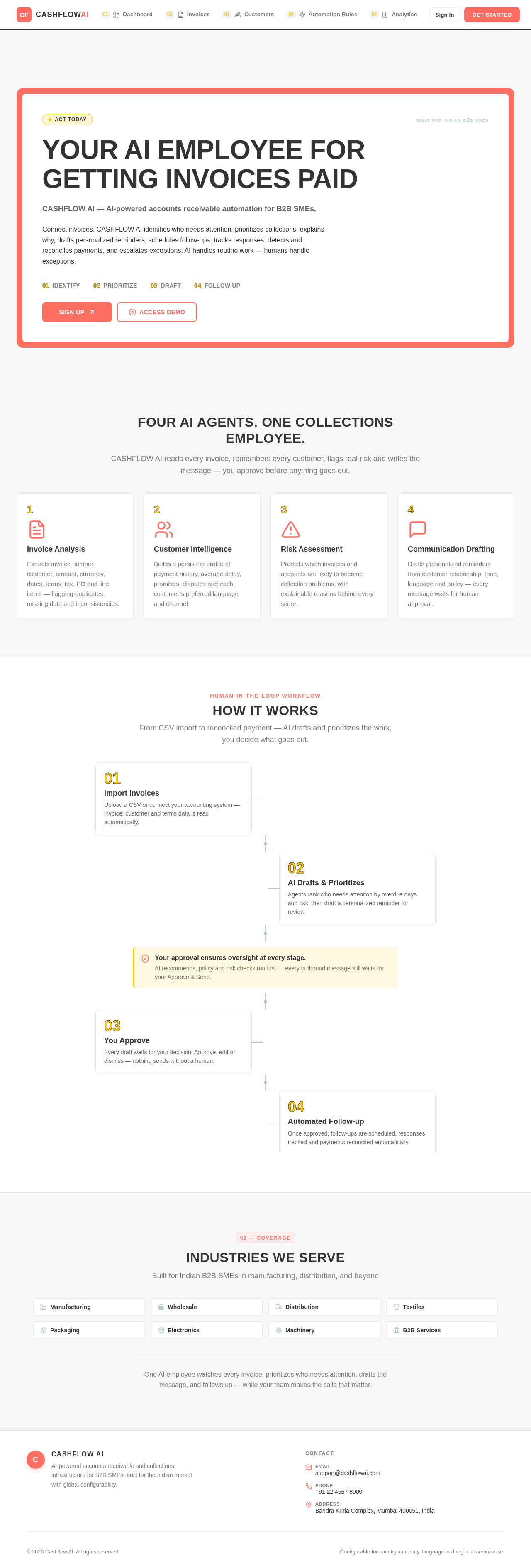
CASHFLOW AI — AI-powered accounts receivable automation for B2B SMEs.
Connect invoices. CASHFLOW AI identifies who needs attention, prioritizes collections, explains why, drafts personalized reminders, schedules follow-ups, tracks responses, detects and reconciles payments, and escalates exceptions. AI handles routine work — humans handle exceptions.
CASHFLOW AI reads every invoice, remembers every customer, flags real risk and writes the message — you approve before anything goes out.
Extracts invoice number, customer, amount, currency, dates, terms, tax, PO and line items — flagging duplicates, missing data and inconsistencies.
Builds a persistent profile of payment history, average delay, promises, disputes and each customer’s preferred language and channel.
Predicts which invoices and accounts are likely to become collection problems, with explainable reasons behind every score.
Drafts personalized reminders from customer relationship, tone, language and policy — every message waits for human approval.
From CSV import to reconciled payment — AI drafts and prioritizes the work, you decide what goes out.
Upload a CSV or connect your accounting system — invoice, customer and terms data is read automatically.
Agents rank who needs attention by overdue days and risk, then draft a personalized reminder for review.
Your approval ensures oversight at every stage.
AI recommends, policy and risk checks run first — every outbound message still waits for your Approve & Send.
Every draft waits for your decision. Approve, edit or dismiss — nothing sends without a human.
Once approved, follow-ups are scheduled, responses tracked and payments reconciled automatically.
Built for Indian B2B SMEs in manufacturing, distribution, and beyond
One AI employee watches every invoice, prioritizes who needs attention, drafts the message, and follows up — while your team makes the calls that matter.
CASHFLOW AI — AI-powered accounts receivable automation for B2B SMEs.
Connect invoices. CASHFLOW AI identifies who needs attention, prioritizes collections, explains why, drafts personalized reminders, schedules follow-ups, tracks responses, detects and reconciles payments, and escalates exceptions. AI handles routine work — humans handle exceptions.
CASHFLOW AI reads every invoice, remembers every customer, flags real risk and writes the message — you approve before anything goes out.
Extracts invoice number, customer, amount, currency, dates, terms, tax, PO and line items — flagging duplicates, missing data and inconsistencies.
Builds a persistent profile of payment history, average delay, promises, disputes and each customer’s preferred language and channel.
Predicts which invoices and accounts are likely to become collection problems, with explainable reasons behind every score.
Drafts personalized reminders from customer relationship, tone, language and policy — every message waits for human approval.
From CSV import to reconciled payment — AI drafts and prioritizes the work, you decide what goes out.
Upload a CSV or connect your accounting system — invoice, customer and terms data is read automatically.
Agents rank who needs attention by overdue days and risk, then draft a personalized reminder for review.
Your approval ensures oversight at every stage.
AI recommends, policy and risk checks run first — every outbound message still waits for your Approve & Send.
Every draft waits for your decision. Approve, edit or dismiss — nothing sends without a human.
Once approved, follow-ups are scheduled, responses tracked and payments reconciled automatically.
Built for Indian B2B SMEs in manufacturing, distribution, and beyond
One AI employee watches every invoice, prioritizes who needs attention, drafts the message, and follows up — while your team makes the calls that matter.
No comments yet. Be the first!