


Private · Local-first · Zero paid APIs
Your college knowledge,answered locally.
CAMPUSGPT is a private AI-powered college knowledge and study assistant. It reads your syllabus, notes, textbooks, lab manuals, regulations, assignments, previous-year papers and study materials, then answers with grounded, page-level citations instead of guesses.
Understands PDF DOCX TXT Markdown HTML — with OCR fallback for scanned papers.
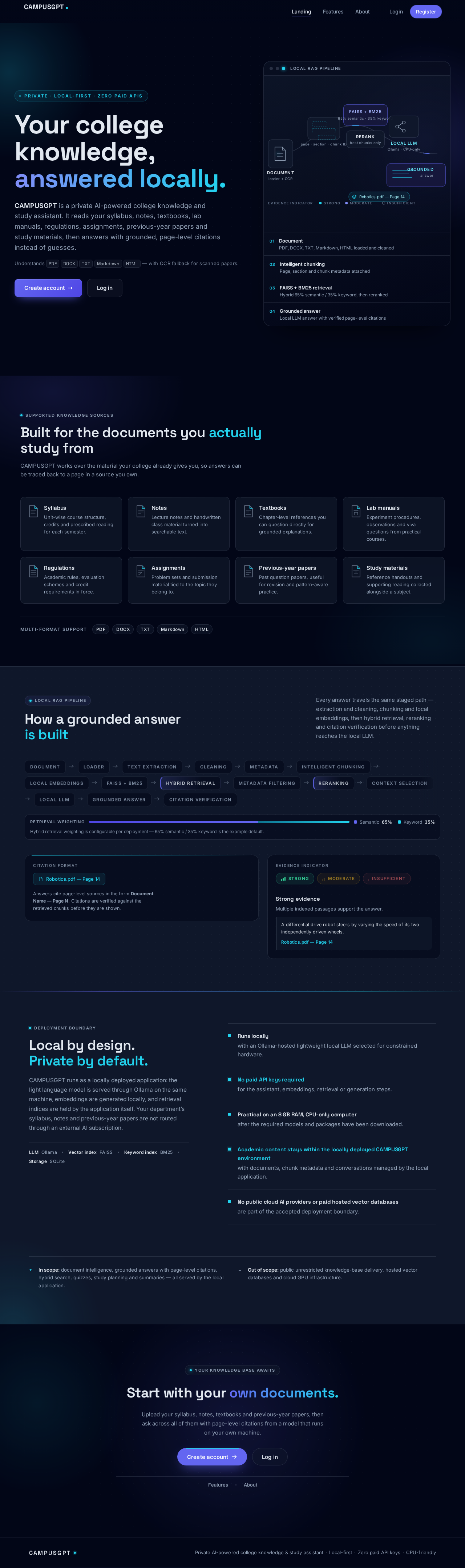
- DocumentPDF, DOCX, TXT, Markdown, HTML loaded and cleaned
- Intelligent chunkingPage, section and chunk metadata attached
- FAISS + BM25 retrievalHybrid 65% semantic / 35% keyword, then reranked
- Grounded answerLocal LLM answer with verified page-level citations
Built for the documents you actually study from
CAMPUSGPT works over the material your college already gives you, so answers can be traced back to a page in a source you own.
Syllabus
Unit-wise course structure, credits and prescribed reading for each semester.
Notes
Lecture notes and handwritten class material turned into searchable text.
Textbooks
Chapter-level references you can question directly for grounded explanations.
Lab manuals
Experiment procedures, observations and viva questions from practical courses.
Regulations
Academic rules, evaluation schemes and credit requirements in force.
Assignments
Problem sets and submission material tied to the topic they belong to.
Previous-year papers
Past question papers, useful for revision and pattern-aware practice.
Study materials
Reference handouts and supporting reading collected alongside a subject.
- DOCX
- TXT
- Markdown
- HTML
How a grounded answeris built
Every answer travels the same staged path — extraction and cleaning, chunking and local embeddings, then hybrid retrieval, reranking and citation verification before anything reaches the local LLM.
- 01Document
- 02Loader
- 03Text extraction
- 04Cleaning
- 05Metadata
- 06Intelligent chunking
- 07Local embeddings
- 08FAISS + BM25
- 09Hybrid retrieval
- 10Metadata filtering
- 11Reranking
- 12Context selection
- 13Local LLM
- 14Grounded answer
- 15Citation verification
Hybrid retrieval weighting is configurable per deployment — 65% semantic / 35% keyword is the example default.
Answers cite page-level sources in the form Document Name — Page N. Citations are verified against the retrieved chunks before they are shown.
Strong evidence
Multiple indexed passages support the answer.
A differential drive robot steers by varying the speed of its two independently driven wheels.Robotics.pdf — Page 14Deployment boundary
Local by design.Private by default.
CAMPUSGPT runs as a locally deployed application: the light language model is served through Ollama on the same machine, embeddings are generated locally, and retrieval indices are held by the application itself. Your department’s syllabus, notes and previous-year papers are not routed through an external AI subscription.
- Runs locallywith an Ollama-hosted lightweight local LLM selected for constrained hardware.
- No paid API keys requiredfor the assistant, embeddings, retrieval or generation steps.
- Practical on an 8 GB RAM, CPU-only computerafter the required models and packages have been downloaded.
- Academic content stays within the locally deployed CAMPUSGPT environmentwith documents, chunk metadata and conversations managed by the local application.
- No public cloud AI providers or paid hosted vector databasesare part of the accepted deployment boundary.
In scope: document intelligence, grounded answers with page-level citations, hybrid search, quizzes, study planning and summaries — all served by the local application.
Out of scope: public unrestricted knowledge-base delivery, hosted vector databases and cloud GPU infrastructure.
Start with your own documents.
Upload your syllabus, notes, textbooks and previous-year papers, then ask across all of them with page-level citations from a model that runs on your own machine.
No comments yet. Be the first!