asset-structuring-hnw
I'm planning to setup a startup on the domain of financial services. With the upcoming launching of IIFC (Indonesia International Financial Center) or PFII - Pusat Financial Internasional Indonesia, we plan a startup to offer asset structuring services to entry-level Indonesia HNW and also the UHNW (gen X & baby boomers) and their successor (milenial & gen Z mostly). Currently, any Indonesia HNW will need to go to SG or HK or Dubai for asset structuring services such as trust, family office and PPLI. With the establishment of PFII (Pusat Financial International Indonesia) soon, we are anticipating that the cost will be lower and thus make these services available to broader HNW market. And also this fnancial center can be an alternative for the current Indonesia HNW to diversify their asset portofolio. I plan to build the apps using AI agentic vibe tools such as 8080.ai ( i heard a lot of good things). So the apps will have client-facing apps and for-advisor apps to help when discussing with clients especially the patriarch who are not digital natives and favor face-to-face meeting. Currently I'm a one-man dev team and we plan to look for investor and then when the PFII launched ( maybe mid/end of next year) we hope to be among the pioneers. As the details of the regulation is being worked out by the Indonesia government, I want to build the prototype to show to angel investor and prepare for the apps to launch early next year when the PFII is planned for official launch. I'm also considering building SaaS providing API services to the financial advisors/institutions that will do business in the IIFC to help with the complexity of setting & managing various entities involved. I'm also considering the idea in the future of creating something like a marketplace to help entry-level HNW or higher mass affluent to search a cost-effective asset structuring strategy that feasible & suitable for their need. Take into consideration that after some time (maybe in 5 or 10 years), I would suppose that IIFC will collab with its peers such as the Singapore & Dubai financial center. Analyze the concept and the probability of the services that we can provide at the beginning and for the development in the near future. Help me to think through all these pieces of ideas & the information as the IIFC details are being updated/finalized by the Indonesia government


Comments (0)
Sign in to leave a comment
System Requirements
System Requirements Document for Asset Structuring
1. Introduction
Asset Structuring is a financial-services startup product for the Indonesian market, timed to the planned launch of IIFC (Indonesia International Financial Center), also known as PFII — Pusat Financial Internasional Indonesia. Today an Indonesian high-net-worth (HNW) individual must go to Singapore, Hong Kong or Dubai to obtain asset structuring services such as trust, family office and PPLI. With the establishment of PFII, the startup anticipates lower costs, which would make these services available to a broader HNW market, and would give current Indonesian HNW clients an alternative way to diversify their asset portfolio.
The product serves two audiences through two apps:
- A client-facing app for entry-level Indonesian HNW clients, UHNW clients (Gen X and baby boomers) and their successors (mostly millennials and Gen Z).
- An advisor app that helps the advisor during discussions with clients — especially the patriarch, who is not a digital native and favors face-to-face meetings.
This document is the System Requirements Document for the prototype. The prototype exists to show the concept to angel investors and to prepare the apps to launch early next year, when the PFII official launch is planned. The founder is currently a one-man dev team and intends to build with AI agentic vibe tools such as 8080.ai.
The IIFC regulation details are still being worked out by the Indonesia government. This document therefore specifies the product behavior that is stable regardless of the final regulatory text, and keeps regulatory-dependent facts as explicit constraints rather than invented rules.
1a. Success Criteria
- An angel investor can be shown a working prototype of both the client-facing app and the advisor app, demonstrating trust, family office and PPLI structuring for Indonesian HNW and UHNW families and their successors.
- A client can reach the service options (trust, family office, PPLI) in the client-facing app after verifying identity.
- An advisor can open the advisor app during a face-to-face meeting and use it to support the discussion with the client, including the patriarch.
- The apps are in a state ready to launch early next year, aligned with the planned PFII official launch.
- The product does not depend on final IIFC regulation text to function, so it can be updated as the government finalizes the details.
2. System Overview
Asset Structuring is delivered as a React web application backed by a shared FastAPI service and a MariaDB database. It has two product surfaces for two accepted human personas: a client-facing app used by the Client (HNW individual or successor) and an advisor app used by the Advisor. Both personas establish their own identity through self-service enrollment and returning verification, then reach the protected work that belongs to their role.
The current delivery covers:
- An anonymous Landing page that explains the asset structuring services and the clients they serve.
- A Login page where a client or an advisor establishes or verifies identity.
- A role-restricted Services page in the client-facing app where the client views trust, family office and PPLI service options.
- A role-restricted Advisor Workspace in the advisor app where the advisor supports a face-to-face discussion with a client.
The backend is a single shared FastAPI process that hosts the application APIs and domain modules for identity, service catalog and advisor workspace data. MariaDB stores application-owned persistent data. The frontend is a React application.
Removed from scope — the following are explicitly not current commitments and are not built into the current pages or acceptance:
- SaaS API service for financial advisors and institutions in the IIFC to set up and manage entities (also: API services, entity management SaaS) — a consideration only, not a current commitment.
- Marketplace for entry-level HNW and mass affluent users to search a cost-effective asset structuring strategy (also: structuring marketplace) — a future idea, not a current commitment.
- IIFC collaboration with peer financial centers such as Singapore and Dubai (also: peer financial center collaboration) — a 5-to-10-year horizon idea, not a current commitment.
2a. Product Interpretation and Delivery Boundary
The current product is a first-party web application with application-owned identity. Both accepted personas — the client and the advisor — enroll themselves and verify their identity on return. The Landing page is anonymous and is the public entry. The Login page is anonymous and is the only place where identity is established or verified; a protected page never establishes access to itself. The Services page and the Advisor Workspace are role-restricted: the client reaches Services, the advisor reaches the Advisor Workspace.
The prototype is the current deliverable. It is built to be shown to angel investors and to be ready for the early-next-year launch window that coincides with the planned PFII official launch. Because the IIFC regulation details are not final, the product does not encode regulatory rules as fixed behavior; it presents the accepted service categories (trust, family office, PPLI) and supports the advisor–client discussion.
The SaaS API offering for advisors and institutions, the marketplace for entry-level HNW and mass affluent users, and the long-horizon collaboration between IIFC and peer financial centers are outside the current delivery boundary. They are recorded in the future section and are not represented by any current page, requirement or flow.
2c. Page Content and Component Coverage
Landing
- Information and state: Anonymous public entry. Warm paper ground (#F2EFE9). Full-width hero with a 96px black headline flush left across columns 1–7: "Structure your family wealth in Indonesia". Subline: "Trust, family office and PPLI structuring for Indonesian families, built for the PFII launch." A visible twelve-column hairline grid runs behind the hero. A large vermilion circle (#D6401E) and a black arc lock to the right grid (columns 8–12), overlapping the headline column edge but covering no text. A black rectangular CTA "See services" sits under the headline.
- Primary action: "See services" — leads the visitor toward the client-facing service options, passing through identity verification at Login.
- Supporting actions: Navigate to Login to sign in as a client or as an advisor.
- Domain entities: Service category (trust, family office, PPLI); audience description (entry-level HNW, UHNW Gen X and baby boomers, successors — millennials and Gen Z).
- Component responsibilities: Hero block (headline, subline, CTA); grid overlay; geometric composition (circle, arc); section openers using a black rule with a small capital label and a number; service rows as aligned label/value pairs on tabular rules.
- States: Loading — static content, no data fetch required. Empty — not applicable. Success — hero and service rows render fully. Error — not applicable for static content. Recovery — if the CTA target is unavailable, the visitor can still reach Login from the header.
Login
- Information and state: Anonymous identity-access surface for both personas. Warm paper ground, black rules, one vermilion signal element. Two clearly separated paths: client and advisor.
- Primary action: Establish identity on first use (self-service enrollment) or verify identity on return, then continue to the role-appropriate protected destination (Services for the client, Advisor Workspace for the advisor).
- Supporting actions: Switch between client and advisor path; return to Landing.
- Domain entities: Account identity (client or advisor), credential, role.
- Component responsibilities: Role selector; enrollment form; returning-verification form; inline validation; submit control as a black rectangle.
- States: Loading — submit in progress. Empty — initial form. Success — identity established or verified, redirect to the role-appropriate destination. Error — invalid credentials or incomplete enrollment, with an inline message and the form preserved for correction. Recovery — the user can retry, switch role path, or return to Landing.
Services
- Information and state: Role-restricted client-facing page. Shows the three accepted service categories — trust, family office and PPLI — as dense ordered rows of aligned label/value pairs on tabular rules. Section opener uses a black rule with a small capital label and a number. One vermilion signal element per view.
- Primary action: The client reviews the trust, family office and PPLI service options.
- Supporting actions: Open a service row to read its description; return to the client home context.
- Domain entities: Service category (trust, family office, PPLI); service description.
- Component responsibilities: Section opener; service row list; row detail; tabular rule styling.
- States: Loading — service rows loading. Empty — no service rows available, with a plain message. Success — all three service categories listed. Error — service data unavailable, with a retry control. Recovery — retry reloads the rows; the client remains signed in.
Advisor Workspace
- Information and state: Role-restricted advisor-app page used during a face-to-face discussion with a client, especially the patriarch. Presents the structuring options (trust, family office, PPLI) in a form the advisor can walk through with the client. Warm paper ground, black rules, one vermilion signal element.
- Primary action: The advisor opens the structuring options and walks the client through them during the meeting.
- Supporting actions: Select a service category to discuss; present the option detail to the client; return to the option list.
- Domain entities: Service category (trust, family office, PPLI); option detail; discussion context.
- Component responsibilities: Section opener; option list; option detail panel; tabular rule styling.
- States: Loading — options loading. Empty — no options available, with a plain message. Success — options presented for discussion. Error — options unavailable, with a retry control. Recovery — retry reloads the options; the advisor remains signed in.
3. Functional Requirements
FR-1 — Client views asset structuring service options. As a Client (HNW individual or successor), I should view the trust, family office and PPLI service options in the client-facing app, so that I understand what structuring services are available to me.
- Provenance: explicit (services include trust, family office and PPLI; client-facing app).
- Trigger/input: the client signs in and opens Services.
- Observable result: the three service categories are listed as ordered rows.
- Access state: role-restricted; requires verified client identity.
- Failure/recovery: if service data is unavailable, an error with retry is shown; the client stays signed in.
- Continuation: the client can open a service row to read its description.
FR-2 — Client is served as entry-level HNW, UHNW or successor. As a Client (HNW individual or successor), I should be served as an entry-level Indonesian HNW client, a UHNW client (Gen X or baby boomer) or a successor (millennial or Gen Z), so that the services presented match my segment.
- Provenance: explicit.
- Trigger/input: the client's identity and segment.
- Observable result: the client-facing app presents the accepted service categories for the client's segment.
- Access state: role-restricted; requires verified client identity.
- Failure/recovery: if the segment is not set, the client still sees the accepted service categories.
- Continuation: the client proceeds to review the service options.
FR-3 — Advisor supports a face-to-face discussion. As an Advisor, I should open the advisor app during a face-to-face meeting with a client, especially the patriarch, and walk the client through the structuring options, so that the discussion is supported by the app.
- Provenance: explicit (advisor app helps during discussions with clients, especially the patriarch who favors face-to-face meetings).
- Trigger/input: the advisor signs in and opens the Advisor Workspace during the meeting.
- Observable result: the structuring options (trust, family office, PPLI) are presented for discussion.
- Access state: role-restricted; requires verified advisor identity.
- Failure/recovery: if options are unavailable, an error with retry is shown; the advisor stays signed in.
- Continuation: the advisor selects a service category and presents its detail to the client.
FR-4 — Client self-service enrollment and returning verification. As a Client (HNW individual or successor), I should establish my identity on first use and verify it on return, so that I can reach the client-facing Services page.
- Provenance: required_inference (indispensable for the accepted client journey).
- Trigger/input: the client opens Login and chooses the client path.
- Observable result: identity is established or verified and the client is taken to Services.
- Access state: anonymous entry at Login; protected state at Services.
- Failure/recovery: invalid credentials or incomplete enrollment show an inline error and preserve the form.
- Continuation: the client retries or returns to Landing.
FR-5 — Advisor self-service enrollment and returning verification. As an Advisor, I should establish my identity on first use and verify it on return, so that I can reach the Advisor Workspace.
- Provenance: required_inference (indispensable for the accepted advisor journey).
- Trigger/input: the advisor opens Login and chooses the advisor path.
- Observable result: identity is established or verified and the advisor is taken to the Advisor Workspace.
- Access state: anonymous entry at Login; protected state at the Advisor Workspace.
- Failure/recovery: invalid credentials or incomplete enrollment show an inline error and preserve the form.
- Continuation: the advisor retries or returns to Landing.
FR-6 — Visitor understands the services and audience. As a visitor (Client or Advisor before signing in), I should read on the Landing page what asset structuring services are offered and which clients they serve, so that I can decide to continue.
- Provenance: required_inference (public entry for the accepted services).
- Trigger/input: the visitor opens Landing.
- Observable result: the hero headline, subline and service rows are shown.
- Access state: anonymous.
- Failure/recovery: if the CTA target is unavailable, the visitor can still reach Login from the header.
- Continuation: the visitor selects "See services" or navigates to Login.
FR-7 — Prototype demonstrates the concept to angel investors. As the founder, I should be able to demonstrate the client-facing app and the advisor app as a working prototype, so that angel investors can see the concept.
- Provenance: explicit (prototype to show to angel investors).
- Trigger/input: the founder runs the prototype.
- Observable result: both apps are usable end to end.
- Access state: as per the accepted pages.
- Failure/recovery: not applicable to the product surface.
- Continuation: the founder proceeds toward the early-next-year launch.
4. User Personas
Client (HNW individual or successor)
- Product context: An Indonesian HNW individual — entry-level HNW, or UHNW in Gen X or baby boomer generation — or a successor, mostly millennial or Gen Z. Today this client would have to go to Singapore, Hong Kong or Dubai for trust, family office or PPLI structuring. With PFII, the client expects lower cost and a way to diversify the asset portfolio.
- Primary goal: Understand and obtain asset structuring services — trust, family office and PPLI — through the client-facing app.
- Distinct accepted responsibilities: Enrolls and verifies identity; reviews the trust, family office and PPLI service options; meets the advisor face to face, in particular the patriarch who is not a digital native and favors face-to-face meetings.
- Relevant inputs or decisions: Which service category to review; whether to proceed with a structuring discussion.
- Interactions with other accepted participants: Meets the Advisor face to face; the Advisor walks the client through the structuring options in the advisor app.
- Observable success: The client sees the three service categories in the client-facing app and completes a supported discussion with the advisor.
Advisor
- Product context: The advisor works with Indonesian HNW and UHNW clients and their successors, and meets them face to face — especially the patriarch, who is not a digital native and favors face-to-face meetings.
- Primary goal: Support the face-to-face discussion with the client using the advisor app.
- Distinct accepted responsibilities: Enrolls and verifies identity; opens the Advisor Workspace during the meeting; walks the client through the trust, family office and PPLI options.
- Relevant inputs or decisions: Which service category to discuss; which option detail to present.
- Interactions with other accepted participants: Works directly with the Client during the meeting.
- Observable success: The advisor presents the structuring options to the client in the advisor app during the meeting.
5. Core User Flows
Flow A — Client reviews structuring services
- The Client opens the Landing page anonymously and reads the headline, subline and service rows.
- The Client selects "See services" and arrives at Login.
- On Login, the Client chooses the client path. On first use, the Client completes self-service enrollment; on return, the Client verifies identity.
- On success, the Client is taken to Services.
- On Services, the Client reviews the trust, family office and PPLI rows and opens a row to read its description.
- If service data is unavailable, the Client sees an error with a retry control and remains signed in; retry reloads the rows.
- The Client continues to a face-to-face discussion with the Advisor (Flow C).
Flow B — Advisor prepares and signs in
- The Advisor opens the Landing page anonymously.
- The Advisor navigates to Login and chooses the advisor path.
- On first use, the Advisor completes self-service enrollment; on return, the Advisor verifies identity.
- On success, the Advisor is taken to the Advisor Workspace.
- If credentials are invalid or enrollment is incomplete, an inline error is shown and the form is preserved; the Advisor retries or returns to Landing.
Flow C — Advisor supports a face-to-face discussion
- The Advisor is signed in and opens the Advisor Workspace during a face-to-face meeting with the Client, especially the patriarch.
- The Advisor selects a service category (trust, family office or PPLI) and presents its detail to the Client.
- The Client reviews the option with the Advisor.
- If options are unavailable, the Advisor sees an error with a retry control and remains signed in; retry reloads the options.
- The Advisor returns to the option list to continue the discussion.
Flow D — Founder demonstrates the prototype to angel investors
- The founder runs the prototype.
- The founder shows the Landing page and the accepted service categories.
- The founder signs in as a Client and shows Services.
- The founder signs in as an Advisor and shows the Advisor Workspace in a face-to-face discussion scenario.
- The founder explains the early-next-year launch plan aligned with the planned PFII official launch.
6. Visuals Colors and Theme
Authoritative creative direction: Swiss geometric rigour after Josef Müller-Brockmann. The register is trust, precision and calm authority before a regulated launch.
- Muse and headline: Josef Müller-Brockmann; headline "Structure your family wealth in Indonesia".
- Mode: Light.
- Palette (exact hex by role):
- Background:
#F2EFE9(warm paper ground, covers most of the page) - Surface:
#E4DFD3 - Text:
#161514 - Primary:
#161514 - Accent:
#D6401E(vermilion — one signal element per view) - Muted:
#6E6A62 - No blue anywhere.
- Background:
- Typography: Headings and body in Archivo (Grotesque), flush left, ragged right. Heavy 700 headings against 400 body. Tight tracking; no capitals except small labels. Modular scale 1.333: 64 / 48 / 32 / 20 / 16. Mobile headline 40px to desktop 96px with
clamp(). - Shape language: Hard edges only. Rectangles, circles and quarter arcs lock to the grid. One-pixel black rules divide every zone.
- Layout: Twelve-column grid with visible hairline rules. Asymmetric poster composition: type in columns 1–7, geometry in columns 8–12. Dense ordered rows for services.
- Imagery: Abstract geometry only — black circles, vermilion bars and grid diagrams. No stock photography and no illustration.
- Motion: Restrained. One geometric wipe on load and instant state changes. No bounce and no float.
7. Signature Design Concept
The public entry is a full-width warm paper ground (#F2EFE9). A 96px black Archivo headline sits flush left across columns 1–7: "Structure your family wealth in Indonesia". A large vermilion circle (#D6401E) and a black arc lock to the right grid in columns 8–12; the circle overlaps the headline column edge but covers no text. A black rectangular CTA "See services" sits under the headline. A visible twelve-column hairline grid runs behind the whole hero. Section openers use a black rule with a small capital label and a number. Service rows are aligned label/value pairs on tabular rules. The composition recomposes only accepted content — the headline, subline, CTA and service categories — and introduces no new behavior or destination.
8. Interaction Model & Motion Direction
Interaction Model: Animated Motion Tempo: restrained Hero Dimensionality: flat
Landing Hero Motion Brief
- Focal subject: The vermilion circle and black arc locked to the right grid, with the headline in columns 1–7.
- Input → transformation → outcome thesis: On load, one geometric wipe reveals the hero — the grid rules draw in, the vermilion circle and black arc settle into their grid positions, and the headline and CTA appear — ending in a still, composed poster. No further motion on the hero.
- Motion vocabulary: Single geometric wipe; instant state changes; no bounce; no float.
- Composed first frame: Warm paper ground, visible twelve-column hairline grid, 96px black headline flush left, vermilion circle and black arc on the right, black rectangular CTA under the headline.
- Reduced-motion state: With
prefers-reduced-motion, the hero renders in its final composed state with no wipe; all text and controls remain whole and readable at 375px, 768px and 1280px.
9. Non-Functional Requirements
- Prototype constraint (explicit): The prototype must show the concept to angel investors.
- Launch timing (explicit): The apps must be ready to launch early next year, when the PFII official launch is planned.
- Regulatory uncertainty (explicit): The IIFC regulation details are not final and the Indonesia government is still working them out; the product must not encode unconfirmed regulatory rules as fixed behavior.
- Team constraint (explicit): The founder is a one-man dev team; the build must be achievable with AI agentic vibe tools such as 8080.ai.
- Readability (explicit design constraint): Headlines, wordmarks, labels, numbers, card text and controls stay entirely inside the viewport and their container at 375px, 768px and 1280px, wrapping or scaling with
clamp(); no other element covers readable text or controls. - Accessibility (required_inference): Reduced-motion users receive a usable static arrangement of the hero and any scrollable rows.
10. Tech Stack
- Frontend: React application UI.
- Backend: Shared FastAPI process for application APIs and domain modules (identity, service catalog, advisor workspace).
- Database: MariaDB for application-owned persistent data.
- Build tooling: AI agentic vibe tools such as 8080.ai (explicit user choice).
11. Assumptions and Constraints
- A-1 (explicit): The IIFC/PFII regulation details are not final; the product presents the accepted service categories without encoding unconfirmed rules.
- A-2 (explicit): The prototype is the current deliverable, aimed at angel investors and at an early-next-year launch aligned with the planned PFII official launch.
- A-3 (explicit): The founder is a one-man dev team building with AI agentic vibe tools such as 8080.ai.
- A-4 (explicit): The SaaS API service for advisors and institutions is a consideration, not a current commitment.
- A-5 (explicit): The marketplace for entry-level HNW and mass affluent users is a future idea, not a current commitment.
- A-6 (explicit): IIFC collaboration with peer financial centers such as Singapore and Dubai is a 5-to-10-year horizon idea, not a current commitment.
- A-7 (required_inference): Client and advisor identity is application-owned, established at Login and used to reach the role-restricted Services and Advisor Workspace pages.
12. Glossary
- IIFC / PFII: Indonesia International Financial Center / Pusat Financial Internasional Indonesia — the planned Indonesian financial center whose launch the product is timed to.
- HNW: High-net-worth individual.
- UHNW: Ultra-high-net-worth individual.
- Trust: An asset structuring service in which assets are held by a trustee for beneficiaries.
- Family office: An asset structuring service that manages a family's wealth and affairs.
- PPLI: Private Placement Life Insurance — an asset structuring service.
- Patriarch: The senior family member, typically not a digital native, who favors face-to-face meetings.
- Successor: The next generation of the family (mostly millennials and Gen Z).
- Advisor Workspace: The role-restricted advisor-app page used during a face-to-face client discussion.
- Services: The role-restricted client-facing page listing trust, family office and PPLI options.
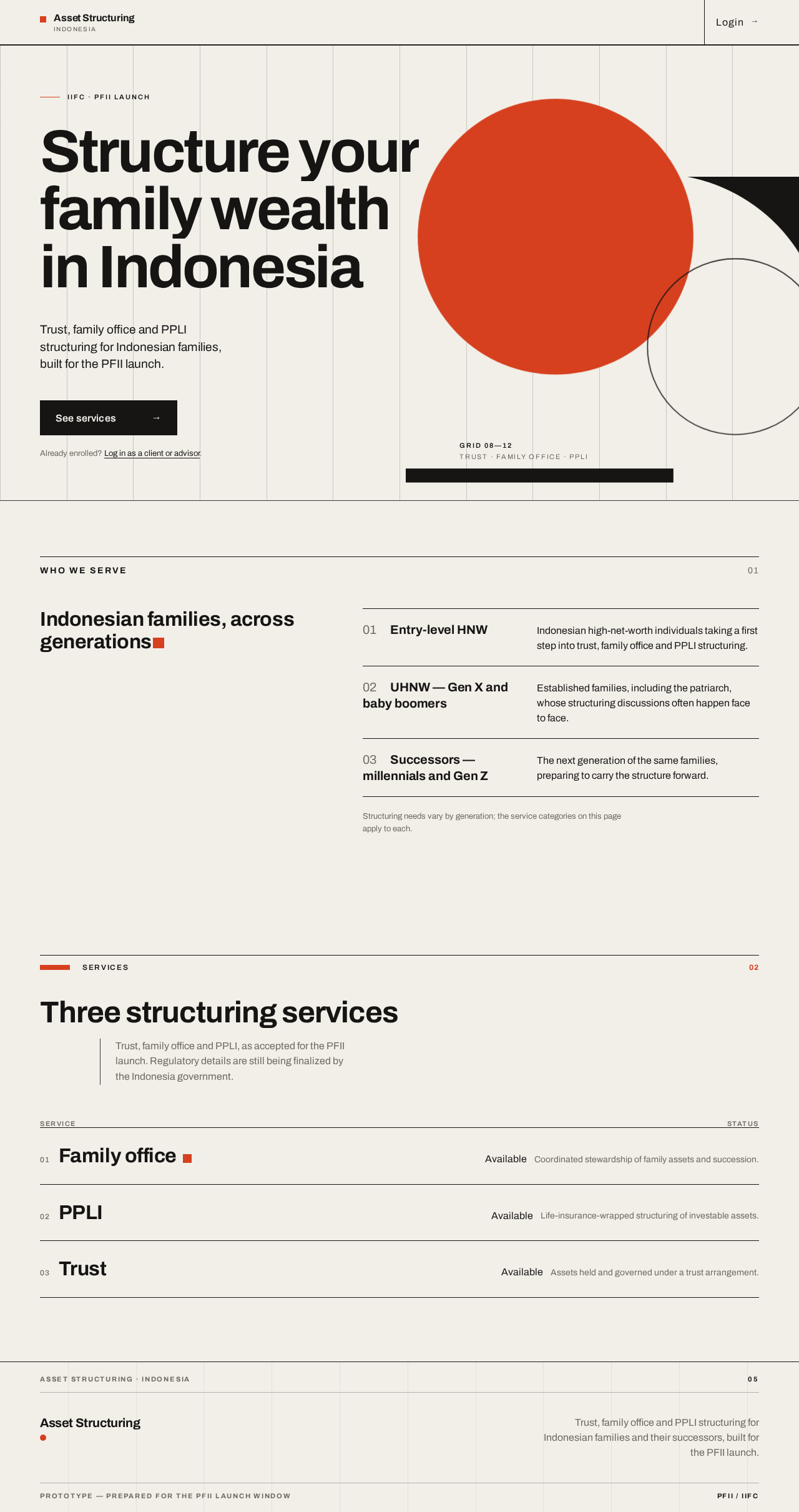
IIFC · PFII launch
Structure yourfamily wealthin Indonesia
Trust, family office and PPLI structuring for Indonesian families, built for the PFII launch.
See servicesAlready enrolled? Log in as a client or advisor.
Who we serve
Indonesian families, across generations
- Entry-level HNW
- Indonesian high-net-worth individuals taking a first step into trust, family office and PPLI structuring.
- UHNW — Gen X and baby boomers
- Established families, including the patriarch, whose structuring discussions often happen face to face.
- Successors — millennials and Gen Z
- The next generation of the same families, preparing to carry the structure forward.
Structuring needs vary by generation; the service categories on this page apply to each.
Three structuring services
Trust, family office and PPLI, as accepted for the PFII launch. Regulatory details are still being finalized by the Indonesia government.
- Family officeAvailableCoordinated stewardship of family assets and succession.
- PPLIAvailableLife-insurance-wrapped structuring of investable assets.
- TrustAvailableAssets held and governed under a trust arrangement.
No comments yet. Be the first!