arv1production
 info 369
Build a production-oriented SaaS MVP called RetEdge. RetEdge is a Recovery Operating Layer for Indian B2B distributors. IMPORTANT: Do not build a generic AR dashboard. Do not build an accounting system. Do not build a generic CRM. Do not build a generic WhatsApp reminder application. The core product is a daily recovery decision and execution workflow. ================================================== CORE PRODUCT PROMISE ================================================== "RetEdge tells a distributor which customers their collection team should act on today, why, and what to do next — then tracks what happened and reprioritizes the account." ================================================== TARGET CUSTOMER ================================================== Indian B2B distributors. Initial vertical: Electrical and electrical-industrial-supplies distributors. Typical company: ₹10–50Cr revenue 100–300 active credit buyers Tally/BUSY/Excel/manual collection workflows Economic buyers: Owner Managing Director CFO Finance Head Finance Manager Daily users: Accountant Collections Executive Collections Manager ================================================== CORE WORKFLOW ================================================== Receivables ↓ Recovery Audit ↓ Recovery Intelligence ↓ Priority ↓ Today's Recovery Actions ↓ Action Execution ↓ Customer Response ↓ Payment Commitment ↓ Payment / Outcome ↓ Broken Promise Detection ↓ Escalation ↓ Re-prioritization ↓ New Today's Recovery Actions This workflow is the heart of the product. ================================================== MVP INPUT ================================================== The first version accepts CSV/XLSX receivables data. Do NOT build Tally/BUSY integrations in the first implementation. Supported fields: Customer Name Invoice Number Invoice Date Due Date Invoice Amount Amount Paid Outstanding Balance Days Overdue Optional: Promise Date Promise Amount Notes Collector Salesperson Customer Phone Customer Email ================================================== RECOVERY AUDIT ================================================== After upload, calculate: Total Outstanding Total Overdue Overdue % Ageing buckets Top overdue customers Largest exposures Oldest overdue accounts Broken promises if available Data quality problems Customer concentration Priority recovery exposure Show the audit before showing the recovery queue. ================================================== RECOVERY INTELLIGENCE ================================================== Create a deterministic and explainable scoring engine. Every score MUST have: Priority Score Priority Level Reason Codes Evidence Recommended Action The system must never invent financial facts. AI may explain or summarize. Financial calculations must be deterministic. Example: ABC Electrical Outstanding: ₹8,40,000 Days overdue: 62 Broken promises: 2 Latest promise: ₹3,00,000 Friday Payment received: ₹0 Output: Priority: CRITICAL Why today: High outstanding exposure + 62 days overdue + Repeated broken promises + Latest promise failed Recommended action: Owner escalation + Call + WhatsApp follow-up ================================================== TODAY'S RECOVERY QUEUE ================================================== The primary home screen must be: TODAY'S RECOVERY ACTIONS Each item shows: Customer Outstanding Days overdue Priority Why today Evidence Recommended action Last interaction PTP status Next action Example: 🔴 ABC Electrical ₹8.4L overdue 62 days 2 broken promises WHY TODAY: High exposure + repeated broken PTP ACTION: Owner escalation + call ================================================== RECOVERY ACTIONS ================================================== Users can: Call Open WhatsApp Create follow-up Record customer response Create payment promise Record partial payment Record full payment Record dispute Record no response Escalate Snooze with reason Every action creates a recovery event. ================================================== PAYMENT PROMISE STATE MACHINE ================================================== States: NO_PTP PTP_CREATED PTP_DUE PAYMENT_PARTIAL PAYMENT_COMPLETED PTP_BROKEN ESCALATED NEW_PTP Only valid transitions are allowed. Example: PTP_CREATED ↓ PTP_DUE ↓ NO_PAYMENT ↓ PTP_BROKEN ↓ ESCALATION When a promise becomes broken: Increase priority Create BROKEN_PTP event Generate next recommended action Return account to Today's Recovery Actions ================================================== RE-PRIORITIZATION ================================================== The queue must change when new information is recorded. Examples: Payment received → lower outstanding → lower priority New PTP created → update recovery state PTP broken → increase priority Customer dispute recorded → change recommended action No response → increase follow-up priority according to rules ================================================== USER ROLES ================================================== Owner/CFO Finance Manager Collections Manager Accountant/Collections Executive Each role should see an appropriate view. ================================================== OWNER/CFO VIEW ================================================== Show: Total overdue Priority recovery amount Payments received Broken promises PTPs due today High-risk accounts Accounts requiring escalation Cash currently trapped Do NOT create dozens of charts. ================================================== DATABASE ================================================== Use PostgreSQL. Core entities: organizations users roles customers invoices receivables payments payment_promises recovery_cases recovery_actions recovery_events escalations audit_logs The application must be multi-tenant. Tenant data must never be visible across organizations. ================================================== SECURITY ================================================== Implement: Authentication Authorization Tenant isolation Row-level security where supported Audit logging Secure file uploads Server-side validation Secret management Never expose API secrets in frontend code. ================================================== UI ================================================== Mobile responsive. Simple Indian B2B business software. Do not make it look like a consumer AI application. Primary navigation: Overview Recovery Audit Today's Actions Customers Receivables Recovery History Reports Settings Today's Actions should be the primary screen. ================================================== MVP EXCLUSIONS ================================================== Do NOT build: Tally connector BUSY connector QuickBooks connector Marg connector Xero connector AI voice calling Mass WhatsApp campaign engine SMS automation Email automation Mobile native application Complex predictive ML Generic chatbot Accounting functionality ERP replacement These are future phases. ================================================== TECHNICAL REQUIREMENTS ================================================== Use a maintainable full-stack architecture. Prefer: TypeScript React/Next.js PostgreSQL Tailwind/shadcn or equivalent component system Use automated tests. Use realistic seed data representing an Indian electrical distributor. ================================================== CRITICAL DEVELOPMENT RULE ================================================== Do not generate the entire application blindly from this prompt. First create: 1. Requirements 2. User flows 3. Database architecture 4. Recovery engine specification 5. Action policy specification 6. Technical architecture 7. Implementation plan STOP. Ask for human approval before implementation. After approval: Build in vertical slices. Each completed feature must have: Unit tests Integration tests where appropriate UI tests for critical workflows Error states Empty states Loading states Security checks The final MVP must be deployable and usable with a real CSV/XLSX file. The most important test is: Can a distributor upload real receivables and immediately see a trustworthy list of customers that the collection team should act on today? If not, the MVP is not complete.


Comments (0)
Sign in to leave a comment
System Requirements
System Requirements Document for arv1production
1. Introduction
RetEdge is a production-oriented SaaS MVP designed as a Recovery Operating Layer for Indian B2B distributors, specifically targeting the electrical and electrical-industrial-supplies sectors. The primary goal is to facilitate daily recovery decision-making and execution workflows, helping distributors identify which customers to act on, understand the reasons, and track outcomes for effective reprioritization.
2. System Overview
RetEdge is a multi-tenant SaaS application that provides a structured workflow for managing receivables recovery. It is designed for Indian B2B distributors with a focus on electrical supplies. The application supports CSV/XLSX data uploads for receivables and provides a comprehensive recovery audit, recovery intelligence, and a prioritized action queue. The system is built with a focus on security, role-based access, and deterministic financial calculations.
2a. Product Interpretation and Delivery Boundary
RetEdge is delivered as a web-based application with a mobile-responsive design, ensuring accessibility for business users. The application requires authentication and authorization to access tenant-specific data, ensuring data isolation and security. The MVP excludes integrations with accounting software like Tally or BUSY and focuses on CSV/XLSX data input. Future phases may expand functionality beyond the current scope.
2b. Source Content Inventory
Not applicable as there is no explicit content source directive.
2c. Page Content and Component Coverage
Landing
- Purpose: Introduce RetEdge, its audience, and core recovery decision workflow.
- Components:
- Introduction to RetEdge and its benefits for Indian B2B distributors.
- Overview of the recovery decision workflow.
- Call-to-action for login or signup.
Login
- Purpose: Provide access to authenticated users.
- Components:
- Username and password fields.
- Login button.
- Forgot password link.
- New user invitation acceptance.
Today's Actions
- Purpose: Display the primary recovery action queue.
- Components:
- List of customers with recovery actions.
- Details: Customer name, outstanding amount, days overdue, priority, evidence, recommended action, last interaction, PTP status, next action.
- Action buttons: Call, WhatsApp, follow-up, record response, create promise, record payment, escalate, snooze.
Overview
- Purpose: Provide role-appropriate recovery oversight.
- Components:
- Total overdue amount.
- Priority recovery amount.
- Payments received.
- Broken promises.
- PTPs due today.
- High-risk accounts.
- Accounts requiring escalation.
- Cash currently trapped.
Recovery Audit
- Purpose: Present a pre-queue audit of uploaded receivables.
- Components:
- Total outstanding and overdue.
- Overdue percentage.
- Ageing buckets.
- Top overdue customers.
- Largest exposures.
- Oldest overdue accounts.
- Broken promises.
- Data quality issues.
- Customer concentration.
- Priority recovery exposure.
Customers
- Purpose: Browse and manage customer recovery accounts.
- Components:
- Customer list with search and filter options.
- Customer details link.
Customer Details
- Purpose: Provide detailed recovery context for a specific customer.
- Components:
- Customer profile.
- Interaction history.
- Promises and account history.
- Exposure details.
Receivables
- Purpose: Manage receivables data intake and records.
- Components:
- CSV/XLSX upload interface.
- Data validation results.
- Receivables list with search and filter options.
Recovery History
- Purpose: Record and review recovery events and actions.
- Components:
- List of recovery events.
- Filters for event type and date range.
- Detailed event view.
Reports
- Purpose: Generate recovery reports for operational and executive use.
- Components:
- Report generation options.
- Downloadable report formats.
Settings
- Purpose: Manage application and tenant settings.
- Components:
- User management.
- Role assignments.
- Application configuration options.
3. Functional Requirements
-
As an Accountant/Collections Executive, I should be able to upload CSV/XLSX receivables data to initiate the recovery process.
Provenance: explicit
Lifecycle: Upload → Validation → Recovery Audit
Acceptance: Successful data validation and audit initiation. -
As a Finance Manager, I should be able to view a comprehensive recovery audit to assess the current state of receivables.
Provenance: explicit
Lifecycle: Audit initiation → Review → Decision-making
Acceptance: Display of audit metrics and insights. -
As a Collections Manager, I should be able to manage Today's Recovery Actions to ensure timely follow-ups and escalations.
Provenance: explicit
Lifecycle: Action queue → Execution → Outcome tracking
Acceptance: Accurate action execution and event logging. -
As an Owner/CFO, I should be able to view an overview of recovery metrics to understand financial exposure and risks.
Provenance: explicit
Lifecycle: Data aggregation → Review → Strategic planning
Acceptance: Display of key metrics without excessive charts. -
As a user, I should be able to authenticate and access role-specific views to perform my responsibilities securely.
Provenance: required_inference
Lifecycle: Authentication → Authorization → Access
Acceptance: Successful login and access to appropriate views.
4. User Personas
- Owner/CFO: Reviews executive recovery metrics, cash trapped, overdue exposure, broken promises, PTPs due, high-risk accounts, and escalations.
- Finance Manager: Manages receivables recovery oversight, audits uploaded data, monitors recovery intelligence, and coordinates recovery outcomes.
- Collections Manager: Supervises Today's Recovery Actions, escalations, collector execution, reprioritization, and recovery history.
- Accountant/Collections Executive: Uploads receivables data and performs customer recovery actions including calls, follow-ups, responses, promises, payments, disputes, no-response records, escalations, and snoozes.
5. Core User Flows
Accountant/Collections Executive
- Upload Receivables Data: Navigate to Receivables → Upload CSV/XLSX → Validate data → Initiate Recovery Audit.
- Execute Recovery Actions: Access Today's Actions → Select customer → Perform action (e.g., call, follow-up) → Record outcome.
Finance Manager
- Review Recovery Audit: Navigate to Recovery Audit → Review metrics and insights → Make informed decisions.
- Monitor Recovery Intelligence: Access Overview → Analyze recovery metrics → Coordinate with collections team.
Collections Manager
- Manage Today's Actions: Access Today's Actions → Prioritize tasks → Supervise execution and outcomes.
- Handle Escalations: Identify escalated cases → Coordinate with team → Ensure timely resolution.
Owner/CFO
- View Recovery Metrics: Access Overview → Review financial exposure and risks → Plan strategic actions.
- Monitor High-Risk Accounts: Identify high-risk accounts → Ensure appropriate follow-up and escalation.
6. Visuals Colors and Theme
- Muse: Dieter Rams
- Palette:
- Background: #F5F5F5
- Surface: #FFFFFF
- Text: #333333
- Primary: #FF8000
- Accent: #006400
- Muted: #A9A9A9
- Typography:
- Headings: IBM Plex Sans, Medium, Uppercase
- Body: Source Sans Pro
- Scale: 1.250 modular (48/32/24/18/14)
- Shape Language: Rounded-rectangle controls, aligned label/value pairs
- Layout: Modular grid, clear sections
- Motion: Instant, mechanical feedback
- Imagery: Diagrammatic line art, product silhouettes
7. Signature Design Concept
The public entry page will feature a full-width grid layout with a focus on "Today's Recovery Actions." The primary orange accent will highlight critical tasks, and the background will be a warm grey to maintain content focus. The headline will span the width of the hero section with an orange underline, and a split-screen will show Recovery Audit results on the left and actionable tasks on the right. Rounded rectangle buttons will provide crisp, mechanical feedback for task execution.
8. Interaction Model & Motion Direction
- Interaction Model: Static
- Motion Tempo: Restrained
- Hero Dimensionality: Flat
- Landing Hero Motion Brief: The hero section will feature a composed layout with a focus on "Today's Recovery Actions," using the primary orange accent to draw attention to critical tasks. The layout will be static with instant feedback for interactions, ensuring clarity and efficiency.
9. Non-Functional Requirements
- Security: Implement authentication, authorization, tenant isolation, row-level security, audit logging, secure file uploads, server-side validation, and secret management.
- Performance: Ensure fast load times and responsive interactions.
- Scalability: Support multi-tenant architecture with isolated data.
- Maintainability: Use a maintainable full-stack architecture with automated tests.
10. Tech Stack
- Frontend: TypeScript, React/Next.js, Tailwind/shadcn or equivalent
- Backend: PostgreSQL
- Testing: Automated tests for unit, integration, and UI
- Deployment: Docker/docker-compose, Kubernetes if required
11. Assumptions and Constraints
- The MVP will not include integrations with Tally, BUSY, or other ERP/accounting systems.
- The system will not invent financial facts; all calculations must be deterministic.
- The application will not include AI voice calling, mass WhatsApp campaigns, or other excluded features.
12. Glossary
- PTP: Promise to Pay
- MVP: Minimum Viable Product
- B2B: Business to Business
- CSV/XLSX: File formats for data upload
- Recovery Audit: A process to assess the state of receivables and prioritize recovery actions.
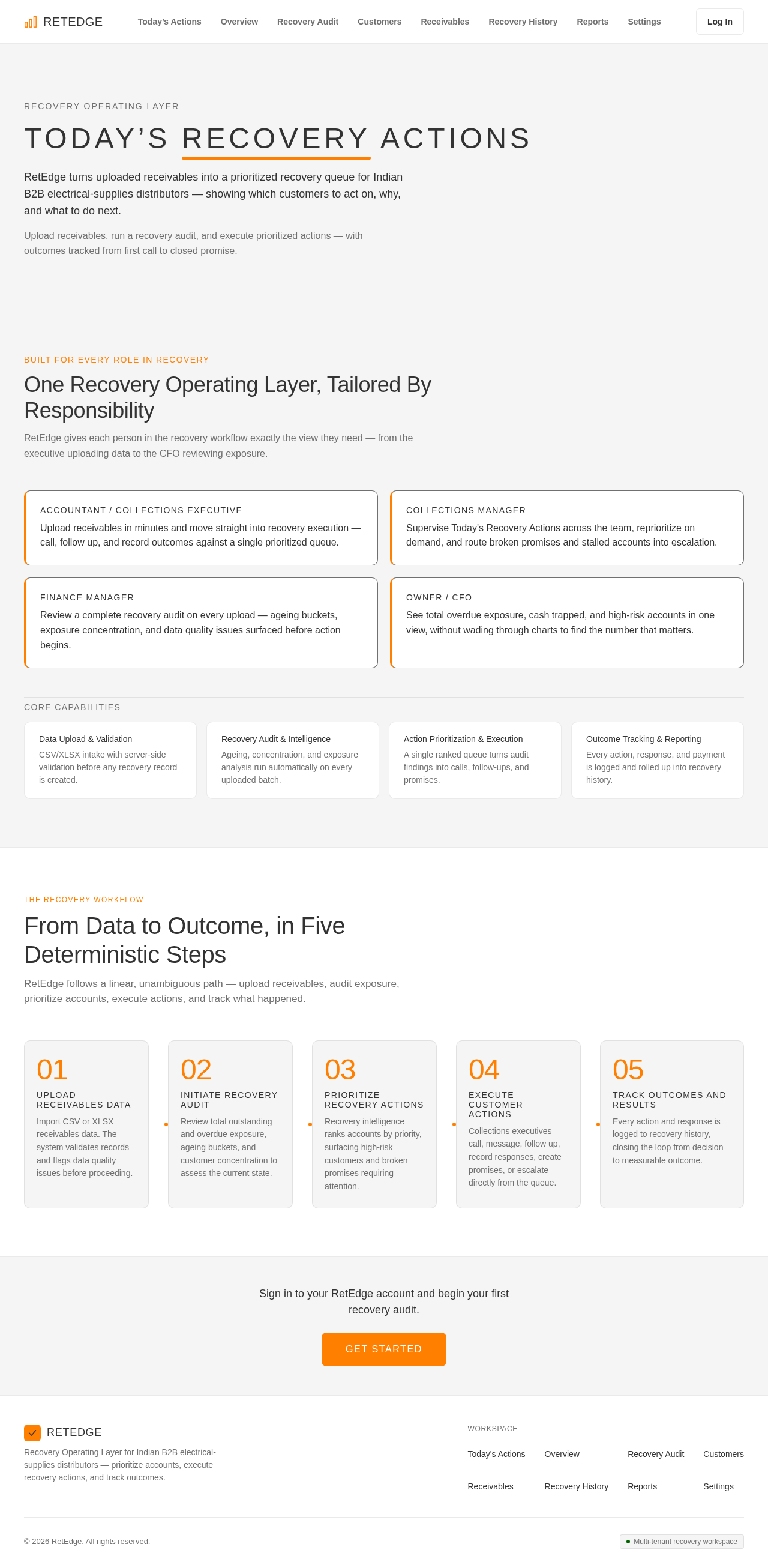
Recovery Operating Layer
Today’s Recovery Actions
RetEdge turns uploaded receivables into a prioritized recovery queue for Indian B2B electrical-supplies distributors — showing which customers to act on, why, and what to do next.
Upload receivables, run a recovery audit, and execute prioritized actions — with outcomes tracked from first call to closed promise.
Built For Every Role In Recovery
One Recovery Operating Layer, Tailored By Responsibility
RetEdge gives each person in the recovery workflow exactly the view they need — from the executive uploading data to the CFO reviewing exposure.
Accountant / Collections Executive
Upload receivables in minutes and move straight into recovery execution — call, follow up, and record outcomes against a single prioritized queue.
Collections Manager
Supervise Today's Recovery Actions across the team, reprioritize on demand, and route broken promises and stalled accounts into escalation.
Finance Manager
Review a complete recovery audit on every upload — ageing buckets, exposure concentration, and data quality issues surfaced before action begins.
Owner / CFO
See total overdue exposure, cash trapped, and high-risk accounts in one view, without wading through charts to find the number that matters.
Core Capabilities
Data Upload & Validation
CSV/XLSX intake with server-side validation before any recovery record is created.
Recovery Audit & Intelligence
Ageing, concentration, and exposure analysis run automatically on every uploaded batch.
Action Prioritization & Execution
A single ranked queue turns audit findings into calls, follow-ups, and promises.
Outcome Tracking & Reporting
Every action, response, and payment is logged and rolled up into recovery history.
The Recovery Workflow
From Data to Outcome, in Five Deterministic Steps
RetEdge follows a linear, unambiguous path — upload receivables, audit exposure, prioritize accounts, execute actions, and track what happened.
Upload Receivables Data
Import CSV or XLSX receivables data. The system validates records and flags data quality issues before proceeding.
Initiate Recovery Audit
Review total outstanding and overdue exposure, ageing buckets, and customer concentration to assess the current state.
Prioritize Recovery Actions
Recovery intelligence ranks accounts by priority, surfacing high-risk customers and broken promises requiring attention.
Execute Customer Actions
Collections executives call, message, follow up, record responses, create promises, or escalate directly from the queue.
Track Outcomes and Results
Every action and response is logged to recovery history, closing the loop from decision to measurable outcome.
Sign in to your RetEdge account and begin your first recovery audit.
Get StartedRecovery Operating Layer
Today’s Recovery Actions
RetEdge turns uploaded receivables into a prioritized recovery queue for Indian B2B electrical-supplies distributors — showing which customers to act on, why, and what to do next.
Upload receivables, run a recovery audit, and execute prioritized actions — with outcomes tracked from first call to closed promise.
Built For Every Role In Recovery
One Recovery Operating Layer, Tailored By Responsibility
RetEdge gives each person in the recovery workflow exactly the view they need — from the executive uploading data to the CFO reviewing exposure.
Accountant / Collections Executive
Upload receivables in minutes and move straight into recovery execution — call, follow up, and record outcomes against a single prioritized queue.
Collections Manager
Supervise Today's Recovery Actions across the team, reprioritize on demand, and route broken promises and stalled accounts into escalation.
Finance Manager
Review a complete recovery audit on every upload — ageing buckets, exposure concentration, and data quality issues surfaced before action begins.
Owner / CFO
See total overdue exposure, cash trapped, and high-risk accounts in one view, without wading through charts to find the number that matters.
Core Capabilities
Data Upload & Validation
CSV/XLSX intake with server-side validation before any recovery record is created.
Recovery Audit & Intelligence
Ageing, concentration, and exposure analysis run automatically on every uploaded batch.
Action Prioritization & Execution
A single ranked queue turns audit findings into calls, follow-ups, and promises.
Outcome Tracking & Reporting
Every action, response, and payment is logged and rolled up into recovery history.
The Recovery Workflow
From Data to Outcome, in Five Deterministic Steps
RetEdge follows a linear, unambiguous path — upload receivables, audit exposure, prioritize accounts, execute actions, and track what happened.
Upload Receivables Data
Import CSV or XLSX receivables data. The system validates records and flags data quality issues before proceeding.
Initiate Recovery Audit
Review total outstanding and overdue exposure, ageing buckets, and customer concentration to assess the current state.
Prioritize Recovery Actions
Recovery intelligence ranks accounts by priority, surfacing high-risk customers and broken promises requiring attention.
Execute Customer Actions
Collections executives call, message, follow up, record responses, create promises, or escalate directly from the queue.
Track Outcomes and Results
Every action and response is logged to recovery history, closing the loop from decision to measurable outcome.
Sign in to your RetEdge account and begin your first recovery audit.
Get Started
No comments yet. Be the first!