
ai appy

byDigital Dreamscape

Build a tool that builds a tool that turns prompts into working websites and apps.

LandingLoginPreview
Landing

Comments (0)

No comments yet. Be the first!

System Requirements

System Requirement Document
Page 1 of 4

ai appy

Introduction

The "ai appy" project aims to develop an innovative tool that automates the creation of websites and applications from user prompts. This tool will leverage advanced AI capabilities to interpret user inputs and generate functional digital products efficiently.

System Overview

The "ai appy" system is designed to transform natural language prompts into fully functional websites and applications. By utilizing pre-resolved API capabilities, the system will streamline the development process, enabling users to create digital products without extensive technical knowledge. The system will be particularly beneficial for users in India, considering locale-specific defaults such as currency and timezone.

Functional Requirements

  • As a User, I should be able to input a natural language prompt to generate a website.
  • As a User, I should be able to input a natural language prompt to generate an application.
  • As a Developer, I should be able to access pre-resolved API capabilities to enhance the tool's functionality.
  • As a User, I should be able to customize the generated website or app based on specific requirements.
  • As a User, I should be able to preview the generated website or app before finalizing.
  • As a User, I should be able to deploy the generated website or app directly from the tool.
Page 2 of 4

User Personas

  • User: Individuals looking to create websites or apps without technical expertise.
  • Developer: Technical users who enhance and maintain the tool's capabilities.

Core User Flows

  • User inputs prompt -> System interprets prompt -> Generates website/app -> User customizes -> User previews -> User deploys.
  • Developer accesses API -> Integrates new capabilities -> Tests enhancements -> Updates tool.

Visuals Colors and Theme

  • primary: #1A73E8 (a vibrant blue for brand identity)
  • primary_light: #E8F0FE (a light blue for hover states)
  • secondary: #FF6F61 (a coral hue for emphasis)
  • accent: #FFD700 (a bright gold for CTAs and active states)
  • highlight: #FFA500 (a warm orange for notifications)
  • bg: #FFFFFF (a clean white background)
  • surface: rgba(240, 240, 240, 0.8) (a light grey for panels)
  • text: #202124 (a dark grey for primary text)
  • text_muted: #5F6368 (a softer grey for secondary text)
  • border: rgba(218, 220, 224, 0.2) (a subtle grey for borders)
Page 3 of 4

Signature Design Concept

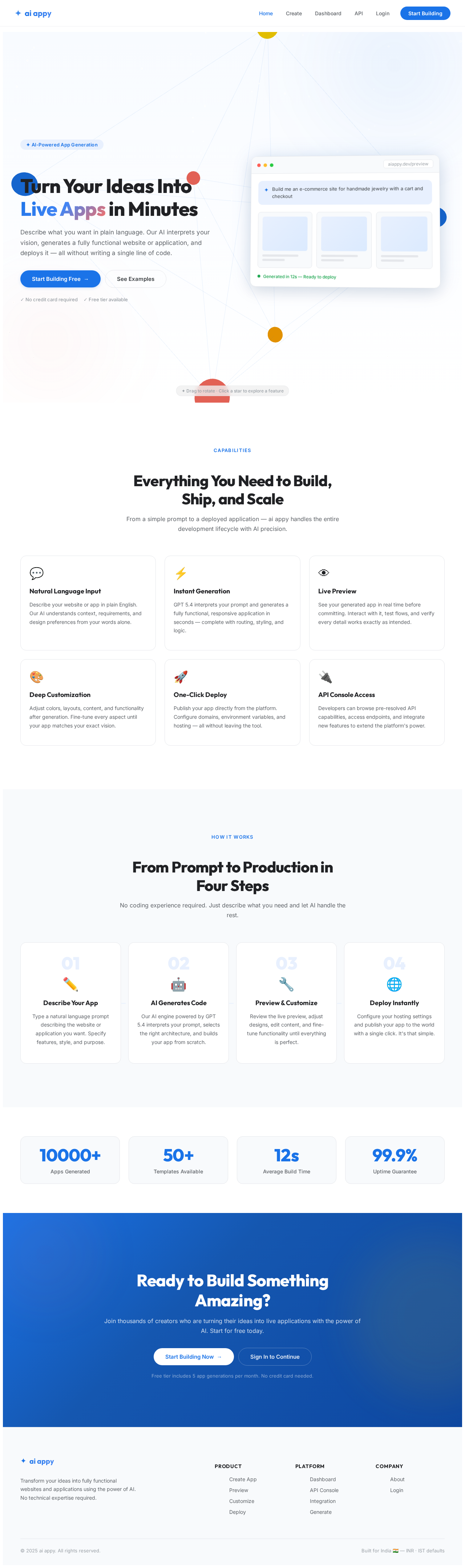
The homepage of "ai appy" will feature an interactive galaxy map, where each star represents a different feature or section of the tool. Users can click on a star to open a detailed view of that feature, drag to rotate the galaxy, and hover to highlight connections between related features. This dynamic and engaging interface will be built using @react-three/fiber and @react-three/drei for 3D interactions, providing an immersive experience that visually represents the tool's capabilities.

Interaction Model & Motion Direction

The landing page will utilize a "parallax" interaction model, creating a layered depth effect as users scroll. Decorative elements will move at varying speeds to enhance the storytelling aspect, while core content remains in the natural flow. This approach will provide a visually rich first impression, ideal for showcasing the innovative nature of "ai appy."

Non-Functional Requirements

  • The system should be highly responsive and perform efficiently across various devices and screen sizes.
  • Ensure data security and privacy for all user inputs and generated outputs.
  • Provide robust error handling and user feedback mechanisms.
Page 4 of 4

Tech Stack

  • Frontend: React for Web
  • Backend: Python, FastAPI
  • Database: MySQL or MariaDB
  • AI Models: GPT 5.4 for user-friendly responses
  • AI Tools: Litellm for LLM Routing
  • Local Orchestration: Docker, docker-compose
  • Server-side Orchestration: Kubernetes

Assumptions and Constraints

  • The tool will primarily target users in India, considering locale-specific defaults.
  • The system will rely on pre-resolved API capabilities to enhance functionality.
  • The tool must be scalable to accommodate a growing user base.

Glossary

  • API: Application Programming Interface
  • CTA: Call to Action
  • LLM: Large Language Model
  • Parallax: A design technique that creates an illusion of depth by moving background images slower than foreground images.
Landing design preview
Landing: View Galaxy Map
Login: Sign In
Dashboard: View API Console
API Console: Browse Capabilities
API Console: Access Endpoint
Integration: Add Capability
Integration: Test Enhancement
Integration: Deploy Update
Dashboard: Monitor Tool
Dashboard: Review Logs
Landing design preview
Landing: View Galaxy Map
Login: Sign In
Dashboard: View API Console
API Console: Browse Capabilities
API Console: Access Endpoint
Integration: Add Capability
Integration: Test Enhancement
Integration: Deploy Update
Dashboard: Monitor Tool
Dashboard: Review Logs