
agent-rental

byMeghna Rajawat

We are an early-stage company building AI agents for short-term rental and hotel businesses. We have a detailed written specification and a working first version of the platform. We need two agents built to that specification, delivered as two milestones. Agent 1: Back-office agent - Checks that each listing's rates and availability reach every booking channel, and reports gaps. - Looks up reservations, stay history and payments for other agents, and carries out approved changes: date changes, payment requests, listing and calendar updates. - Works through the property management system's interface first, with a Chrome browser extension as the fallback. Its chat and approval cards appear inside the extension after login. - Never messages guests. Every binding change waits for a recorded human approval. Keeps its own change log. Agent 2: Website sales and sign-up agent - Chats with website visitors and answers only from an approved knowledge base and the current public offer: no invented claims or prices. - Answers five free messages, then asks the visitor to register. - Guides registration, the start of onboarding and the subscription purchase; handles upgrades, downgrades and cancellations through the billing system. - No access to any client's private data. Runs on its own hosting, separate from client systems.

LandingBillingLookupsOnboardingSign UpApprovalsChannel GapsLoginAgent ChatChange Log
Landing

Comments (0)

No comments yet. Be the first!

System Requirements

System Requirements Document for agent-rental

Page 1 of 27

1. Introduction

agent-rental is the product name for a two-agent AI system built for an early-stage company that serves short-term rental and hotel businesses. The company already holds a detailed written specification and a working first version of the platform; this document specifies the two agents to be built to that specification, delivered as two milestones — one per agent.

Agent 1 — Back-office agent (Milestone 1). An operations agent that verifies each listing's rates and availability reach every booking channel and reports gaps; looks up reservations, stay history, and payments for other agents; and carries out approved changes (date changes, payment requests, listing and calendar updates). It works through the property management system (PMS) interface first, with a Chrome browser extension as the fallback. Its chat and approval cards appear inside the extension after login. It never messages guests, every binding change waits for a recorded human approval, and it keeps its own change log.

Agent 2 — Website sales and sign-up agent (Milestone 2). A public-facing sales agent that chats with website visitors and answers only from an approved knowledge base and the current public offer — no invented claims or prices. It answers five free messages, then asks the visitor to register, and guides registration, the start of onboarding, and the subscription purchase. It handles upgrades, downgrades, and cancellations through the billing system. It has no access to any client's private data and runs on its own hosting, separate from client systems.

Audience. The product serves the operating company's own staff who supervise and approve back-office work (the human approver), prospective customers browsing the public website (the website visitor), and paying customers managing their plan (the subscribed customer). The agents act on behalf of the company, not on behalf of guests.

Page 2 of 27

Success Criteria

  • Both agents are delivered as two distinct milestones, each independently usable at the end of its milestone.
  • Agent 1 produces a channel-gap report per listing, returns reservation/stay-history/payment lookups, and applies no binding change without a recorded human approval, with every applied change present in its own change log.
  • Agent 1 never sends a guest message.
  • Agent 2 answers strictly from the approved knowledge base and current public offer, gives exactly five free messages before requesting registration, and completes registration, onboarding start, subscription purchase, and billing changes through the billing system.
  • Agent 2 holds no client private data and runs on hosting separate from client systems.
Page 3 of 27

2. System Overview

agent-rental is delivered as a React web application backed by a shared FastAPI backend, with MariaDB for application-owned persistent data, Redis for shared state and coordination, and a LiteLLM gateway (backed by its own PostgreSQL) for model-provider calls. The two agents are two milestones of the same product: Agent 2 owns the public, anonymous-to-registered sales journey; Agent 1 owns the authenticated back-office operations journey surfaced through the Chrome extension.

Actors.

  • Human approver — an authenticated staff member who reviews Agent 1's proposed binding changes and records approval, and who reads channel-gap reports, lookups, and the change log.
  • Website visitor — an anonymous visitor who chats with Agent 2 on the public site and receives five free messages before being asked to register.
  • Subscribed customer — a registered customer who starts onboarding, purchases a subscription, and later upgrades, downgrades, or cancels through the billing system.
Page 4 of 27

Accepted behavior and ownership.

  • Agent 2's public chat, the five-free-message gate, registration, onboarding start, subscription purchase, and billing changes are first-party application surfaces (Landing, Sign Up, Onboarding, Billing).
  • Agent 1's chat and approval cards live inside the Chrome extension after login; the application provides the authenticated Login surface and the back-office surfaces for Channel Gaps, Lookups, Approvals, Agent Chat, and Change Log.
  • Agent 1's PMS-first execution and Chrome-extension fallback are agent runtime behavior; the human-facing control points (approval, review) are first-party.
  • Model reasoning for both agents is routed through the LiteLLM gateway; Redis holds shared conversation/session and coordination state.

Narrow exclusions. Agent 1 does not message guests. Agent 2 does not access any client's private data and does not run on client systems. No adjacent account-management, marketing, or guest-communication capabilities are in scope.

Removed from scope

  • Guest messaging by Agent 1 (also: guest communication, guest outreach).
  • Client private data access by Agent 2 (also: client data access, private client records).
  • Agent 2 running on client systems (also: client-hosted deployment, in-tenant hosting).
Page 5 of 27

2a. Product Interpretation and Delivery Boundary

The product is delivered in two milestones. Milestone 1 delivers the back-office agent and its authenticated surfaces; Milestone 2 delivers the website sales and sign-up agent and its public and billing surfaces. Both milestones share the same application, backend, database, Redis, and LiteLLM gateway, but Agent 2's runtime is hosted separately from client systems per the hard constraint.

Access is split by lifecycle. The public entry (Landing) and the registration entry (Sign Up) are anonymously reachable; the visitor chats with Agent 2 without an account for five free messages, and registration establishes the application-owned identity that carries onboarding and billing. The back-office surfaces (Channel Gaps, Lookups, Approvals, Agent Chat, Change Log) are reachable only after login, because Agent 1's chat and approval cards appear inside the extension after login and every binding change requires a recorded human approval bound to the correct approver. Login is anonymously reachable as the entry to that protected lifecycle.

Agent 1's PMS-first execution and Chrome-extension fallback are runtime behaviors of the agent, not separate product destinations; the human interacts with the results through the authenticated back-office surfaces. Agent 2's answers are constrained to the approved knowledge base and current public offer; billing changes are executed through the billing system.

2c. Page Content and Component Coverage

Page 6 of 27

Landing

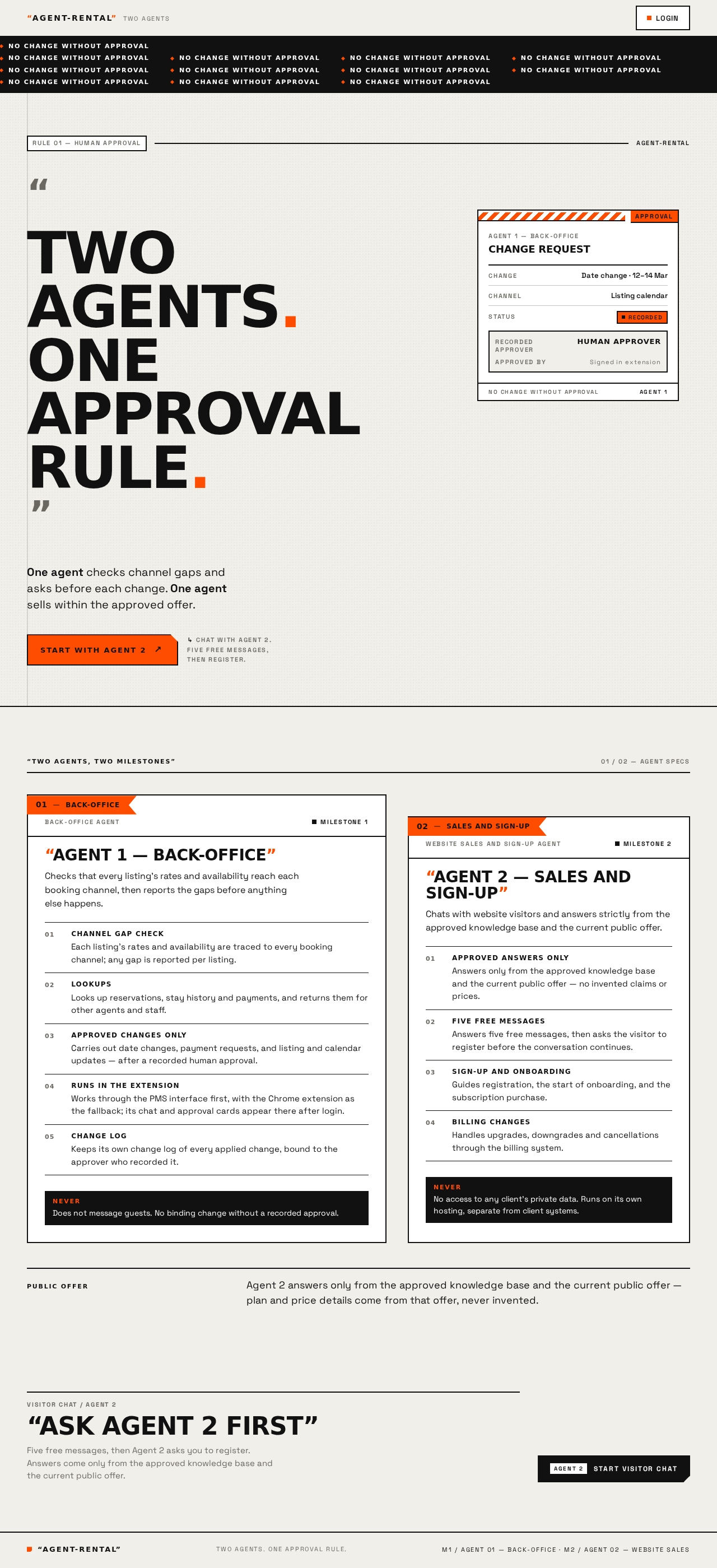
  • Information/state: Public entry. Oversized quoted headline "Two agents. One approval rule."; subline "One agent checks channel gaps and asks before each change. One agent sells within the approved offer."; CTA "Start with Agent 2". A thin ink ticker tape repeating "No change without approval". Two agent sections, each with an orange notched tag stamp. A white approval card overlapping the headline's lower right corner showing a hazard-stripe header and a recorded approver line.
  • Primary actions: Start Agent 2 chat (CTA); open the visitor chat panel.
  • Supporting actions: Read the two agent descriptions; follow the ticker rule.
  • Domain entities: Agent (Agent 1, Agent 2), approval rule, public offer summary.
  • Component responsibilities: Hero (headline, subline, CTA, overlapping approval card), ticker tape, agent tag stamps, agent sections, chat launcher.
  • States: Loading (chat panel initializing); empty (no prior conversation); success (Agent 2 greeting and first answer); error (chat unavailable — show retry); recovery (retry re-establishes chat).
Page 7 of 27

Sign Up

  • Information/state: Registration form reached after five free messages. Shows the visitor's remaining-message context and the registration fields required to create the application-owned identity.
  • Primary actions: Submit registration.
  • Supporting actions: Return to chat; correct invalid input.
  • Domain entities: Visitor account, registration record.
  • Component responsibilities: Registration form, validation messaging, context banner explaining why registration is requested.
  • States: Loading (submitting); empty (blank form); success (account created, handoff to Onboarding); error (validation or submission failure with inline recovery); recovery (resubmit).

Login

  • Information/state: Anonymous entry to the protected back-office lifecycle. Credential fields for the human approver.
  • Primary actions: Log in.
  • Supporting actions: Recover from invalid credentials.
  • Domain entities: Approver identity, session.
  • Component responsibilities: Login form, error messaging, post-login redirect to the extension back-office surfaces.
  • States: Loading; empty; success (session established, Agent Chat and approval cards become available); error (invalid credentials); recovery (retry).
Page 8 of 27

Onboarding

  • Information/state: Registered customer's onboarding start, guided by Agent 2. Shows onboarding steps and the path to subscription purchase.
  • Primary actions: Begin onboarding; proceed to subscription purchase.
  • Supporting actions: Ask Agent 2 for guidance; review plan/offer details from the approved public offer.
  • Domain entities: Onboarding record, plan/offer, subscription intent.
  • Component responsibilities: Onboarding step list, Agent 2 guidance panel, purchase entry point.
  • States: Loading; empty (not yet started); success (onboarding started, purchase available); error (guidance unavailable — retry); recovery.

Billing

  • Information/state: Subscribed customer's current plan and billing actions: upgrade, downgrade, cancel. All changes execute through the billing system.
  • Primary actions: Upgrade; downgrade; cancel.
  • Supporting actions: Review current plan; confirm a change.
  • Domain entities: Subscription, plan, billing transaction.
  • Component responsibilities: Plan summary, change controls, confirmation, billing-system result display.
  • States: Loading; empty (no active subscription); success (change confirmed by billing system); error (billing system rejection — show reason and retry); recovery.
Page 9 of 27

Channel Gaps

  • Information/state: Per-listing report of whether rates and availability reached every booking channel, with gaps highlighted. Gap table uses exposed grid lines and caps labels with 0.16em tracking.
  • Primary actions: Review gaps per listing.
  • Supporting actions: Filter/scan by listing or channel; open a related approval where a gap requires a change.
  • Domain entities: Listing, rate, availability, booking channel, gap.
  • Component responsibilities: Gap table, listing selector, gap status labels.
  • States: Loading (check running); empty (no gaps); success (gaps listed); error (check failed — retry); recovery.

Lookups

  • Information/state: Reservation, stay history, and payment lookup results returned by Agent 1 for other agents.
  • Primary actions: Request a lookup.
  • Supporting actions: Review returned reservation, stay history, and payment detail.
  • Domain entities: Reservation, stay history, payment.
  • Component responsibilities: Lookup query input, result panels for reservations/stay history/payments.
  • States: Loading; empty (no matching records); success (results shown); error (lookup failed — retry); recovery.
Page 10 of 27

Approvals

  • Information/state: Queue of Agent 1's proposed binding changes (date changes, payment requests, listing and calendar updates), each with a hazard-stripe header and a recorded approver line. Approval cards flip once when status changes.
  • Primary actions: Record approval for a proposed change.
  • Supporting actions: Review change detail; decline a proposal.
  • Domain entities: Proposed change, approval record, approver.
  • Component responsibilities: Approval card, hazard-stripe header, approver line, approve/decline controls.
  • States: Loading; empty (no pending approvals); success (approval recorded, change proceeds); error (approval not recorded — retry); recovery.

Agent Chat

  • Information/state: Agent 1 chat inside the Chrome extension after login, with approval cards appearing inline.
  • Primary actions: Send a message to Agent 1; act on an inline approval card.
  • Supporting actions: Review prior messages; open the full Approvals queue.
  • Domain entities: Chat message, approval card, session.
  • Component responsibilities: Chat transcript, message input, inline approval cards, login-gated availability.
  • States: Loading; empty (new session); success (Agent 1 response); error (Agent 1 unavailable — retry); recovery.
Page 11 of 27

Change Log

  • Information/state: Agent 1's own log of applied changes, each with the recorded approval that authorized it.
  • Primary actions: Review the change log.
  • Supporting actions: Inspect an individual change and its approval record.
  • Domain entities: Change log entry, approval record, change type.
  • Component responsibilities: Chronological log, entry detail, approval linkage.
  • States: Loading; empty (no changes yet); success (entries listed); error (log unavailable — retry); recovery.
Page 12 of 27

3. Functional Requirements

FR-1 — Two-milestone delivery. As the operating company, I should receive the two agents as two milestones (Agent 1, then Agent 2) so each is independently usable at milestone end. Provenance: explicit. Lifecycle: milestone 1 delivers Agent 1 and its authenticated surfaces; milestone 2 delivers Agent 2 and its public/billing surfaces. Acceptance: each milestone's agent performs its stated capabilities on completion.

FR-2 — Channel rate/availability check. As a human approver, I should have Agent 1 check that each listing's rates and availability reach every booking channel and report gaps, so I can see where distribution failed. Provenance: explicit. Trigger: check run. Result: per-listing gap report on Channel Gaps. Failure: check failure surfaces a retry. Continuation: gaps can lead to a proposed change.

FR-3 — Reservation, stay history, and payment lookups. As a human approver, I should have Agent 1 look up reservations, stay history, and payments for other agents, so those agents get accurate records. Provenance: explicit. Trigger: lookup request. Result: reservation/stay-history/payment results on Lookups. Failure: lookup failure with retry.

FR-4 — Approved changes. As a human approver, I should have Agent 1 carry out approved changes — date changes, payment requests, and listing and calendar updates — so operations stay correct. Provenance: explicit. Trigger: approved proposal. Result: change applied and recorded. Constraint: every binding change waits for a recorded human approval (FR-7).

Page 13 of 27

FR-5 — PMS-first, extension fallback. As the operating company, I should have Agent 1 work through the PMS interface first, with the Chrome browser extension as the fallback, so it uses the primary system of record and degrades safely. Provenance: explicit. Result: execution path is PMS first; extension used only as fallback.

FR-6 — Chat and approval cards in the extension after login. As a human approver, I should see Agent 1's chat and approval cards inside the Chrome extension after login, so control happens where I work. Provenance: explicit. Access: authenticated (Login). Result: Agent Chat and Approvals available post-login.

FR-7 — Recorded human approval before binding change. As a human approver, I should record approval for each binding change before Agent 1 applies it, so no change is unapproved. Provenance: explicit (constraint) / required_inference (recording mechanics). Trigger: proposed change. Result: approval record bound to the approver; change proceeds only after. Failure: approval not recorded — change does not proceed; retry.

FR-8 — No guest messaging. As the operating company, I should have Agent 1 never message guests, so guest communication stays outside the agent. Provenance: explicit. Constraint: binding.

FR-9 — Agent 1 change log. As a human approver, I should have Agent 1 keep its own change log, so every applied change is auditable. Provenance: explicit. Result: Change Log entries with approval linkage.

FR-10 — Knowledge-base-only answers. As a website visitor, I should get answers only from the approved knowledge base and current public offer, with no invented claims or prices. Provenance: explicit. Result: answers grounded in approved sources; out-of-scope questions are declined.

Page 14 of 27

FR-11 — Five free messages then registration. As a website visitor, I should receive five free messages before Agent 2 asks me to register. Provenance: explicit / required_inference (counting). Result: after the fifth free message, Agent 2 requests registration; Sign Up is offered.

FR-12 — Guided registration, onboarding start, subscription purchase. As a website visitor, I should be guided by Agent 2 through registration, the start of onboarding, and subscription purchase. Provenance: explicit. Result: account created, onboarding started, subscription purchased.

FR-13 — Billing changes. As a subscribed customer, I should upgrade, downgrade, or cancel through the billing system, guided by Agent 2. Provenance: explicit. Result: billing system executes the change; Billing reflects the result.

FR-14 — No client private data. As the operating company, I should ensure Agent 2 has no access to any client's private data. Provenance: explicit. Constraint: binding.

FR-15 — Separate hosting. As the operating company, I should have Agent 2 run on its own hosting, separate from client systems. Provenance: explicit. Constraint: binding.

FR-16 — Login before back-office access. As a human approver, I should log in before Agent 1 chat and approval cards appear. Provenance: required_inference. Result: protected surfaces unavailable until session established.

4. User Personas

Page 15 of 27

Human approver

An authenticated staff member of the operating company who supervises Agent 1. Context: works inside the Chrome extension where Agent 1's chat and approval cards appear after login. Primary goal: keep operations correct while retaining control of every binding change. Distinct responsibilities: reviews channel-gap reports per listing; requests and reads reservation/stay-history/payment lookups for other agents; reviews proposed date changes, payment requests, and listing/calendar updates; records approval (or declines) before any binding change; audits the change log. Inputs/decisions: approve or decline each proposal; interpret gaps. Interactions: with Agent 1 (chat, proposals) and with other agents consuming lookups. Observable success: every applied change has a recorded approval and appears in the change log; gaps are visible. Constraints: cannot act before login; Agent 1 never messages guests on their behalf.

Website visitor

An anonymous visitor on the public site. Context: arrives at Landing, chats with Agent 2. Primary goal: get trustworthy answers about the offer without invented claims or prices. Distinct responsibilities: asks questions; receives up to five free messages; is asked to register at the limit; registers to continue. Inputs/decisions: what to ask; whether to register. Interactions: with Agent 2 and the Sign Up surface. Observable success: answers grounded in the approved knowledge base and current public offer; a clear registration prompt after five free messages.

Page 16 of 27

Subscribed customer

A registered customer who has purchased a subscription. Context: has completed registration and onboarding start and holds an active plan. Primary goal: manage the plan — upgrade, downgrade, or cancel — through the billing system with Agent 2's guidance. Distinct responsibilities: starts onboarding, purchases subscription, requests billing changes, confirms them. Inputs/decisions: which plan change to make. Interactions: with Agent 2 and the Billing surface. Observable success: billing system confirms the change and Billing reflects the new plan. Constraints: Agent 2 never accesses client private data.

Page 17 of 27

5. Core User Flows

Flow A — Visitor chats with Agent 2 and registers (Website visitor).

  1. Visitor opens Landing (anonymous) and sees the headline, subline, and CTA "Start with Agent 2".
  2. Visitor starts the chat; Agent 2 greets and answers only from the approved knowledge base and current public offer.
  3. Visitor asks questions; each answer is grounded; out-of-scope questions are declined rather than invented.
  4. After the fifth free message, Agent 2 asks the visitor to register and offers Sign Up.
  5. Visitor completes registration on Sign Up; account is created and the visitor proceeds to Onboarding.
  6. Failure/recovery: if chat is unavailable, Landing shows retry; if registration submission fails, Sign Up shows inline recovery and the visitor resubmits.

Flow B — Customer starts onboarding and purchases (Subscribed customer).

  1. Registered customer lands on Onboarding, guided by Agent 2.
  2. Customer begins onboarding; Agent 2 guides the steps and presents the current public offer for purchase.
  3. Customer proceeds to subscription purchase; the purchase completes and the customer becomes a subscribed customer.
  4. Failure/recovery: if guidance is unavailable, Onboarding offers retry; the customer can resume onboarding.
Page 18 of 27

Flow C — Customer changes plan (Subscribed customer).

  1. Subscribed customer opens Billing and reviews the current plan.
  2. Customer selects upgrade, downgrade, or cancel and confirms.
  3. The change executes through the billing system; Billing shows the confirmed result.
  4. Failure/recovery: if the billing system rejects the change, Billing shows the reason and the customer retries.

Flow D — Approver logs in and reviews Agent 1 (Human approver).

  1. Approver opens Login (anonymous entry) and authenticates.
  2. After login, Agent 1's chat and approval cards become available in the Chrome extension (Agent Chat).
  3. Approver reviews Channel Gaps to see where rates/availability failed to reach channels.
  4. Approver requests lookups and reads reservation, stay history, and payment results on Lookups.
  5. Continuation: gaps or lookups that require a change lead to a proposal in Approvals.
Page 19 of 27

Flow E — Approver records approval for a binding change (Human approver).

  1. Agent 1 proposes a binding change (date change, payment request, or listing/calendar update) and presents an approval card in Agent Chat / Approvals.
  2. Approver reviews the change detail (hazard-stripe header, recorded approver line).
  3. Approver records approval; the approval is bound to the approver and the card flips once on status change.
  4. Only after the recorded approval does Agent 1 apply the change, working through the PMS interface first with the Chrome extension as fallback.
  5. The applied change is written to Change Log with its approval linkage.
  6. Failure/recovery: if approval is not recorded, the change does not proceed; the approver can retry. Agent 1 never messages guests at any step.

Flow F — Approver audits the change log (Human approver).

  1. Approver opens Change Log (authenticated).
  2. Approver reviews applied changes and inspects an entry's approval record.
  3. Failure/recovery: if the log is unavailable, retry.
Page 20 of 27

6. Visuals Colors and Theme

Muse: Virgil Abloh — label-and-tape language that makes rules visible; quoted labels and approval tags show each agent's guardrails as the main visual idea. Tone: strict limits and human approval, not hype.

Mode: Light.

Colour tokens (exact hex by role):

  • Background / concrete ground: #F1EFEA
  • Surface (cards): #FFFFFF
  • Text / ink: #111111
  • Primary: #111111
  • Accent (approval and agent tags only, ~8% of page): #FF4D00
  • Muted: #6B6862

Typography:

  • Headings: Archivo — Archivo Expanded caps, weight 800, tight tracking, set in quotation marks as a label.
  • Body: Space Grotesk.
  • Scale: 1.25 modular; display clamp(44px, …, 104px); body 28/20/16/13; caps labels 11px with 0.16em tracking.

Shape language: Hard rectangles, 2px ink borders, tag notches, diagonal hazard stripes in orange.

Layout: Asymmetric split — full-height ink label rail on the left, white spec sheet on the right; section rules run edge to edge.

Imagery: No photos. The interface is the image: approval cards, gap tables, and label stamps on concrete texture.

Page 21 of 27

Avoid: No gradient blobs or soft shadows; no blue accent or blue buttons; no rounded pill buttons or glass panels; no stock photos of hotel rooms or people; no centred headline with subtext and a button. The generic indigo/blue-on-white SaaS template is forbidden.

Readability: Headlines, wordmarks, labels, numbers, and card text/controls stay whole inside the viewport and their container at 375px, 768px, and 1280px, wrapping or scaling (e.g., clamp(...)) to fit; no element covers them.

7. Signature Design Concept

The public entry (Landing) is a full-bleed concrete-grey (#F1EFEA) ground holding an oversized quoted headline in Archivo Expanded caps — "Two agents. One approval rule." — stacked in three lines across the viewport at 104px desktop / 44px mobile. An orange (#FF4D00) notched tag with the CTA "Start with Agent 2" sits under it. A white approval card with a hazard-stripe header and a recorded approver line overlaps the headline's lower right corner. A thin ink ticker tape repeats "No change without approval" across the top. Each agent section carries an orange notched tag stamp pinned to its top. The gap table uses exposed grid lines and caps labels with 0.16em tracking. The concept recomposes only accepted content and controls.

Page 22 of 27

8. Interaction Model & Motion Direction

Interaction Model: Animated Motion Tempo: restrained Hero Dimensionality: flat

Landing Hero Motion Brief. Focal subject: the oversized quoted headline and the overlapping white approval card. Input→transformation→outcome thesis: as the page loads, the ink ticker tape begins moving across the top repeating "No change without approval"; the approval card settles into its overlap position and flips once when its status line resolves to "recorded approver"; the orange CTA tag remains static and fully readable. Motion vocabulary: restrained — ticker tape movement, a single approval-card flip, no gradient or soft-shadow motion. Composed first frame: concrete ground, three-line quoted headline, orange CTA tag beneath, white approval card overlapping the lower right, ticker tape across the top. Reduced-motion state: ticker tape becomes a static wrapped row of the rule text; the approval card appears in its final state without the flip; all text and controls remain whole and readable.

Page 23 of 27

9. Non-Functional Requirements

  • NFR-1 — Guest-messaging prohibition. Agent 1 must never message guests. Provenance: explicit. Rationale: hard source constraint.
  • NFR-2 — Approval gate. No binding change by Agent 1 may be applied without a recorded human approval bound to the approver. Provenance: explicit.
  • NFR-3 — Execution order. Agent 1 must attempt the PMS interface first and use the Chrome extension only as fallback. Provenance: explicit.
  • NFR-4 — Extension-gated chat. Agent 1 chat and approval cards appear inside the Chrome extension only after login. Provenance: explicit.
  • NFR-5 — Grounded answers. Agent 2 must answer only from the approved knowledge base and current public offer; no invented claims or prices. Provenance: explicit.
  • NFR-6 — Free-message limit. Agent 2 must give exactly five free messages before requesting registration. Provenance: explicit.
  • NFR-7 — Data isolation. Agent 2 must have no access to any client's private data. Provenance: explicit.
  • NFR-8 — Hosting separation. Agent 2 must run on its own hosting, separate from client systems. Provenance: explicit.
  • NFR-9 — Auditability. Agent 1 must keep its own change log of applied changes with approval linkage. Provenance: explicit.
  • NFR-10 — Durable state. Conversation, approval, and change-log state must persist durably (MariaDB) with shared coordination state in Redis. Provenance: required_inference / planning scope.
  • NFR-11 — Readability. Readable text and controls remain whole at 375px, 768px, and 1280px. Provenance: creative direction.
Page 24 of 27

10. Tech Stack

  • Frontend: React application UI.
  • Backend: shared FastAPI process for application APIs and domain modules (both agents' feature APIs reuse it).
  • Database: MariaDB for application-owned persistent data (accounts, approvals, change log, onboarding/subscription records).
  • Cache/coordination: Redis for shared caching, state, queue, or coordination (conversation/session state, free-message counting, approval coordination).
  • Model gateway: LiteLLM gateway for the backend's model-provider calls, backed by its own PostgreSQL (separate from application-owned storage).
  • Agent 1 runtime: PMS-interface-first execution with Chrome browser extension fallback; chat and approval cards surfaced in the extension after login.
  • Agent 2 runtime: separately hosted from client systems, per NFR-8.
  • Deployment: docker-compose services — backend, database (MariaDB), frontend, litellm, postgres (LiteLLM), redis.
Page 25 of 27

11. Assumptions and Constraints

  • A-1: The existing working first version of the platform provides the base application, backend, and UI into which both agents are integrated. [Assumption]
  • A-2: The approved knowledge base and current public offer are maintained as authoritative sources Agent 2 reads; their authoring workflow is outside this scope. [Assumption]
  • A-3: The billing system is an external system of record for subscription changes; Agent 2 guides and triggers changes through it. [Assumption]
  • A-4: The PMS is the primary system of record for Agent 1; the Chrome extension is the fallback execution path and the surface for chat and approval cards. [Assumption]
  • A-5: "Other agents" consuming lookups are existing platform agents; their consumption is outside this document's surfaces. [Assumption]
  • C-1: Agent 1 never messages guests. [Constraint]
  • C-2: Every binding change waits for a recorded human approval. [Constraint]
  • C-3: Agent 2 has no access to client private data and runs on separate hosting. [Constraint]
  • C-4: Delivery is two milestones, one per agent. [Constraint]
Page 26 of 27

12. Glossary

  • Agent 1 / Back-office agent: Operations agent that checks channel rates/availability, performs lookups, and applies approved changes.
  • Agent 2 / Website sales and sign-up agent: Public sales agent that answers from approved sources, gates at five free messages, and guides registration, onboarding, purchase, and billing changes.
  • PMS: Property management system; Agent 1's primary interface.
  • Chrome extension: Fallback execution surface and the location of Agent 1's chat and approval cards after login.
  • Binding change: A date change, payment request, or listing/calendar update that requires recorded human approval.
  • Recorded human approval: An approval bound to the human approver and stored before a binding change is applied.
  • Change log: Agent 1's own record of applied changes with approval linkage.
  • Approved knowledge base: The authoritative source Agent 2 may answer from.
  • Current public offer: The live offer/pricing Agent 2 may cite; no invented prices.
  • Five free messages: The pre-registration message allowance for a website visitor.
  • Billing system: External system through which upgrades, downgrades, and cancellations execute.
  • Human approver / Website visitor / Subscribed customer: The three active human personas.
Page 27 of 27
Live
Landing design preview

Landing: Open Login

Login: 1. Log in

Login: 2. Retry invalid credentials

Agent Chat: 1. Send message to Agent 1

Agent Chat: 2. Retry unavailable Agent 1

Channel Gaps: 1. Review gaps per listing

Channel Gaps: 2. Retry failed check

Lookups: 1. Request lookup

Lookups: 2. Retry failed lookup

Approvals: Review proposed change

Approvals: 1. Record approval

Approvals: 2. Retry unrecorded approval

Approvals: Decline proposal

Change Log: 1. Review applied changes

Change Log: Inspect approval record

Change Log: 2. Retry unavailable log