Security Guard
 Imran Waheed
hi

Comments (0)
Sign in to leave a comment
System Requirements
Security Guard System Requirements Document
1. Introduction
The "Security Guard" project is aimed at developing an AI-powered security agent capable of identifying every security error within an entire codebase. This project will be deployed as an open-source tool on GitHub, allowing developers worldwide to utilize its capabilities without language-specific constraints.
2. System Overview and Deployment
The Security Guard project is designed to be a comprehensive security analysis tool that can scan codebases across various programming languages. It will leverage AI to detect vulnerabilities and provide actionable insights to developers. The tool will be accessible as a public open-source repository on GitHub, encouraging community contributions and widespread adoption. The project will be structured as a standalone deployable codebase, allowing users to easily fork and deploy it directly without additional landing pages or complex setup.
3. Functional Requirements
- As a Developer, I should be able to deploy the Security Guard agent to my GitHub repository to scan my codebase for security vulnerabilities.
- As a Developer, I should be able to receive a detailed report of identified security issues in my codebase.
- As a Developer, I should be able to configure the Security Guard to focus on specific areas of my codebase.
- As a Developer, I should be able to view recommendations for fixing identified security vulnerabilities.
- As a Contributor, I should be able to suggest improvements or report issues with the Security Guard tool on GitHub.
4. User Personas
- Developer: A user who integrates the Security Guard into their codebase to identify and fix security vulnerabilities.
- Contributor: A user who contributes to the development and improvement of the Security Guard tool on GitHub.
5. Core User Flows
- Developer integrates Security Guard into their GitHub repository -> Security Guard scans the codebase -> Developer receives a security report -> Developer applies recommended fixes.
- Contributor forks the Security Guard repository -> Suggests improvements or reports issues -> Maintainers review and merge contributions.
7. Signature Design Concept
The Security Guard homepage will feature an interactive "Code Galaxy" visualization. Users can explore a 3D galaxy where each star represents a different programming language. Clicking on a star zooms into a constellation of common security vulnerabilities for that language. Users can drag to rotate the galaxy and hover over stars to see brief descriptions of each vulnerability. This concept will be built using @react-three/fiber and @react-three/drei for 3D rendering, providing an engaging and educational experience.
8. Interaction Model & Motion Direction
The landing page will employ a "parallax" interaction model, creating a sense of depth as users scroll through layers of code snippets and security insights. The internal pages, such as the detailed security report, will use a "static" model to prioritize readability and clarity.
9. Non-Functional Requirements
- The system must support scanning codebases in multiple programming languages.
- The tool should provide results within a reasonable time frame for large codebases.
- The system should be scalable to accommodate a growing number of users and contributors.
10. Tech Stack
- Frontend: React for Web
- Backend: Python, FastAPI
- Database: MongoDB for storing scan results and configurations
- AI Models: GPT 5.4 for generating security insights and recommendations
- AI Tools: Litellm for LLM Routing, Langchain
- Orchestration: Docker, docker-compose for local development; Kubernetes for server-side orchestration
11. Assumptions and Constraints
- The tool will be open-source and hosted on GitHub, relying on community contributions for enhancements.
- The system will not be constrained by any specific programming language, allowing for broad applicability.
- The project will assume users have basic knowledge of GitHub and code integration processes.
12. Glossary
- AI: Artificial Intelligence
- LLM: Large Language Model
- GitHub: A platform for version control and collaboration
- Vulnerability: A weakness in a codebase that can be exploited to cause harm
This document outlines the requirements and design concepts for the Security Guard project, ensuring a robust and user-friendly tool for developers worldwide.
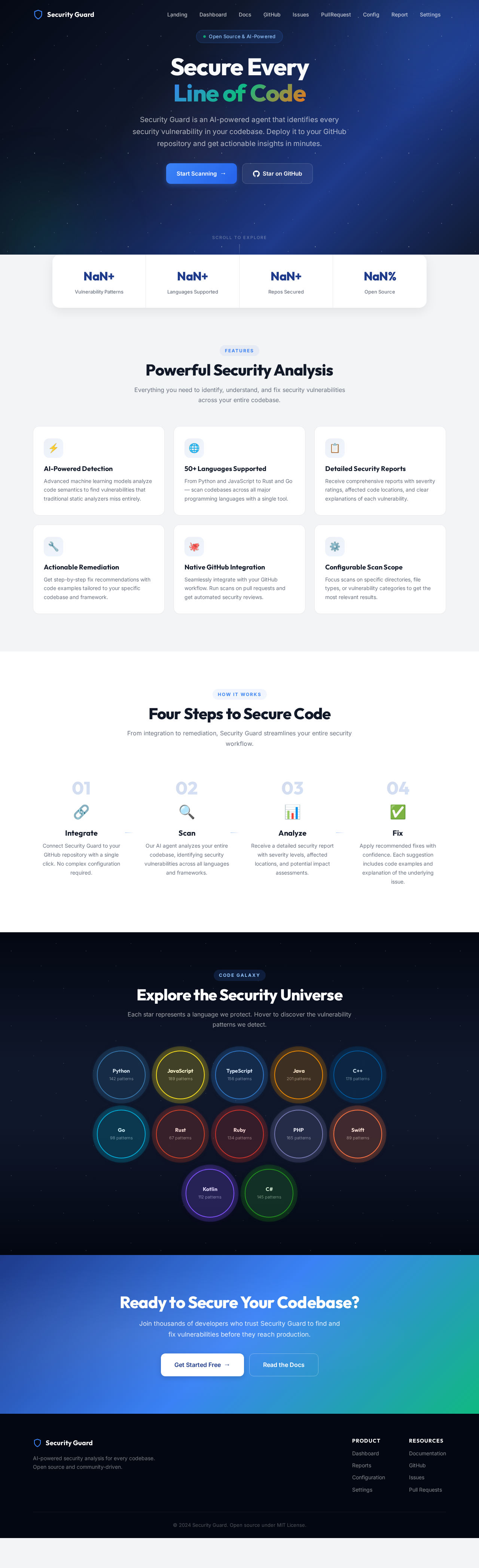
Secure Every
Line of Code
Security Guard is an AI-powered agent that identifies every security vulnerability in your codebase. Deploy it to your GitHub repository and get actionable insights in minutes.
Powerful Security Analysis
Everything you need to identify, understand, and fix security vulnerabilities across your entire codebase.
AI-Powered Detection
Advanced machine learning models analyze code semantics to find vulnerabilities that traditional static analyzers miss entirely.
50+ Languages Supported
From Python and JavaScript to Rust and Go — scan codebases across all major programming languages with a single tool.
Detailed Security Reports
Receive comprehensive reports with severity ratings, affected code locations, and clear explanations of each vulnerability.
Actionable Remediation
Get step-by-step fix recommendations with code examples tailored to your specific codebase and framework.
Native GitHub Integration
Seamlessly integrate with your GitHub workflow. Run scans on pull requests and get automated security reviews.
Configurable Scan Scope
Focus scans on specific directories, file types, or vulnerability categories to get the most relevant results.
Four Steps to Secure Code
From integration to remediation, Security Guard streamlines your entire security workflow.
Integrate
Connect Security Guard to your GitHub repository with a single click. No complex configuration required.
Scan
Our AI agent analyzes your entire codebase, identifying security vulnerabilities across all languages and frameworks.
Analyze
Receive a detailed security report with severity levels, affected locations, and potential impact assessments.
Fix
Apply recommended fixes with confidence. Each suggestion includes code examples and explanation of the underlying issue.
Explore the Security Universe
Each star represents a language we protect. Hover to discover the vulnerability patterns we detect.
Ready to Secure Your Codebase?
Join thousands of developers who trust Security Guard to find and fix vulnerabilities before they reach production.
No comments yet. Be the first!