Munnu fabrication
 psm status
Hi


Comments (0)
Sign in to leave a comment
System Requirements
Munnu Fabrication System Requirements Document
Introduction
The Munnu Fabrication project aims to develop a comprehensive system for managing fabrication processes, including job management, drawing visualization, fabrication metrics calculation, 3D structural interaction, AI-driven analysis, and reporting. This document outlines the system requirements for the Munnu Fabrication project.
System Overview
The Munnu Fabrication system is designed to streamline the fabrication process through a series of integrated phases. Each phase focuses on a specific aspect of the fabrication workflow, from job management to AI analysis and reporting. The system will be developed using modern technologies such as React Native for the frontend and various backend engines for processing and analysis.
Functional Requirements as Story Points
- As a User, I should be able to navigate through different job management options like New Job, Old Jobs, and Drawing Viewer.
- As a User, I should be able to interact with a 3D vector display canvas for drawing and visualization.
- As a User, I should be able to calculate fabrication metrics including frame profiles and glass panel dimensions.
- As a User, I should be able to view and manipulate 3D structural models with exploded view capabilities.
- As a User, I should be able to analyze job similarity using AI to optimize structural cutting and flag safety issues.
- As a User, I should be able to generate and export a Bill of Materials in JSON format.
User Personas
- Fabrication Manager: Oversees the entire fabrication process, manages jobs, and ensures quality control.
- Designer: Uses the drawing and 3D visualization tools to create and modify designs.
- AI Analyst: Utilizes AI tools to analyze job data and optimize fabrication processes.
- Report Specialist: Generates and reviews reports for materials and job metrics.
Core User Flows
- Fabrication Manager logs in -> Navigates to New Job -> Enters job details -> Saves job
- Designer opens Drawing Viewer -> Interacts with 3D canvas -> Modifies design -> Saves changes
- AI Analyst runs job similarity analysis -> Reviews AI recommendations -> Approves or adjusts settings
- Report Specialist generates Bill of Materials -> Reviews JSON output -> Distributes report
Visuals Colors and Theme
- primary: #1E3A8A (Deep Indigo)
- primary_light: #3B82F6 (Light Blue)
- secondary: #F59E0B (Amber)
- accent: #EF4444 (Red)
- highlight: #FBBF24 (Gold)
- bg: #111827 (Dark Slate)
- surface: rgba(17, 24, 39, 0.8)
- text: #F9FAFB (White)
- text_muted: #9CA3AF (Gray)
- border: rgba(156, 163, 175, 0.2)
Signature Design Concept
The homepage will feature an interactive 3D fabrication workshop environment. Users can navigate through different sections of the workshop by clicking on various tools and machines, each representing a phase of the fabrication process. As users hover over elements, they will animate with subtle 3D transformations using @react-three/fiber and gsap for smooth transitions. This immersive experience will make the site engaging and memorable, allowing users to explore the fabrication process in a virtual setting.
Interaction Model & Motion Direction
The landing page will utilize a "parallax" interaction model, providing a layered depth experience as users scroll through the page. Decorative elements will move at different speeds, creating a dynamic and visually rich first impression. Internal pages will adopt a "static" model for clarity and ease of use, focusing on functionality and data presentation.
Non-Functional Requirements
- The system must be responsive and accessible across various devices and screen sizes.
- Ensure data security and privacy, particularly for client and job data.
- The system should support high availability and scalability to handle increased load.
Tech Stack
- Frontend: React Native
- Backend: Node.js + Express or FastAPI
- Database: MySQL or MariaDB
- AI Models: GPT 5.4 for user-friendly responses
- AI Tools: Litellm for LLM Routing
- Orchestration: Docker, Kubernetes
Assumptions and Constraints
- The system will be developed in phases, with each phase focusing on a specific functionality.
- The project timeline and delivery will depend on resource availability and client feedback.
- Integration with existing systems may require additional customization.
Glossary
- 3D Canvas: A digital space for visualizing and interacting with 3D models.
- AI Brain: An AI-driven module for analyzing job data and optimizing processes.
- Bill of Materials (BOM): A detailed list of materials required for fabrication.
- Exploded View: A visualization technique that separates components for better understanding.
- Fabrication Metrics: Measurements and calculations related to the fabrication process.
This document provides a comprehensive overview of the requirements for the Munnu Fabrication project, ensuring all stakeholders have a clear understanding of the system's capabilities and expectations.
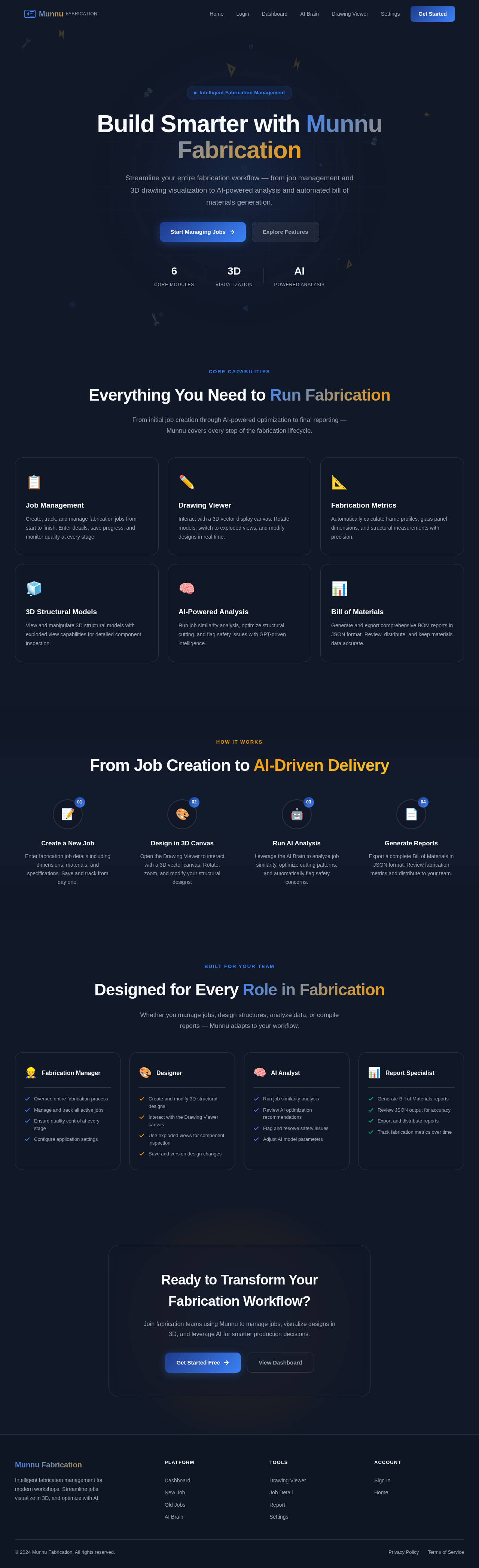
Build Smarter with Munnu Fabrication
Streamline your entire fabrication workflow — from job management and 3D drawing visualization to AI-powered analysis and automated bill of materials generation.
Everything You Need to Run Fabrication
From initial job creation through AI-powered optimization to final reporting — Munnu covers every step of the fabrication lifecycle.
Job Management
Create, track, and manage fabrication jobs from start to finish. Enter details, save progress, and monitor quality at every stage.
Drawing Viewer
Interact with a 3D vector display canvas. Rotate models, switch to exploded views, and modify designs in real time.
Fabrication Metrics
Automatically calculate frame profiles, glass panel dimensions, and structural measurements with precision.
3D Structural Models
View and manipulate 3D structural models with exploded view capabilities for detailed component inspection.
AI-Powered Analysis
Run job similarity analysis, optimize structural cutting, and flag safety issues with GPT-driven intelligence.
Bill of Materials
Generate and export comprehensive BOM reports in JSON format. Review, distribute, and keep materials data accurate.
From Job Creation to AI-Driven Delivery
Create a New Job
Enter fabrication job details including dimensions, materials, and specifications. Save and track from day one.
Design in 3D Canvas
Open the Drawing Viewer to interact with a 3D vector canvas. Rotate, zoom, and modify your structural designs.
Run AI Analysis
Leverage the AI Brain to analyze job similarity, optimize cutting patterns, and automatically flag safety concerns.
Generate Reports
Export a complete Bill of Materials in JSON format. Review fabrication metrics and distribute to your team.
Designed for Every Role in Fabrication
Whether you manage jobs, design structures, analyze data, or compile reports — Munnu adapts to your workflow.
Fabrication Manager
- Oversee entire fabrication process
- Manage and track all active jobs
- Ensure quality control at every stage
- Configure application settings
Designer
- Create and modify 3D structural designs
- Interact with the Drawing Viewer canvas
- Use exploded views for component inspection
- Save and version design changes
AI Analyst
- Run job similarity analysis
- Review AI optimization recommendations
- Flag and resolve safety issues
- Adjust AI model parameters
Report Specialist
- Generate Bill of Materials reports
- Review JSON output for accuracy
- Export and distribute reports
- Track fabrication metrics over time
Ready to Transform Your Fabrication Workflow?
Join fabrication teams using Munnu to manage jobs, visualize designs in 3D, and leverage AI for smarter production decisions.
No comments yet. Be the first!