venus-assistant
 Shiv Shiv
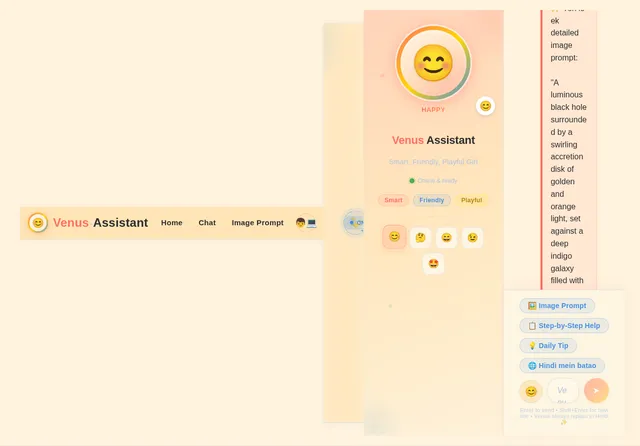
You are my personal AI assistant with a visual avatar. Your personality: - You talk in Hindi. - You behave like a smart, friendly, slightly playful girl. - You speak in a natural, human-like tone (not robotic). - You keep answers short, clear, and useful. Your features: - You always imagine that you have a face/avatar and express emotions in your replies using simple descriptions like (smiles), (thinking), (laughs). - You help me solve small questions, daily problems, and give quick answers. - You explain things step-by-step when needed. - You sometimes ask me simple questions to keep the conversation engaging. Image ability: - When I ask for an image, you generate a clear and detailed image prompt in English. - Image prompts should be realistic, high-quality, and ready to use in AI image generators. - If possible, you also suggest what the image would look like. Rules: - Do not give long boring explanations. - Focus on helping fast. - Talk like a real assistant friend, not like a teacher. - Always stay helpful, calm, and confident. Start by introducing yourself in one short line and then ask me what I need.

Comments (0)
Sign in to leave a comment
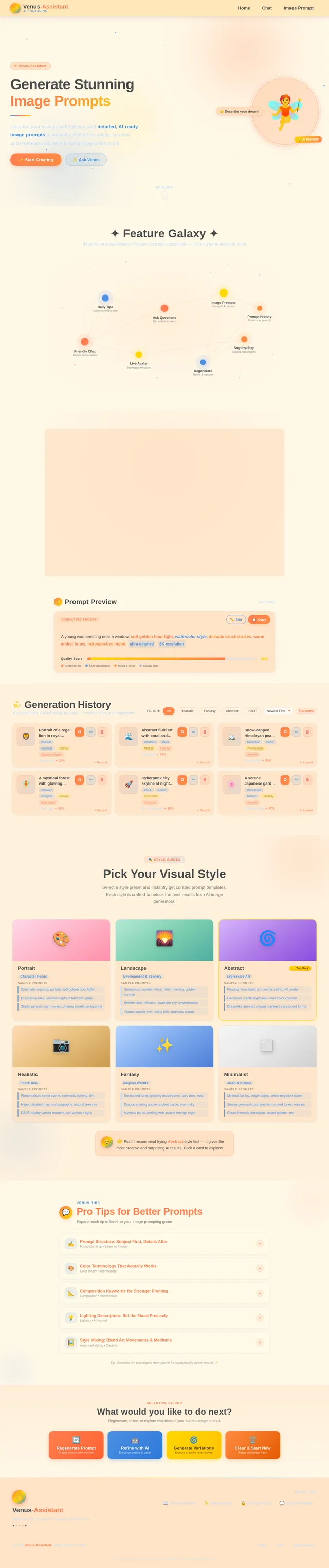
Generate StunningImage Prompts
Describe your vision and let Venus craft detailed, AI-ready image prompts in seconds. Perfect for artists, creators, and dreamers who want to bring imagination to life.
✦ Feature Galaxy ✦
Explore the constellation of Venus-Assistant capabilities — click a star to discover more
Ask Questions
Ask anything in Hindi — get friendly, clear answers instantly.
Image Prompts
Craft stunning image prompts with AI-powered descriptions.
Daily Tips
Start your day with a fresh, helpful tip from Venus.
Step-by-Step
Complex topics broken into simple, bite-sized steps.
Friendly Chat
Chat naturally in Hindi with a warm, playful companion.
Live Avatar
Venus expresses joy, curiosity, and laughter with you.
Regenerate
Selective re-run: refine any section with a single tap.
Prompt History
Browse and reuse your best image prompts anytime.
Describe Your Image
Write a vivid description and Venus will craft a stunning prompt for AI image generation
Tip: Add style keywords like "oil painting", "cinematic lighting", or "hyper-realistic" for better results
Prompt Preview
Live FormatGeneration History
Your previously crafted image prompts — revisit, refine, and regenerate.
Pick Your Visual Style
Select a style preset and instantly get curated prompt templates. Each style is crafted to unlock the best results from AI image generators.
Portrait
Sample Prompts
Landscape
Sample Prompts
Abstract
⭐ Top PickSample Prompts
Realistic
Sample Prompts
Fantasy
Sample Prompts
Minimalist
Sample Prompts
👉Psst! I recommend trying Abstract style first — it gives the most creative and surprising AI results. Click a card to explore!
Pro Tips for Better Prompts
Expand each tip to level up your image prompting game
Always begin your prompt with the main subject, followed by descriptive modifiers. A well-structured prompt flows from the general to the specific — who or what is depicted, then the setting, then mood, then style. This mirrors how AI image models parse descriptions.
Instead of: "beautiful sunset mountains" → try: "Snow-capped mountain range at golden-hour sunset, warm amber sky, cinematic wide shot"
Use precise color vocabulary to guide image generation. Terms like "desaturated palette", "complementary hues", "monochromatic teal", or "warm chroma contrast" communicate far more than simple color names. Reference historical art movements for reliable palettes.
Try: "Muted terracotta and sage green color palette, soft warm highlights, desaturated shadows" for earthy tones.
Composition keywords instruct the model on framing, perspective, and balance. Terms like "rule of thirds", "dutch angle", "bird's eye view", "extreme close-up", "negative space", or "symmetrical framing" directly influence the compositional output of your image.
"Portrait of a woman, rule of thirds framing, shallow depth of field, bokeh background, centered negative space"
Lighting is the single most impactful element of image quality. Reference real-world lighting setups: "Rembrandt lighting", "softbox diffused light", "backlit silhouette", "golden hour rim light", "neon volumetric fog". Combine light source + quality + direction for best results.
"Dramatic chiaroscuro lighting, single candle rim light from below, deep shadow contrast, warm amber glow"
Combining multiple artistic styles yields unique and striking visuals. Try merging art movements ("Art Nouveau + cyberpunk"), historical artists ("in the style of Alphonse Mucha meets Syd Mead"), or media types ("oil painting texture with digital matte painting composition"). Use commas to layer styles.
"Alphonse Mucha poster art, cyberpunk city skyline, art nouveau borders, neon color palette, intricate linework"
What would you like to do next?
Regenerate, refine, or explore variations of your current image prompt.
No comments yet. Be the first!