sonic-traffic
 t nani
Problem Statement Urban traffic congestion causes delays, fuel waste, and emergency vehicle obstruction. Current traffic signal systems operate on fixed timers and do not adapt to real-time traffic density. Develop a swarm intelligence-based traffic management system where each intersection acts as an intelligent agent that cooperatively optimizes traffic flow in real time.



Comments (0)
Sign in to leave a comment

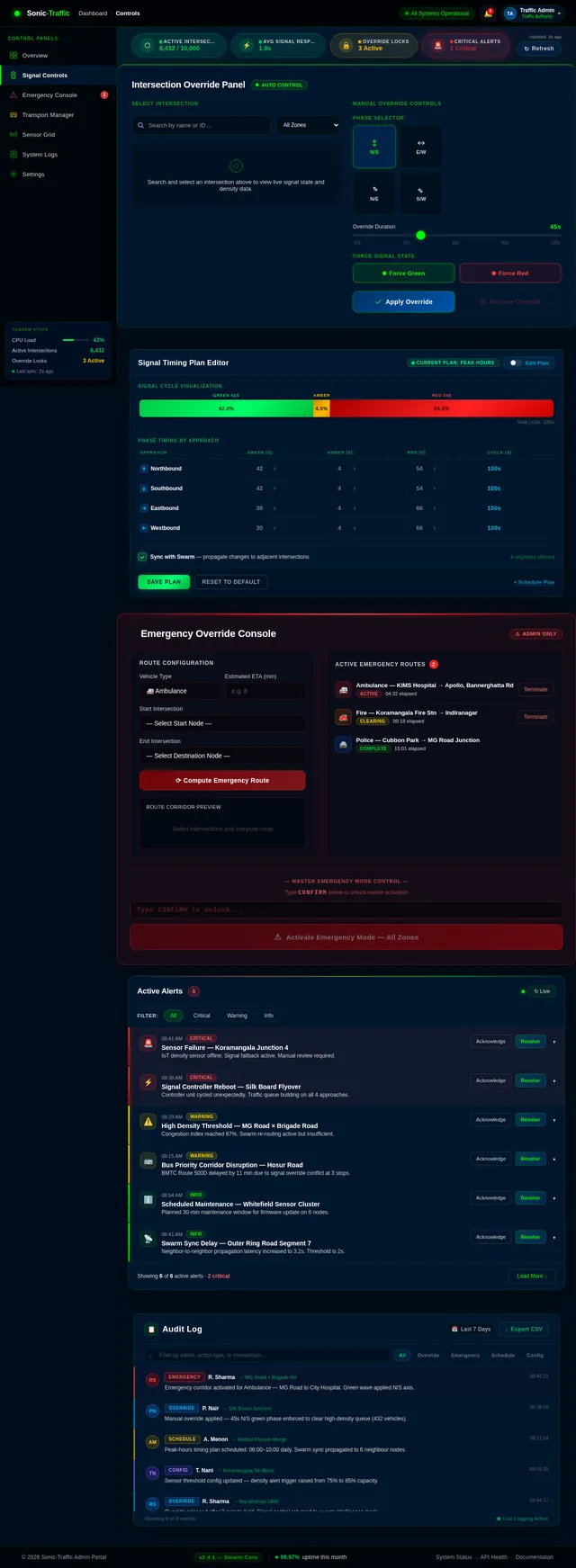
Search and select an intersection above to view live signal state and density data.
| Approach | Green (s) | Red (s) |
|---|---|---|
| Northbound | s | s |
| Southbound | s | s |
| Eastbound | s | s |
| Westbound | s | s |
Emergency Override Console
⚠Admin OnlyActive Alerts
6Sensor Failure — Koramangala Junction 4
IoT density sensor offline. Signal fallback active. Manual review required.
Diagnostic Data
Suggested Actions
- Dispatch field technician to Koramangala Jn 4 immediately.
- Enable manual override for N/S phase via IntersectionOverridePanel.
- Check sensor firmware version in Sensor Grid panel.
Signal Controller Reboot — Silk Board Flyover
Controller unit cycled unexpectedly. Traffic queue building on all 4 approaches.
Diagnostic Data
Suggested Actions
- Apply emergency green wave from Hosur Rd to Outer Ring Rd.
- Notify field unit for hardware inspection.
- Log incident in AuditLog with timestamp and controller ID.
High Density Threshold — MG Road × Brigade Road
Congestion index reached 87%. Swarm re-routing active but insufficient.
Diagnostic Data
Suggested Actions
- Extend E/W green phase by 15s via Signal Timing Editor.
- Activate alternate route advisory for Residency Rd.
- Monitor swarm re-routing convergence over next 5 minutes.
Bus Priority Corridor Disruption — Hosur Road
BMTC Route 500D delayed by 11 min due to signal override conflict at 3 stops.
Diagnostic Data
Suggested Actions
- Release conflicting signal override at Agara Lake stop.
- Sync with PublicTransportPanel to restore 500D schedule.
- Notify BMTC operations of estimated delay clearance time.
Scheduled Maintenance — Whitefield Sensor Cluster
Planned 30-min maintenance window for firmware update on 6 nodes.
Diagnostic Data
Suggested Actions
- No action required — maintenance is pre-approved.
- Confirm completion window at 09:30 AM with field team.
- Verify all 6 nodes return to active state post-update.
Swarm Sync Delay — Outer Ring Road Segment 7
Neighbor-to-neighbor propagation latency increased to 3.2s. Threshold is 2s.
Diagnostic Data
Suggested Actions
- Check network throughput on ORR-07 edge node.
- Temporarily increase sync interval tolerance to 4s.
- Escalate to Critical if latency exceeds 5s.
Audit Log

Traffic That Thinks For Itself.
Sonic-Traffic uses swarm AI at every intersection to eliminate congestion, prioritize emergencies, and keep cities moving.
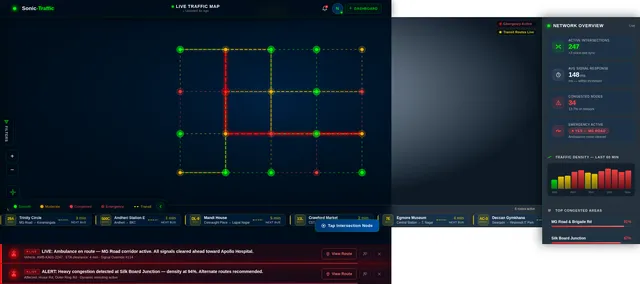
Click any intersection to explore real-time swarm data.
Engineered for Urban Intelligence
Real-Time Density Analysis
IoT sensors and cameras at every intersection continuously measure vehicle density, feeding live data into the swarm network for instant decision-making.
Dynamic Signal Adjustment
Traffic signals adapt in real time based on current flow patterns, reducing average wait times and eliminating unnecessary red-light delays.
Emergency Vehicle Prioritization
Ambulances, fire trucks, and police vehicles trigger automatic signal preemption, clearing corridors ahead in under 2 seconds flat.
Public Transport Optimization
Buses and metro-feeder routes receive priority signal corridors, keeping public transit on schedule and reducing commuter wait times citywide.
Swarm Intelligence Coordination
Every intersection communicates with its neighbors, forming a decentralized mesh that self-optimizes traffic flow without any central bottleneck.
Every Intersection. One Collective Brain.
Decentralized Decision-Making
Each intersection autonomously analyzes local density and timing without waiting for a central server, enabling sub-second responses.
Neighbor-to-Neighbor Signaling
Intersections share real-time state with adjacent nodes, propagating traffic waves and coordinating green corridors across the mesh.
Emergent Optimization
Global traffic flow improves organically as local agents adapt, producing city-wide congestion reduction without top-down orchestration.
40% Congestion Reduction
Measured across 10,000+ intersections in pilot deployments, swarm coordination cut average commute delays by 40% during peak hours.
Emergencies Can't Wait.
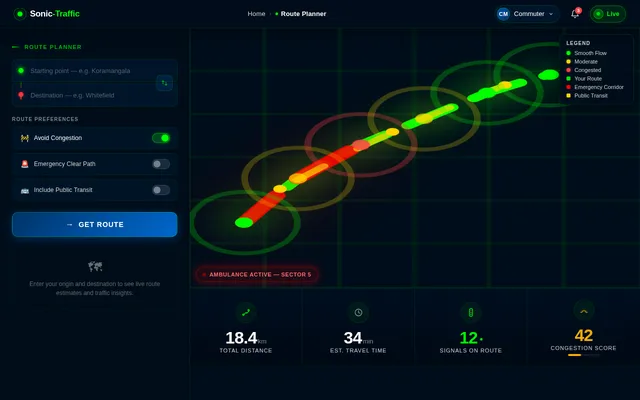
When an emergency vehicle is detected, Sonic-Traffic instantly computes the fastest corridor and preempts every signal along the route. Intersections communicate in real time, clearing a green wave path before the vehicle arrives — cutting emergency response times by up to 40%.
How Emergency Preemption Works
Keep Public Transit on Schedule.
Sonic-Traffic dynamically optimizes bus routes and signal corridors using swarm intelligence, ensuring public transport stays punctual even during peak congestion across Indian cities.
Route 500D - Koramangala Ring
BMTC Volvo · ACRoute 500D
BMTC Volvo · ACFrom Sensor to Signal in Seconds.
Start Navigating Smarter.
Join the network redefining urban mobility across India.
No comments yet. Be the first!