project-c6839733
 Chris Arxate
Act as an elite Blockchain Engineer, Principal MEV Quantitative Developer, and Smart Contract Security Expert specializing in EVM networks. I am building an enterprise-grade trading, arbitrage, and liquidation bot suite on the Polygon PoS network, utilizing the split-architecture model inspired by the `pmuens/midas` repository. Please provide the complete repository structure and production-hardened, fully fleshed-out code for the core implementation files in TypeScript and Solidity. The codebase must be highly optimized for the brutal, fast-changing environment of Polygon. Do not use placeholders like '// implement logic here' for critical logic paths; all mathematical routing, gas strategies, and decoding loops must be fully written. ### I. System Architecture & Component Specifications #### 1. Hardened Execution Layer (`InstitutionalExecutor.sol`) - **Multi-DEX Multi-Hop Interface:** Build an execution entry point that accepts an array of token addresses (the swap path) and an array of custom market/DEX identifiers (e.g., Uniswap V3, Quickswap V3, Balancer, or V2 forks). - **Atomic Profit Guardrail & Minimum Output Check:** The function must accept a `minProfit` parameter. It must track the contract's starting balance of the base asset, execute the multi-hop route, and perform an atomic check: `require(finalBalance - startingBalance >= minProfit, "Slippage/Negative Profit")`. If this condition is not met, the entire transaction must revert to eliminate losing trades and prevent wasting gas on failed outcomes. - **Actinide-Grade Access Controls:** Implement a dual-layer defense system. Use standard administrative controls (`Ownable`) for parameter adjustments, but restrict the core execution function via a strict custom modifier that permits calls *only* from the explicit hot-wallet address of your off-chain TypeScript engine. - **Asset Resiliency & Circuit Breaker:** Include an `emergencyDrain(address token)` function allowing immediate sweeping of 100% of the contract's inventory to a hardware-secured cold wallet if an anomaly is flagged. Integrate flash loan callbacks (e.g., Balancer or Aave V3) ensuring zero-capital high-leverage execution. #### 2. Sub-Millisecond, Low-Latency Strategy Layer (`low-latency-engine.ts`) - **Raw Log Decoding Over Library Abstractions:** Standard provider abstractions introduce up to 50ms of overhead. Implement a performance-critical WebSocket listener using the raw `ws` library. Parse raw incoming JSON-RPC hex strings directly to instantly flag target `Swap` topics (`0xc4202...`) from targeted liquidity pools. - **Pre-Flight On-Chain Simulation:** Build an internal simulation step using `eth_call` or `multicall` to dry-run the generated execution calldata against the absolute latest block state *before* broadcasting a live transaction. - **Deep Reorg Protection & Caching:** Polygon suffers from micro-forks and deep block reorgs. Build a block listener that tracks state and cache-hashes previously sent transactions to prevent sending duplicate payloads if a block is temporarily dropped or rewritten. - **Fail-Closed State Machine:** If connection to your RPC network drops for more than 500 milliseconds, transition the engine into a global `PAUSED` state, freezing all pending executions and wiping the transaction pool cache. #### 3. Polygon Overdrive Gas & Routing Strategy - **EIP-1559 Dynamic Base-Fee Scaling:** Implement logic that directly polls the network's fee data. To secure top-of-block positioning during high-congestion events, automatically scale `maxPriorityFeePerGas` up to 30% higher than the network median, applying a protective max cap to prevent toxic gas burn. - **Private MEV Routing (FastLane/Flashbots):** Completely bypass public mempools to eliminate sandwich or front-running vulnerabilities. Structure the transaction broadcasting module to send transactions as private bundles directly to Polygon FastLane or equivalent private builder endpoints. - **Dynamic Flash-Slippage Optimization:** Before generating a payload, the off-chain engine must read depth across pools (e.g., Quickswap and Uniswap V3). If target paths exhibit high price-impact, dynamically adjust the size of the principal to minimize self-induced slippage. ### II. Code Deliverables Required Please output the exact, complete code for these four files, fully fleshed out with clean documentation: 1. `InstitutionalExecutor.sol` (The complete Solidity smart contract matching all specs above). 2. `low-latency-engine.ts` (The master TypeScript execution and ingestion engine using Ethers.js v6 or Viem where appropriate, and the raw `ws` library for the intake loop). 3. `package.json` (The exact production dependencies required, including TypeScript, Ethers, and Hardhat tool suites). 4. `hardhat.config.ts` (The complete configuration file configured for deployment and testing on Polygon Mainnet).


Comments (0)
Sign in to leave a comment
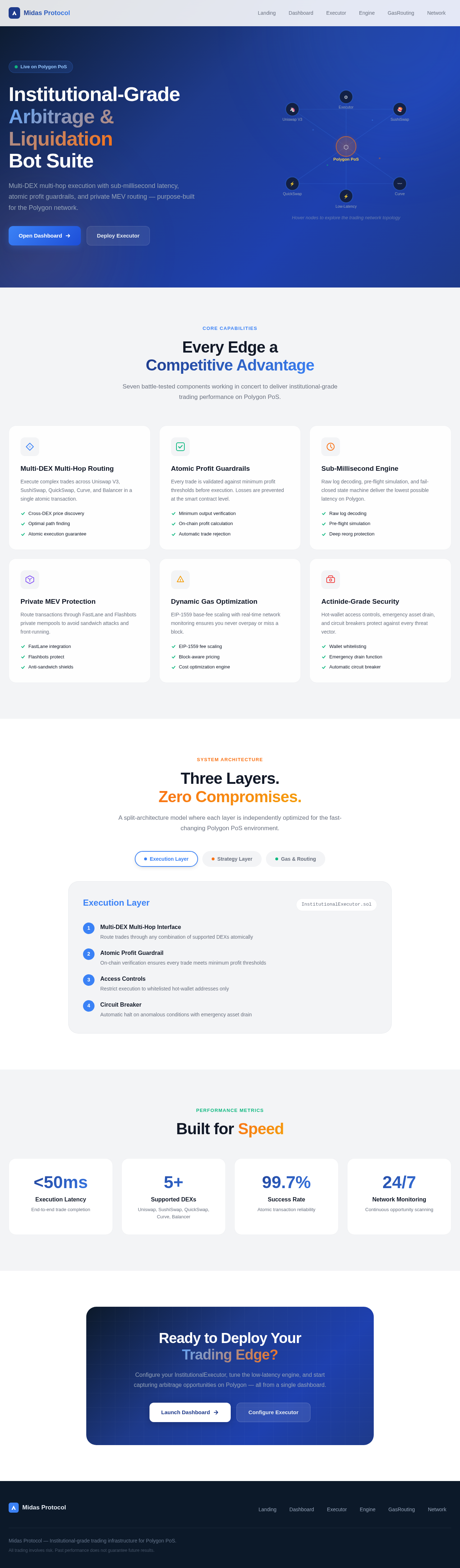
Institutional-Grade
Arbitrage & Liquidation
Bot Suite
Multi-DEX multi-hop execution with sub-millisecond latency, atomic profit guardrails, and private MEV routing — purpose-built for the Polygon network.
Hover nodes to explore the trading network topology
Every Edge a
Competitive Advantage
Seven battle-tested components working in concert to deliver institutional-grade trading performance on Polygon PoS.
Multi-DEX Multi-Hop Routing
Execute complex trades across Uniswap V3, SushiSwap, QuickSwap, Curve, and Balancer in a single atomic transaction.
- Cross-DEX price discovery
- Optimal path finding
- Atomic execution guarantee
Atomic Profit Guardrails
Every trade is validated against minimum profit thresholds before execution. Losses are prevented at the smart contract level.
- Minimum output verification
- On-chain profit calculation
- Automatic trade rejection
Sub-Millisecond Engine
Raw log decoding, pre-flight simulation, and fail-closed state machine deliver the lowest possible latency on Polygon.
- Raw log decoding
- Pre-flight simulation
- Deep reorg protection
Private MEV Protection
Route transactions through FastLane and Flashbots private mempools to avoid sandwich attacks and front-running.
- FastLane integration
- Flashbots protect
- Anti-sandwich shields
Dynamic Gas Optimization
EIP-1559 base-fee scaling with real-time network monitoring ensures you never overpay or miss a block.
- EIP-1559 fee scaling
- Block-aware pricing
- Cost optimization engine
Actinide-Grade Security
Hot-wallet access controls, emergency asset drain, and circuit breakers protect against every threat vector.
- Wallet whitelisting
- Emergency drain function
- Automatic circuit breaker
Three Layers.
Zero Compromises.
A split-architecture model where each layer is independently optimized for the fast-changing Polygon PoS environment.
Execution Layer
InstitutionalExecutor.solMulti-DEX Multi-Hop Interface
Route trades through any combination of supported DEXs atomically
Atomic Profit Guardrail
On-chain verification ensures every trade meets minimum profit thresholds
Access Controls
Restrict execution to whitelisted hot-wallet addresses only
Circuit Breaker
Automatic halt on anomalous conditions with emergency asset drain
Built for Speed
Ready to Deploy Your
Trading Edge?
Configure your InstitutionalExecutor, tune the low-latency engine, and start capturing arbitrage opportunities on Polygon — all from a single dashboard.
Institutional-Grade
Arbitrage & Liquidation
Bot Suite
Multi-DEX multi-hop execution with sub-millisecond latency, atomic profit guardrails, and private MEV routing — purpose-built for the Polygon network.
Hover nodes to explore the trading network topology
Every Edge a
Competitive Advantage
Seven battle-tested components working in concert to deliver institutional-grade trading performance on Polygon PoS.
Multi-DEX Multi-Hop Routing
Execute complex trades across Uniswap V3, SushiSwap, QuickSwap, Curve, and Balancer in a single atomic transaction.
- Cross-DEX price discovery
- Optimal path finding
- Atomic execution guarantee
Atomic Profit Guardrails
Every trade is validated against minimum profit thresholds before execution. Losses are prevented at the smart contract level.
- Minimum output verification
- On-chain profit calculation
- Automatic trade rejection
Sub-Millisecond Engine
Raw log decoding, pre-flight simulation, and fail-closed state machine deliver the lowest possible latency on Polygon.
- Raw log decoding
- Pre-flight simulation
- Deep reorg protection
Private MEV Protection
Route transactions through FastLane and Flashbots private mempools to avoid sandwich attacks and front-running.
- FastLane integration
- Flashbots protect
- Anti-sandwich shields
Dynamic Gas Optimization
EIP-1559 base-fee scaling with real-time network monitoring ensures you never overpay or miss a block.
- EIP-1559 fee scaling
- Block-aware pricing
- Cost optimization engine
Actinide-Grade Security
Hot-wallet access controls, emergency asset drain, and circuit breakers protect against every threat vector.
- Wallet whitelisting
- Emergency drain function
- Automatic circuit breaker
Three Layers.
Zero Compromises.
A split-architecture model where each layer is independently optimized for the fast-changing Polygon PoS environment.
Execution Layer
InstitutionalExecutor.solMulti-DEX Multi-Hop Interface
Route trades through any combination of supported DEXs atomically
Atomic Profit Guardrail
On-chain verification ensures every trade meets minimum profit thresholds
Access Controls
Restrict execution to whitelisted hot-wallet addresses only
Circuit Breaker
Automatic halt on anomalous conditions with emergency asset drain
Built for Speed
Ready to Deploy Your
Trading Edge?
Configure your InstitutionalExecutor, tune the low-latency engine, and start capturing arbitrage opportunities on Polygon — all from a single dashboard.
No comments yet. Be the first!