











Introduction
Content deduplication is one of the most critical challenges in automated AI publishing pipelines. Without a robust mechanism to identify near-duplicate articles, publishing systems can flood their audiences with repetitive content — damaging both credibility and SEO rankings.
How Vector Search Solves Duplication
WeaviateDB employs high-dimensional vector embeddings to represent article summaries in semantic space. When a new summary is generated, pearl-ai computes its embedding and queries WeaviateDB for the nearest neighbours within a configurable similarity threshold.
client.query
  .get("Article", ["title", "summary", "_additional { certainty }"])
  .withNearText({ concepts: [newSummary] })
  .withLimit(5)
.do();Threshold Configuration
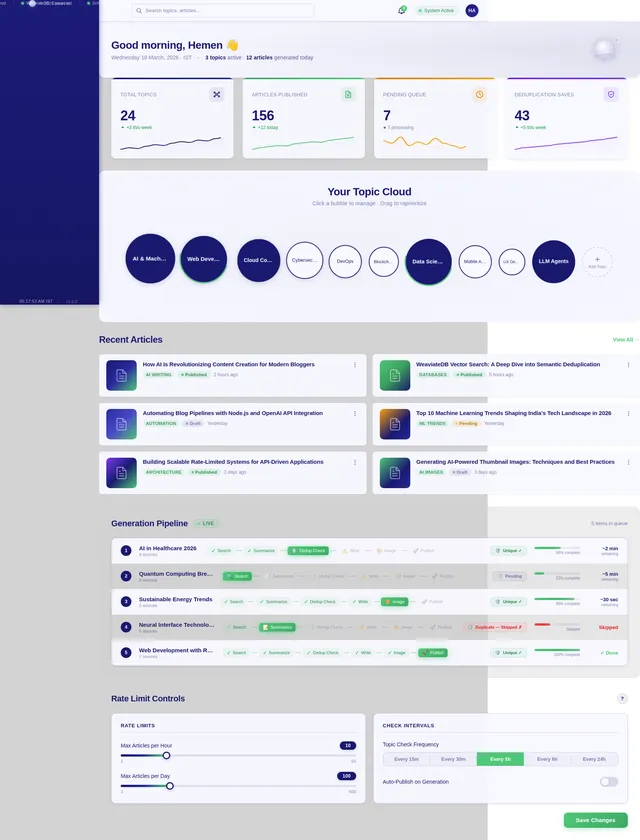
The default deduplication threshold is set at 0.92 cosine similarity. Articles scoring above this threshold are marked as "Duplicate — Skipped" and stored with a reference to the original record for audit purposes.
Summary-to-Full Article Flow
Pearl-ai first generates a concise summary, runs the deduplication check, and only if the content is novel does it proceed to generate the full article body — saving both compute cost and API quota on truly duplicate topics.
No comments yet. Be the first!