neuro
 Monin Modi
this is the requirement doc


Comments (0)
Sign in to leave a comment

Graph Memory
Live topology of patient records, wearable metrics, assessments, and AI-derived insights across the Healthopia clinical graph.
Schema Overview
A live summary of neuro's graph memory schema — the node and relationship model connecting patients, wearable metrics, clinical records, assessments, AI insights, and consent metadata.
Distinct entity types modeled in the graph
View detailsDirected edge types linking entities
View detailsLive entities currently stored in graph memory
View detailsValidated node & relationship coverage
Node Type Distribution
13 types- Patient18%
- WearableMetric22%
- ClinicalRecord15%
- AssessmentResult10%
- AppBehaviorSignal9%
- AIInsight8%
- ClinicalSummary6%
- Other (6 types)12%
Relationship Counts
9 typesNode Type Management
Define and govern the entity types that make up the patient knowledge graph. 12 types · 2.4M instances.
Relationship Rule Engine
Define allowed relationship types between node classes, enforce cardinality, configure versioning strategy, and manage time-aware relationship metadata (valid_from / valid_to) for the neuro patient knowledge graph.
Relationship Type Matrix
Click a cell to define or edit the relationship rule from a source node type to a target node type.
| Source \ Target | Patient | WearableMetric | ClinicalRecord | Assessment | AIInsight | Nudge |
|---|---|---|---|---|---|---|
| Patient | ||||||
| WearableMetric | ||||||
| ClinicalRecord | ||||||
| Assessment | ||||||
| AIInsight | ||||||
| Nudge |
Rule Editor
Select a cell in the relationship matrix to define or edit a rule.
Cardinality Rules
- 1:1 One source instance maps to exactly one target instance (e.g. Assessment generates a single AIInsight).
- 1:N One source instance may relate to many target instances (e.g. Patient has_wearable many WearableMetric streams).
- M:N Many source instances may relate to many target instances (e.g. WearableMetric derived_from multiple correlated signals).
Versioning Config
Applied as the default strategy for newly created relationship rules.
Time Window Settings
valid_from is auto-stamped at rule creation; valid_to defaults to "Ongoing" unless an expiry window is set.
Interactive Graph Canvas
A rendered sample of the patient knowledge graph — drag nodes, zoom, pan, and inspect relationships exactly as clinicians and the AI layer traverse them.
Drag a node to reposition it · scroll or use the controls to zoom · click a node or relationship for full metadata.
Data Integrity Monitor
Continuous data quality diagnostics for the patient knowledge graph — orphaned nodes, dangling relationships, schema drift, and duplicate detection.
Active Alerts
414 relationships reference AssessmentResult nodes that no longer exist in the graph.
Suggested fixRun orphan relationship cleanup or restore the missing AssessmentResult nodes from the last sync snapshot.
9 ClinicalSummary nodes have no incoming SUMMARIZES relationship to a Patient node.
Suggested fixRe-link summaries to their source patient using the visit_id cross-reference, or archive if the patient record was purged.
Property type drift detected — 328 nodes store recorded_at as string instead of ISO datetime.
Suggested fixApply the type coercion migration to normalize recorded_at across affected WearableMetric nodes.
5 duplicate Patient nodes detected sharing identical MRN identifiers from the EMR sync.
Suggested fixMerge duplicate nodes using MRN as the canonical key; retain the most recent consent metadata.
Check Log
4- 3.2s
Found 4 new schema mismatches in the WearableMetric batch sync.
- 4.8s
Scheduled nightly check completed with no critical issues.
- 5.1s
Detected 14 dangling HAS_ASSESSMENT relationships after EMR sync.
- 2.9s
Manual check triggered by admin — no anomalies found.
Last synced 4 minutes ago. Run a manual check to re-scan the graph now.
Schema Version History
Track every change to the patient knowledge graph schema, compare revisions side by side, and roll back safely with a confirmed action trail.
Added TimelineEvent node type with time-aware relationship versioning for patient event tracking. Introduced valid_from / valid_to properties on all edges to support point-in-time graph queries.
stableIntroduced ConsentSource metadata nodes to support evidence traceability for clinical AI recommendations, linking every insight back to its originating data source and consent record.
Patched cardinality constraint on WearableMetric -> Patient relationship to allow multiple concurrent device sources without violating uniqueness rules.
hotfixAdded AIInsight and Nudge node types along with GENERATES and TRIGGERS relationship rules connecting clinician actions to downstream patient nudges.
releaseInitial patient knowledge graph schema baseline covering Patient, ClinicalRecord, Lab, Assessment, and AppBehaviorSignal node types with the core relationship model.
baseline
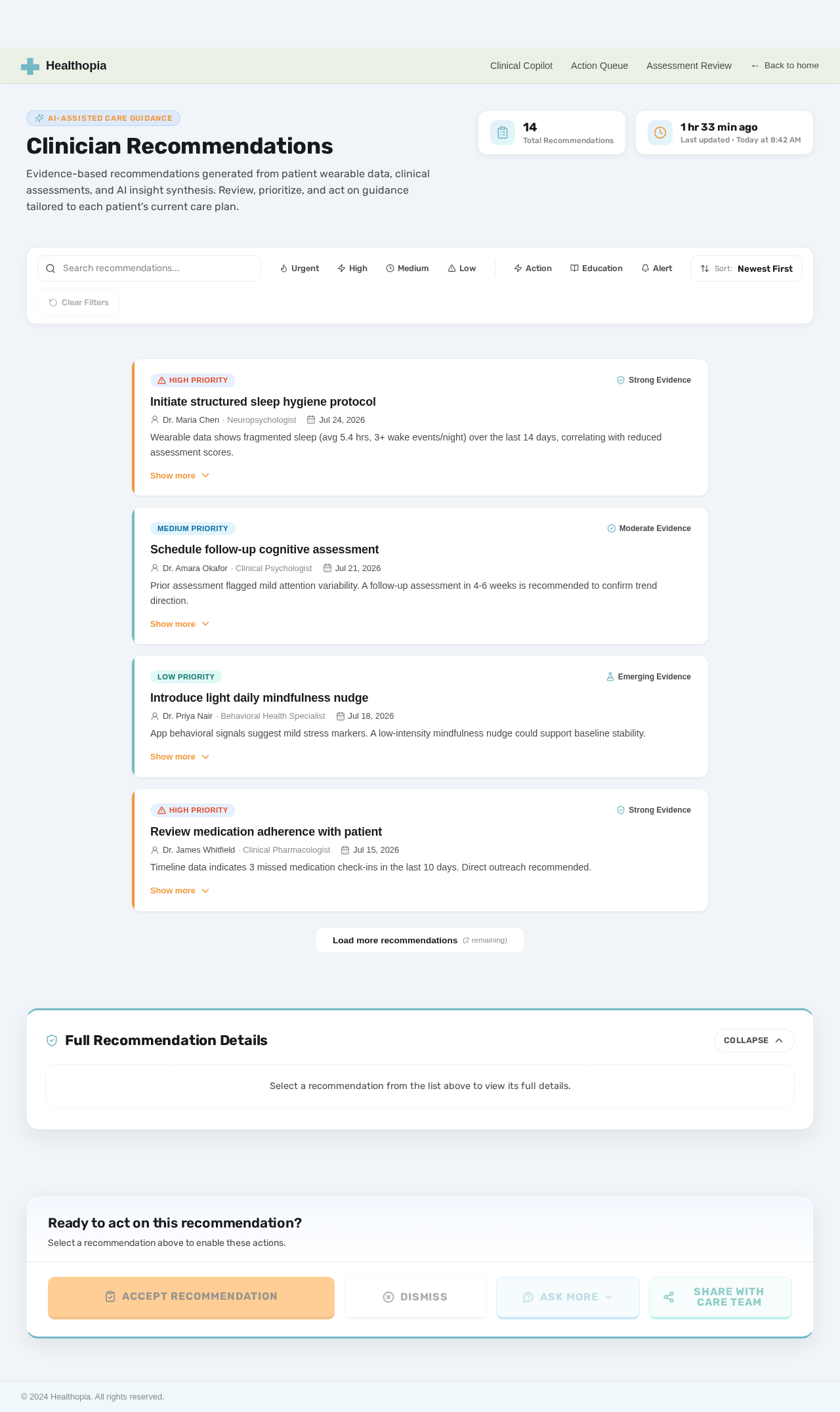
Clinician Recommendations
Evidence-based recommendations generated from patient wearable data, clinical assessments, and AI insight synthesis. Review, prioritize, and act on guidance tailored to each patient's current care plan.
Ready to act on this recommendation?
Select a recommendation above to enable these actions.
No comments yet. Be the first!