misty-build
 Anton Webb
You already have the full, updated build; you just need to pull it down and run it locally, or export it as a zip from Buildy / Devin. ## What the “current full build” is From that Devin session, the canonical project is: - Buildy project: `Club Connect Hub` at `https://www.buildy.ai/projects/ppv2a2aiezpnuaypugw`. - Tech stack: React 19 + Vite, TypeScript, Tailwind, shadcn/ui, Framer Motion, Superdev backend. - Backend: Superdev API with - `VITE_APP_ID=ppv2a2aiezpnuaypugw` - `VITE_SUPERDEV_BASE_URL=https://superdev.build/api`. - Local dev entry: `src/main.tsx`, dev server on port 8080. Devin has already: - Fixed `.env` to point at the same app ID as the original Buildy app. - Installed dependencies and started `npm run dev -- --port 8080`. - Applied multiple UI/UX passes, branding, performance optimisations (bundle down from ~2.6 MB to ~394 kB with route-based code splitting). So the build currently running at `http://localhost:8080` on Devin and at `https://dist-xrfqxqyx.devinapps.com` is your “full updated version” of Club Connect Hub. ## How to get that full build on your machine To have exactly that version locally: 1. Get the project files - In Devin, there should be an option to **Download project** / **Download zip** for `buildy-club-connect-hub` (the session name). That zip is effectively `buildy-club-connect-hub.zip`. - Save it to your machine and extract it. 2. Create the `.env` file at the project root Use the same values Devin used: ```env VITE_APP_ID=ppv2a2aiezpnuaypugw VITE_SUPERDEV_BASE_URL=https://superdev.build/api ``` 3. Install and run From the project folder: ```bash npm install npm run dev -- --port 8080 ``` Then open `http://127.0.0.1:8080` in your browser. This will give you the full updated app, wired to the same Superdev backend/database as the live Buildy version. ## If by “full updated build” you mean a production bundle Once you’ve got the project locally: ```bash npm run build ``` Vite will output the production build into `dist/`. You can then deploy that `dist` folder to any static host (e.g. Netlify, Vercel, Cloudflare Pages) while still pointing at the Superdev backend via the same `.env` values. Do you want explicit step‑by‑step for grabbing the zip out of Devin (click path in their UI), or are you comfortable from here once you have the files?


Comments (0)
Sign in to leave a comment
System design, API contracts, and deployment topology for misty-build Platform
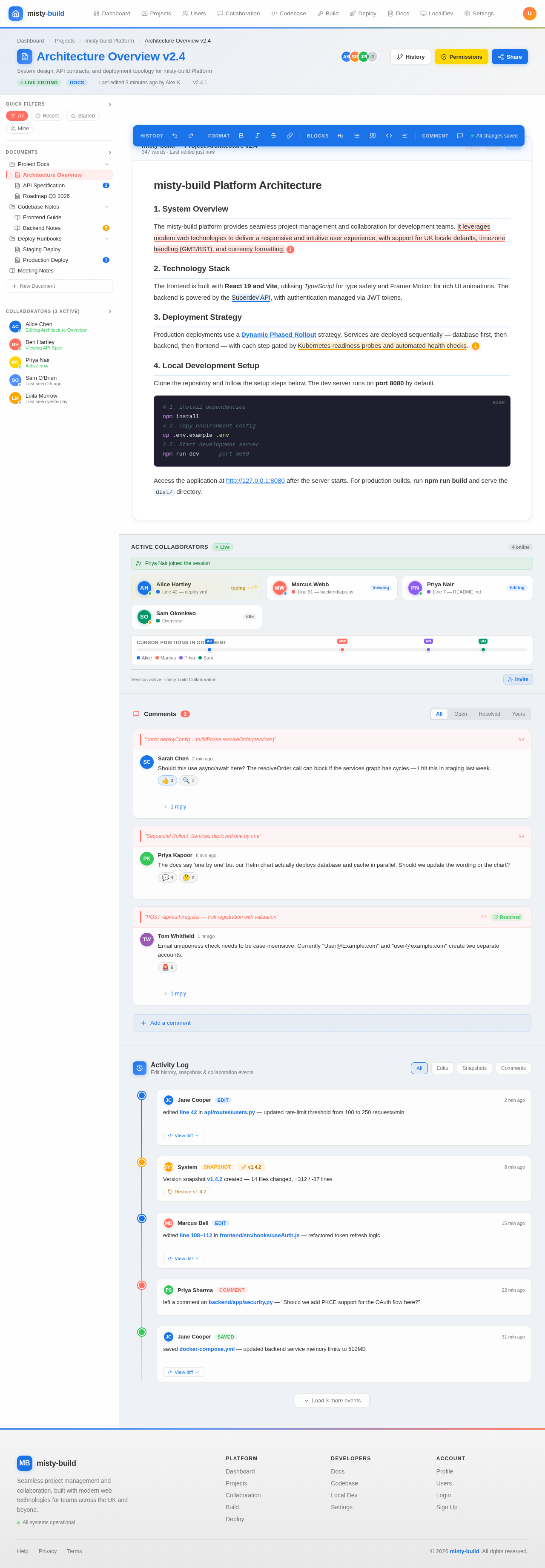
misty-build Platform Architecture
1. System Overview
The misty-build platform provides seamless project management and collaboration for development teams. It leverages modern web technologies to deliver a responsive and intuitive user experience, with support for UK locale defaults, timezone handling (GMT/BST), and currency formatting.1
2. Technology Stack
The frontend is built with React 19 and Vite, utilising TypeScript for type safety and Framer Motion for rich UI animations. The backend is powered by the Superdev API, with authentication managed via JWT tokens.
3. Deployment Strategy
Production deployments use a Dynamic Phased Rollout strategy. Services are deployed sequentially — database first, then backend, then frontend — with each step gated by Kubernetes readiness probes and automated health checks. 1
4. Local Development Setup
Clone the repository and follow the setup steps below. The dev server runs on port 8080 by default.
Access the application at http://127.0.0.1:8080 after the server starts. For production builds, run npm run build and serve the dist/ directory.
Should this use async/await here? The resolveOrder call can block if the services graph has cycles — I hit this in staging last week.
The docs say 'one by one' but our Helm chart actually deploys database and cache in parallel. Should we update the wording or the chart?
Email uniqueness check needs to be case-insensitive. Currently "User@Example.com" and "user@example.com" create two separate accounts.
edited line 42 in api/routes/users.py — updated rate-limit threshold from 100 to 250 requests/min
Version snapshot v1.4.2 created — 14 files changed, +312 / -87 lines
edited line 108–112 in frontend/src/hooks/useAuth.js — refactored token refresh logic
left a comment on backend/app/security.py — "Should we add PKCE support for the OAuth flow here?"
saved docker-compose.yml — updated backend service memory limits to 512MB
No comments yet. Be the first!