Segment
The uploaded puzzle is split into its own fragments. Edge detection and connected-component analysis trace the contour of every piece straight from the image pixels, so the count and the shapes come from your puzzle, not from a template.
 Irvan Andzetha
Halo saya mau buat sebuah laba laba ai solver seperti animasi vidio ini, tapi konteksnya untuk menyelesaikan puzzle gambar pertama agar mendapatkan hasil seperti gambar kedua solver, tapi saya mau merancang laba laba serta tampilan visualnya melakukan pekerjaannya serta lengkap dengan logo terminal yang detail pengerjaannya serta bukan simulasi jika saya gunakan untuk upload teka teki lainnya

Sign in to leave a comment
solver: idle·model: ready
Solver reachable; no run in progress.
Solver reachable; no run in progress.
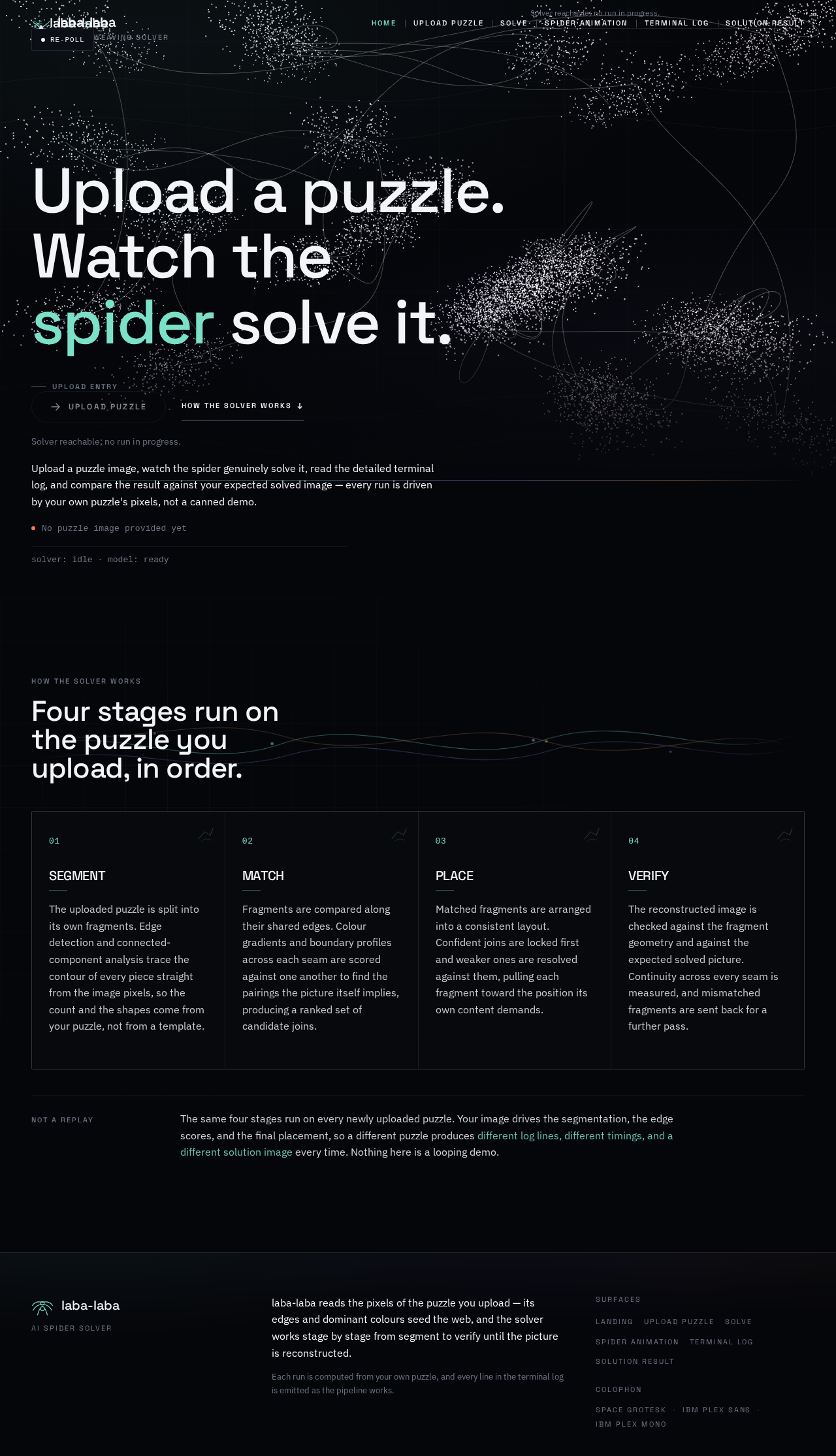
Upload a puzzle image, watch the spider genuinely solve it, read the detailed terminal log, and compare the result against your expected solved image — every run is driven by your own puzzle's pixels, not a canned demo.
No puzzle image provided yet
solver: idle · model: ready
The uploaded puzzle is split into its own fragments. Edge detection and connected-component analysis trace the contour of every piece straight from the image pixels, so the count and the shapes come from your puzzle, not from a template.
Fragments are compared along their shared edges. Colour gradients and boundary profiles across each seam are scored against one another to find the pairings the picture itself implies, producing a ranked set of candidate joins.
Matched fragments are arranged into a consistent layout. Confident joins are locked first and weaker ones are resolved against them, pulling each fragment toward the position its own content demands.
The reconstructed image is checked against the fragment geometry and against the expected solved picture. Continuity across every seam is measured, and mismatched fragments are sent back for a further pass.
The same four stages run on every newly uploaded puzzle. Your image drives the segmentation, the edge scores, and the final placement, so a different puzzle produces different log lines, different timings, and a different solution image every time. Nothing here is a looping demo.
solver: idle·model: ready
Solver reachable; no run in progress.
Solver reachable; no run in progress.
Upload a puzzle image, watch the spider genuinely solve it, read the detailed terminal log, and compare the result against your expected solved image — every run is driven by your own puzzle's pixels, not a canned demo.
No puzzle image provided yet
solver: idle · model: ready
The uploaded puzzle is split into its own fragments. Edge detection and connected-component analysis trace the contour of every piece straight from the image pixels, so the count and the shapes come from your puzzle, not from a template.
Fragments are compared along their shared edges. Colour gradients and boundary profiles across each seam are scored against one another to find the pairings the picture itself implies, producing a ranked set of candidate joins.
Matched fragments are arranged into a consistent layout. Confident joins are locked first and weaker ones are resolved against them, pulling each fragment toward the position its own content demands.
The reconstructed image is checked against the fragment geometry and against the expected solved picture. Continuity across every seam is measured, and mismatched fragments are sent back for a further pass.
The same four stages run on every newly uploaded puzzle. Your image drives the segmentation, the edge scores, and the final placement, so a different puzzle produces different log lines, different timings, and a different solution image every time. Nothing here is a looping demo.
No comments yet. Be the first!