🌈
hardy-holi
by Amit Kumar
Amit KumarHappy Holi







Landing
Comments (0)
Sign in to leave a comment
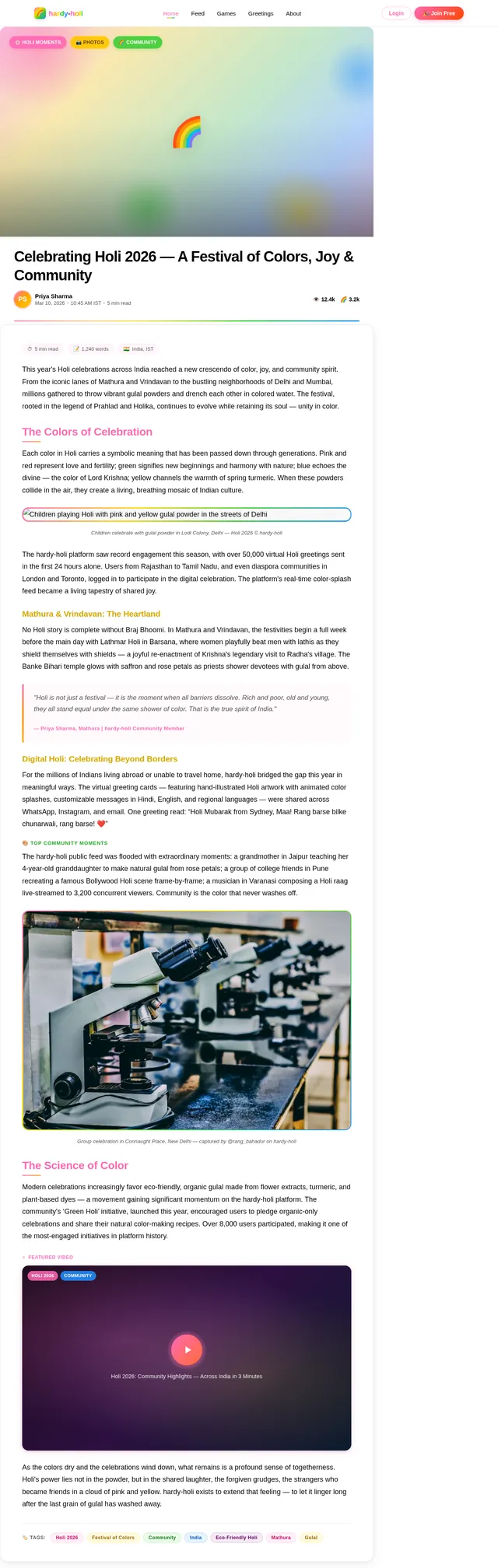
This year's Holi celebrations across India reached a new crescendo of color, joy, and community spirit. From the iconic lanes of Mathura and Vrindavan to the bustling neighborhoods of Delhi and Mumbai, millions gathered to throw vibrant gulal powders and drench each other in colored water. The festival, rooted in the legend of Prahlad and Holika, continues to evolve while retaining its soul — unity in color.
The Colors of Celebration
Each color in Holi carries a symbolic meaning that has been passed down through generations. Pink and red represent love and fertility; green signifies new beginnings and harmony with nature; blue echoes the divine — the color of Lord Krishna; yellow channels the warmth of spring turmeric. When these powders collide in the air, they create a living, breathing mosaic of Indian culture.

The hardy-holi platform saw record engagement this season, with over 50,000 virtual Holi greetings sent in the first 24 hours alone. Users from Rajasthan to Tamil Nadu, and even diaspora communities in London and Toronto, logged in to participate in the digital celebration. The platform's real-time color-splash feed became a living tapestry of shared joy.
Mathura & Vrindavan: The Heartland
No Holi story is complete without Braj Bhoomi. In Mathura and Vrindavan, the festivities begin a full week before the main day with Lathmar Holi in Barsana, where women playfully beat men with lathis as they shield themselves with shields — a joyful re-enactment of Krishna's legendary visit to Radha's village. The Banke Bihari temple glows with saffron and rose petals as priests shower devotees with gulal from above.
"Holi is not just a festival — it is the moment when all barriers dissolve. Rich and poor, old and young, they all stand equal under the same shower of color. That is the true spirit of India."
— Priya Sharma, Mathura | hardy-holi Community Member
Digital Holi: Celebrating Beyond Borders
For the millions of Indians living abroad or unable to travel home, hardy-holi bridged the gap this year in meaningful ways. The virtual greeting cards — featuring hand-illustrated Holi artwork with animated color splashes, customizable messages in Hindi, English, and regional languages — were shared across WhatsApp, Instagram, and email. One greeting read: “Holi Mubarak from Sydney, Maa! Rang barse bilke chunarwali, rang barse! ❤️”
🎨 Top Community Moments
The hardy-holi public feed was flooded with extraordinary moments: a grandmother in Jaipur teaching her 4-year-old granddaughter to make natural gulal from rose petals; a group of college friends in Pune recreating a famous Bollywood Holi scene frame-by-frame; a musician in Varanasi composing a Holi raag live-streamed to 3,200 concurrent viewers. Community is the color that never washes off.
The Science of Color
Modern celebrations increasingly favor eco-friendly, organic gulal made from flower extracts, turmeric, and plant-based dyes — a movement gaining significant momentum on the hardy-holi platform. The community's ‘Green Holi’ initiative, launched this year, encouraged users to pledge organic-only celebrations and share their natural color-making recipes. Over 8,000 users participated, making it one of the most-engaged initiatives in platform history.
Featured Video
Holi 2026: Community Highlights — Across India in 3 Minutes
0:57 / 3:00
As the colors dry and the celebrations wind down, what remains is a profound sense of togetherness. Holi's power lies not in the powder, but in the shared laughter, the forgiven grudges, the strangers who became friends in a cloud of pink and yellow. hardy-holi exists to extend that feeling — to let it linger long after the last grain of gulal has washed away.
No comments yet. Be the first!