hardy-ai
 Het Shah
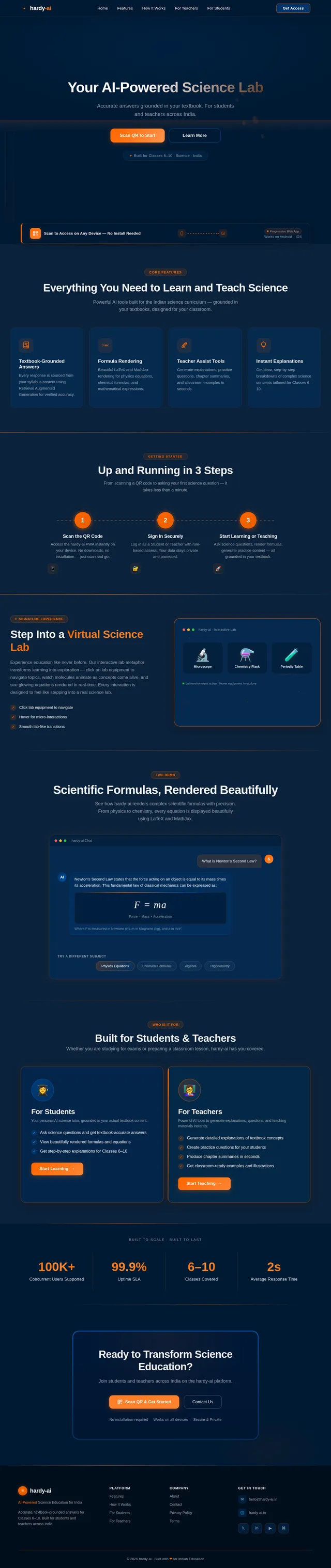
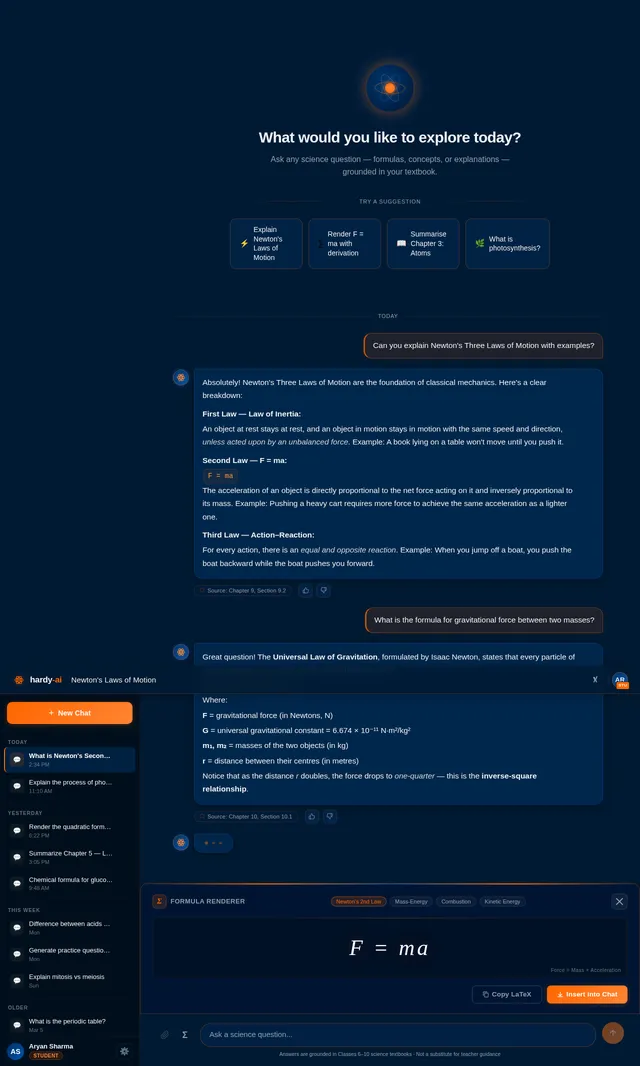
Statement of Work (SOW) Srijan Science AI – Vertical RAG System Client: Srijan Publishers Pvt. Ltd. Project: Science AI Assistant for Classes 6–10 Delivery Type: Fixed-Price MVP Pilot Platform: Web Application (PWA) 1. Project Overview Srijan Publishers intends to develop an AI-powered educational assistant designed specifically for its Science textbook series (Classes 6–10). The system will leverage Retrieval Augmented Generation (RAG) to ensure that all responses are strictly grounded in Srijan’s proprietary textbook content. The goal is to create a secure, reliable AI assistant that helps: Students resolve doubts while studying. Teachers generate explanations, examples, and teaching support materials. The system will operate on approximately 80–90 chapters across multiple science textbooks and will be accessible through a web-based Progressive Web Application (PWA). This MVP will serve as a pilot implementation before potential full-scale deployment across the entire product ecosystem. 2. Project Objectives The objectives of the Srijan Science AI system are: Build a Vertical RAG system grounded only in Srijan’s textbook content. Provide accurate scientific answers aligned with textbook explanations. Support LaTeX / MathJax rendering for physics and chemistry formulas. Ensure complete data privacy and sovereignty for proprietary textbook content. Provide a user-friendly PWA interface accessible through QR codes. 3. Scope of Work The project will include the following components. 3.1 Data Ingestion & Processing The system will ingest the Science textbooks (Classes 6–10) and convert them into structured knowledge for AI retrieval. Tasks • PDF ingestion and parsing • Text extraction from textbook chapters • Identification of sections, headings, diagrams, and formulas • Chunking of content into retrievable knowledge segments • Embedding generation for semantic search Deliverable A structured knowledge base of all textbook chapters ready for AI retrieval. 3.2 RAG-Based AI Engine The core of the system will be a Retrieval Augmented Generation architecture. Functionality When a user asks a question: The system retrieves the most relevant textbook content The AI generates an answer only from retrieved content The system displays source references Key Features • Strict grounding in textbook PDFs • No external internet knowledge usage • Context-aware responses • Source citations from textbooks 3.3 LaTeX / Scientific Formula Rendering Science content requires accurate representation of formulas. The system will support: • LaTeX • MathJax • Chemical formulas • Physics equations • Mathematical expressions Examples: Physics: E = mc² Chemistry: H₂SO₄ 3.4 Web Application (PWA) A Progressive Web Application will be developed for easy access. Features • QR-code based access from textbooks • Student chat interface • Teacher assistance tools • Response rendering with formulas Advantages • Works like a mobile app without installation • Accessible across devices • Lightweight and fast 3.5 Teacher Assistance Features Teachers will be able to use the system to: • Generate explanations of textbook concepts • Create practice questions • Generate summaries of chapters • Get examples for classroom teaching All generated content will remain grounded in textbook materials. 3.6 Security & Data Sovereignty The system will be deployed on a private cloud infrastructure. Security Features • Encrypted document storage • Role-based access control • Secure APIs • No external model training using proprietary content The client retains complete ownership of all data and content. 4. System Architecture (High-Level) The system will consist of the following components: Data Layer Textbook PDF storage Document processing pipeline Vector database AI Layer Embedding models Retrieval system LLM generation layer Application Layer Web-based PWA interface Student and teacher UI Infrastructure Layer Private cloud deployment Secure APIs Monitoring and logging 5. Technology Stack (Proposed) AI / RAG Layer • Python • LangChain / LlamaIndex • OpenAI / Claude • Vector Database (Weaviate / Pinecone / FAISS) Backend • FastAPI Frontend • ReactJS / NextJS Scientific Rendering • MathJax • KaTeX Infrastructure • AWS / Azure / Private Cloud • Docker containers • Kubernetes (optional scaling)






Comments (0)
Sign in to leave a comment

Create Practice Questions
hardy-ai · Teacher Assist
Newton's Second Law of Motion states that the acceleration of an object is directly proportional to the net force acting upon it and inversely proportional to its mass. In simpler terms: the greater the force applied to an object, the greater its acceleration; and for the same force, a heavier object accelerates less.
This law introduces the concept of a proportional relationship between cause (force) and effect (acceleration). If the mass is held constant and the force is doubled, the acceleration also doubles. If the force is held constant but the mass is halved, the acceleration doubles.
A 10 kg shopping trolley is pushed with a net force of 30 N. Using Newton's Second Law:
The trolley accelerates at 3 metres per second squared in the direction of the applied force. This principle underpins everything from vehicle dynamics to rocket propulsion in modern engineering.
No comments yet. Be the first!