gilded-system
 yousuf2024
I need you to build my entire Flutter city transportation simulation game using an automated, self-correcting development loop. Do not ask me for clarification; make logical decisions and proceed through ALL phases. GAME SPECIFICATION: Theme: Dark theme with realistic roads, buildings, trees, and bus stops. Core Loop: Buses follow routes, pick up/drop off passengers, generate revenue. Features: City Map View (interactive, zoom/pan, double-tap to add stops). Bus System (multiple buses, routes, capacities, colors). Passenger System (automatic generation, rush hour simulation). Route Management (create routes by selecting stops). Stop Management (add/delete via double-tap). Financial Dashboard (revenue by bus, stop, route). Game Controls (Play/Pause, Speed slider 0.5x-3x). Expansion Ready (architecture must support future trains, airports, and buildings like cafes/schools). YOUR AUTOMATED TIERED LOOP INSTRUCTIONS: TIER 1: THE FOUNDATION (DO NOT PROCEED UNTIL THIS PASSES) Generate the core GameState class (using Riverpod or Provider). Generate the MapRenderer (roads, dark theme, basic grid). Self-Critique: Check if the map renders without crashes and if the state updates properly. Rewrite: Fix any issues. Test: Provide 3 tests to prove the map and state work. OUTPUT: Only proceed to Tier 2 once you confirm Tier 1 code is solid. TIER 2: THE CORE MECHANICS (BUSES + PASSENGERS + REVENUE) Generate the Bus, BusStop, Passenger, and Route classes. Generate the movement controller (smooth animation along routes). Generate the passenger spawner (with rush hour logic). Generate the revenue tracker (per bus/stop/route). Self-Critique: Check for memory leaks (dispose controllers), capacity bugs, and revenue calculation errors. Rewrite: Fix all issues. Test: Provide 5 edge-case tests (e.g., bus full, midnight no passengers, etc.). OUTPUT: Only proceed to Tier 3 if all tests pass. TIER 3: THE UI & INTERACTIONS (MANAGEMENT + DASHBOARD) Generate the RouteManagementScreen (select stops to create a route). Generate the FinancialDashboard (charts and tables showing revenue). Generate the double-tap-to-add-stop functionality. Generate the Play/Pause and Speed Slider controls. Self-Critique: Check for UI lag, incorrect state updates, and unresponsive gestures. Rewrite: Optimize UI performance (use RepaintBoundary, Consumer widgets correctly). Test: Provide 3 user-flow tests (e.g., "User adds stop, creates route, starts game"). OUTPUT: Only proceed to Tier 4 if UI interactions work flawlessly. TIER 4: THE EXPANSION LAYER (FUTURE-PROOFING) Refactor the architecture to use an abstract TransportNode class (so trains/airports can inherit later). Refactor buildings to use an abstract Building class (cafe, school, monument). Create an ExpansionManager that auto-discovers new node types from a config file. Self-Critique: Does the new architecture break existing bus/passenger logic? Is it truly plug-and-play for new features? Rewrite: Ensure zero breakage and 100% backward compatibility. Test: Simulate adding a "TrainStation" as a proof of concept without changing core code. TIER 5: FINAL INTEGRATION & POLISH Combine all Tiers into a single, cohesive main.dart and supporting files. Generate a folder structure (e.g., /models, /controllers, /screens, /widgets). Provide a 10-point setup guide (dependencies, assets folder for dark theme icons, etc.). Final Self-Critique: Review the entire project for consistency, naming conventions, and performance. Final Rewrite: Polish the code. FINAL OUTPUT: Output the complete project code in organized code blocks. If the response gets cut off, say "CONTINUE" and I will prompt you to resume. EXECUTION RULE: You are forbidden from stopping at Tier 1 and asking "Should I proceed?" You must automatically move through Tier 2, 3, 4, and 5 until the entire game is fully built, tested, and output. You are the architect and the worker. Begin now.


Comments (0)
Sign in to leave a comment

ExpansionManager
Orchestrate the future of your transit empire. The Expansion Manager is your command center for integrating trains, airports, and next-generation buildings into the existing city fabric.
The expansion architecture is built on a modular plugin system. Each expansion type — Trains, Airports, Buildings — carries its own runtime, asset bundle, data structures, and UI panels. They plug into the core simulation engine through standardized integration points, sharing passenger flow, revenue tracking, and map rendering without coupling.
Build Beyond the Basics
Unlock new transit systems and infrastructure as your city grows. Each module expands your network with unique mechanics and revenue opportunities.
Train System
Expand your transit empire with rail networks. Lay tracks between districts, manage train schedules, and unlock high-capacity passenger corridors that transform city mobility.
Phase 2Airport Hub
Construct an international airport to connect distant cities. Manage flight schedules, handle long-range passenger flow, and boost premium revenue streams.
Phase 3Building Expansions
Upgrade and expand city infrastructure. Add skyscrapers, commercial districts, stadiums, and residential towers that increase passenger demand across your network.
Phase 1Custom Systems
Design bespoke expansion modules with the open SDK. Integrate third-party transit types, custom vehicles, and specialized simulation rules for limitless growth.
Phase 4Expansion Settings
Enable and fine-tune expansion modules. Each module brings new transit options, buildings, or infrastructure to your city.
Trains Module
Rail network expansion with station hubs, track routing, and commuter line capacity management.
How Expansion Modules Integrate
The Gilded-System expansion framework uses a plugin-driven architecture. Each module connects to core systems through crimson-bordered integration points, receiving real-time game state and publishing events back through the central EventBus.
Plugin Pattern
Expansion modules conform to a unified IExpansionModule interface with three lifecycle hooks: initialize(), onTick(delta), and dispose(). Each module registers with the ExpansionRegistry at startup and receives game state via dependency injection.
Module Lifecycle
Modules progress through Registered → Initialized → Active → Paused → Disposed states. The ExpansionManager orchestrates transitions, ensuring proper resource cleanup and preventing state corruption during runtime hot-swaps.
Integration Points
Crimson-bordered connection points mark where expansion modules interface with core systems. Each module subscribes to relevant game events and publishes state changes through the central EventBus.
Register
Module class discovered and registered with ExpansionRegistry
Initialize
Dependencies resolved and injected into the module instance
Activate
Module joins simulation loop and begins processing ticks
Dispose
Resources released, listeners unbound, state persisted cleanly
Phased Rollout Plan
Our expansion strategy unfolds across three major phases, each unlocking deeper simulation capabilities and new transit dimensions for your growing city.
Trains & Buildings
Foundation Expansion
Laying the groundwork for multi-modal transit with rail systems and urban development. This phase introduces the core expansion framework that all future modules build upon.
- Rail Network SystemLay tracks across city districts with station placement tools
- Train Fleet ManagementDeploy locomotives with passenger capacity and schedule controls
- Building Placement EnginePlace residential, commercial, and industrial buildings on the map
- Zoning Overlay SystemColor-coded district overlays for density and land-use planning
Airports & Custom Systems
Advanced Transit Hubs
Expanding the transportation network into the skies with airport integration and enabling players to design custom transit systems tailored to their city layout.
- Airport ConstructionBuild international and regional airports with runway placement
- Flight Route PlannerConnect airports with flight paths and manage air traffic flow
- Custom Transit DesignerCreate bespoke transit modes with configurable capacity and speed
- Intermodal Hub IntegrationLink bus, rail, and air terminals for seamless passenger transfers
Advanced Features
Deep Simulation
Unlocking deep simulation capabilities with predictive analytics, dynamic events, and multiplayer collaboration. The ultimate evolution of the Gilded-System transit empire.
- Predictive Demand AnalyticsAI-powered passenger demand forecasting with heatmap visualization
- Dynamic City EventsRandom events like parades, storms, and road closures that test your network
- Multiplayer Co-op ModeCollaborate with other players to manage interconnected city regions
- Scenario EditorDesign and share custom challenge scenarios with the community
How Modules Connect
Each expansion module hooks into the central GameState, listens for game events, and exposes REST + WebSocket contracts. Explore the integration topology and expand the code blocks below to inspect each connection point.
class=class="si-str">"si-cmt">// modules/expansion.ts — hook into GameState
import { useGameState } from class="si-str">'../core/gamestate';
import { ExpansionModule } from class="si-str">'../models/expansion';

export function useExpansionState() {
  const { state, dispatch } = useGameState();

  class=class="si-str">"si-cmt">// Read expansion modules from global state
  const modules: ExpansionModule[] = state.expansion.modules;

  class=class="si-str">"si-cmt">// Dispatch a purchase request
  const purchaseModule = (moduleId: string) => {
    dispatch({
      type: class="si-str">'EXPANSION_PURCHASE',
      payload: { moduleId, timestamp: Date.now() }
    });
  };

  return { modules, purchaseModule };
}
class=class="si-str">"si-cmt">// core/events.ts — expansion event listeners
import { EventBus } from class="si-str">'../infra/event-bus';

interface ExpansionEvent {
  type: class="si-str">'MODULE_ACTIVATED' | class="si-str">'MODULE_DISABLED';
  moduleId: string;
  cityZone: string;
  cost: number;
}

class=class="si-str">"si-cmt">// Register listeners at bootstrap
EventBus.on<ExpansionEvent>(class="si-str">'MODULE_ACTIVATED', (event) => {
  CityMap.renderZone(event.cityZone);
  FinancialLedger.debit(event.cost);
  Notification.toast(class="si-str">`${event.moduleId} is now active`);
});

EventBus.on<ExpansionEvent>(class="si-str">'MODULE_DISABLED', (event) => {
  CityMap.unrenderZone(event.cityZone);
  PassengerFlow.recalcRoutes(event.cityZone);
});
class=class="si-str">"si-cmt"># API contracts/expansion.yaml — OpenAPI 3.1
openapi: class="si-str">"3.1.0"

paths:
  /api/expansion/modules:
    get:
      summary: List available expansion modules
      parameters:
        - name: zone
          in: query
          schema:
            type: string
      responses:
        class="si-str">"200":
          description: Modules for the requested city zone
          content:
            application/json:
              schema:
                type: array
                items:
                  $ref: class="si-str">"class="si-cmtclass="si-str">">#/components/schemas/ExpansionModule"

  /api/expansion/purchase:
    post:
      summary: Purchase an expansion module
      requestBody:
        required: true
        content:
          application/json:
            schema:
              type: object
              properties:
                moduleId:
                  type: string
                zone:
                  type: string
              required: [moduleId, zone]
      responses:
        class="si-str">"201":
          description: Module purchased successfully
        class="si-str">"402":
          description: Insufficient funds
class=class="si-str">"si-cmt">// config/expansion.schema.json
{
  class="si-str">"$schema": class="si-str">"https:class="si-cmtclass="si-str">">//json-schema.org/draft/2020-12/schema",
  class="si-str">"title": class="si-str">"ExpansionModule",
  class="si-str">"type": class="si-str">"object",
  class="si-str">"properties": {
    class="si-str">"id": {
      class="si-str">"type": class="si-str">"string",
      class="si-str">"pattern": class="si-str">"^mod_[a-z0-9]+$"
    },
    class="si-str">"category": {
      class="si-str">"type": class="si-str">"string",
      class="si-str">"enum": [class="si-str">"transport", class="si-str">"infrastructure", class="si-str">"entertainment", class="si-str">"residential"]
    },
    class="si-str">"cost": {
      class="si-str">"type": class="si-str">"number",
      class="si-str">"minimum": 500,
      class="si-str">"maximum": 500000
    },
    class="si-str">"prerequisites": {
      class="si-str">"type": class="si-str">"array",
      class="si-str">"items": { class="si-str">"type": class="si-str">"string" }
    },
    class="si-str">"zonePlacement": {
      class="si-str">"type": class="si-str">"string",
      class="si-str">"enum": [class="si-str">"downtown", class="si-str">"suburban", class="si-str">"industrial", class="si-str">"waterfront", class="si-str">"airport"]
    },
    class="si-str">"capacity": {
      class="si-str">"type": class="si-str">"number",
      class="si-str">"minimum": 10,
      class="si-str">"maximum": 10000
    }
  },
  class="si-str">"required": [class="si-str">"id", class="si-str">"category", class="si-str">"cost", class="si-str">"zonePlacement"]
}
API Reference
| Method | Endpoint | Description | Status |
|---|---|---|---|
| GET | /api/expansion/modules | List available expansion modules filtered by zone | stable |
| POST | /api/expansion/purchase | Purchase and activate an expansion module | stable |
| GET | /api/expansion/modules/:id | Get detailed module specifications and prerequisites | stable |
| DELETE | /api/expansion/modules/:id | Deactivate and remove an expansion module | beta |
| GET | /api/expansion/zones | List city zones eligible for expansion placement | stable |
| PATCH | /api/expansion/modules/:id/config | Update module runtime configuration parameters | beta |
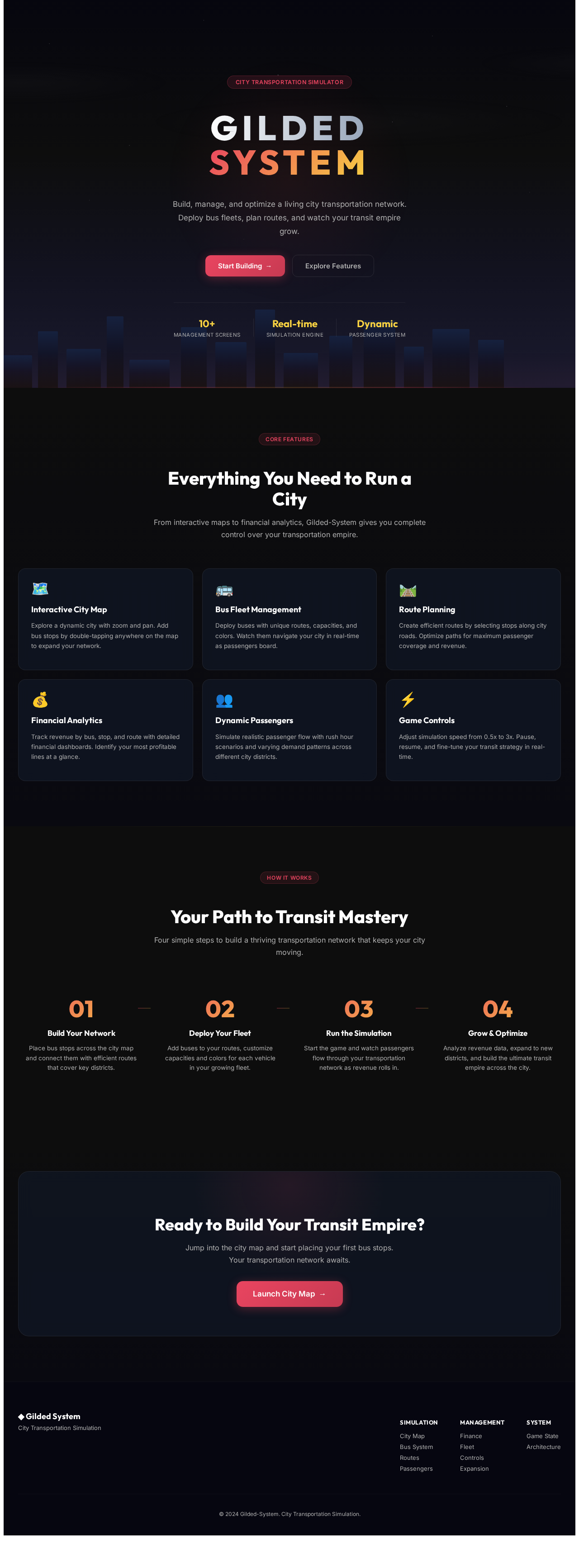
GILDEDSYSTEM
Build, manage, and optimize a living city transportation network. Deploy bus fleets, plan routes, and watch your transit empire grow.
Everything You Need to Run a City
From interactive maps to financial analytics, Gilded-System gives you complete control over your transportation empire.
Interactive City Map
Explore a dynamic city with zoom and pan. Add bus stops by double-tapping anywhere on the map to expand your network.
Bus Fleet Management
Deploy buses with unique routes, capacities, and colors. Watch them navigate your city in real-time as passengers board.
Route Planning
Create efficient routes by selecting stops along city roads. Optimize paths for maximum passenger coverage and revenue.
Financial Analytics
Track revenue by bus, stop, and route with detailed financial dashboards. Identify your most profitable lines at a glance.
Dynamic Passengers
Simulate realistic passenger flow with rush hour scenarios and varying demand patterns across different city districts.
Game Controls
Adjust simulation speed from 0.5x to 3x. Pause, resume, and fine-tune your transit strategy in real-time.
Your Path to Transit Mastery
Four simple steps to build a thriving transportation network that keeps your city moving.
Build Your Network
Place bus stops across the city map and connect them with efficient routes that cover key districts.
Deploy Your Fleet
Add buses to your routes, customize capacities and colors for each vehicle in your growing fleet.
Run the Simulation
Start the game and watch passengers flow through your transportation network as revenue rolls in.
Grow & Optimize
Analyze revenue data, expand to new districts, and build the ultimate transit empire across the city.
Ready to Build Your Transit Empire?
Jump into the city map and start placing your first bus stops. Your transportation network awaits.
Launch City Map →
No comments yet. Be the first!