emerald-bot
 East Los
Act as a Principal MEV (Maximal Extractable Value) R&D Engineer and a Senior Solidity Security Auditor specializing in low-latency EVM arbitrage systems on high-throughput networks. I want to build a highly competitive, production-grade cross-DEX flash loan arbitrage bot for Polygon Mainnet. The architecture must be heavily inspired by the core structural philosophy of the 'pmuens/midas' framework but radically modernized to compete in today's cutthroat MEV environment. Generate the code base according to the exact architectural specifications, structural parameters, and execution protocols outlined below. 1. SYSTEM PARAMETERS & ENVIRONMENTAL BOUNDS Network: Polygon Mainnet (Gas asset: POL / Base trading asset: Native USDC) Flash Loan Source: Balancer V2 Vault (Address: 0xBA12222222228d8Ba445958a75a0704d566BF2C8) for 0% fee asset borrowing. Target DEX Liquidity Pools: QuickSwap V2 (Uniswap V2 Clone) and SushiSwap V2. Development Framework: Foundry (Solidity ^0.8.20) for the smart contracts; TypeScript (ethers.js v6) for the off-chain orchestration engine. 2. CORE COMPONENTS REQUIRED COMPONENT A: The Smart Contract ('MidasPolygonEngine.sol') Write a highly gas-optimized, production-ready Solidity contract that implements the Balancer V2 Flash Loan receiver interface ('IFlashLoanRecipient'). Gas Optimization Rules: Optimize for bytecode compactness and minimal runtime overhead. Use custom errors instead of string require statements. Use 'unchecked {}' blocks for arithmetic loops and balance changes where overflow is mathematically impossible. Avoid high-level abstractions like routers. Direct Pool Routing: The contract must execute swaps by calling the liquidity pool pair contracts directly via '.swap()' instead of using high-level router contracts (like QuickSwapRouter). Strict Execution Safety: Implement a bulletproof safeguard. At the end of the callback function—immediately before the Balancer Vault pulls back the loan principal—the contract must verify that the ending balance of the profit token (USDC) is greater than the starting balance plus an off-chain parameterized 'minProfitThreshold'. If this condition fails, the contract must explicitly revert the entire transaction transaction string to prevent capital loss. Access Control: Secure the trigger mechanism so that only the owner's monitoring bot address can call the execution entry point, completely preventing external actors from frontrunning or hijacking the execution. COMPONENT B: The Node Engine ('monitor.ts') Write a highly optimized TypeScript orchestration script that acts as the real-time data ingestion and calculations hub. Event-Driven Architecture: Do not use interval JSON-RPC block polling. Use a high-fidelity WebSocket provider ('wss://') to subscribe directly to the 'Sync(uint112,uint112)' or 'Swap' event logs emitted directly by the target QuickSwap and SushiSwap pair contracts. Math Engine (Optimal Input Calculation): Implement the standard AMM optimal input amount formula for two constant-product (x * y = k) Uniswap V2 pairs to calculate the mathematically perfect input amount (A_in) that maximizes arbitrage yield given the exact reserves extracted from the latest 'Sync' logs. The equation must natively factor in the standard 0.3% fee modifier (gamma = 0.997). MEV Guardrail & Private Relaying: Structure the transaction submission logic to bypass the public Polygon mempool entirely to prevent frontrunning and sandwich attacks. Integrate the transaction dispatch code with the FastLane Protocol API or Flashbots Polygon Builder endpoint, sending the execution payload as a private bundle.


Comments (0)
Sign in to leave a comment
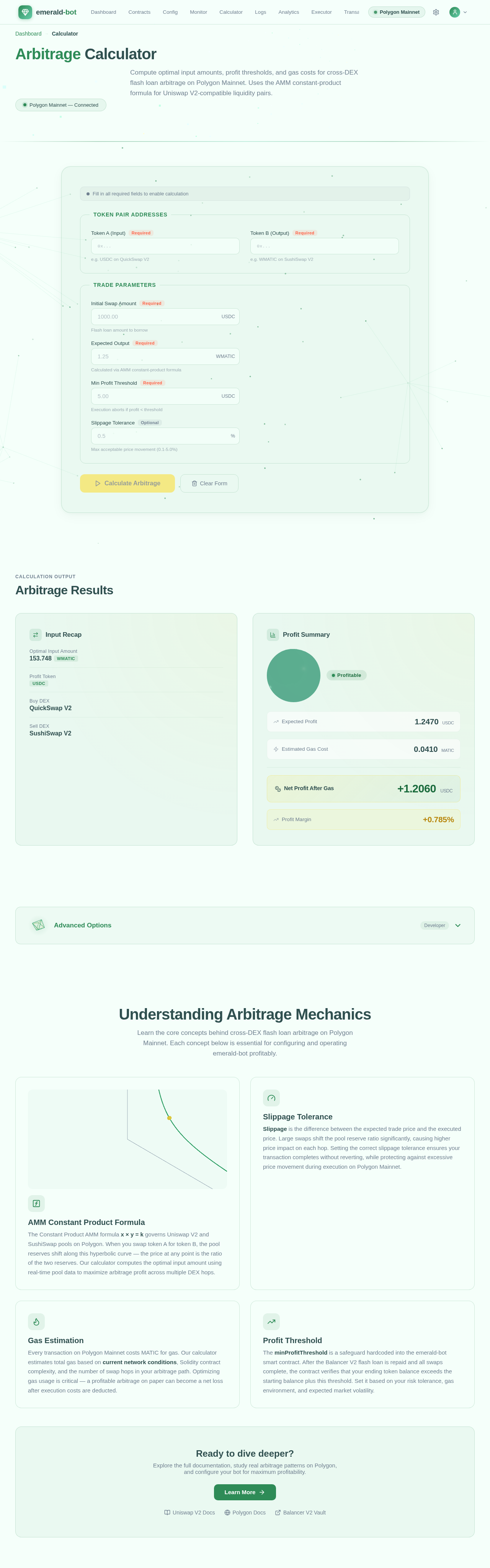
Arbitrage Calculator
Compute optimal input amounts, profit thresholds, and gas costs for cross-DEX flash loan arbitrage on Polygon Mainnet. Uses the AMM constant-product formula for Uniswap V2-compatible liquidity pairs.
Calculation Output
Arbitrage Results
Understanding Arbitrage Mechanics
Learn the core concepts behind cross-DEX flash loan arbitrage on Polygon Mainnet. Each concept below is essential for configuring and operating emerald-bot profitably.
AMM Constant Product Formula
The Constant Product AMM formula x × y = k governs Uniswap V2 and SushiSwap pools on Polygon. When you swap token A for token B, the pool reserves shift along this hyperbolic curve — the price at any point is the ratio of the two reserves. Our calculator computes the optimal input amount using real-time pool data to maximize arbitrage profit across multiple DEX hops.
Slippage Tolerance
Slippage is the difference between the expected trade price and the executed price. Large swaps shift the pool reserve ratio significantly, causing higher price impact on each hop. Setting the correct slippage tolerance ensures your transaction completes without reverting, while protecting against excessive price movement during execution on Polygon Mainnet.
Gas Estimation
Every transaction on Polygon Mainnet costs MATIC for gas. Our calculator estimates total gas based on current network conditions, Solidity contract complexity, and the number of swap hops in your arbitrage path. Optimizing gas usage is critical — a profitable arbitrage on paper can become a net loss after execution costs are deducted.
Profit Threshold
The minProfitThreshold is a safeguard hardcoded into the emerald-bot smart contract. After the Balancer V2 flash loan is repaid and all swaps complete, the contract verifies that your ending token balance exceeds the starting balance plus this threshold. Set it based on your risk tolerance, gas environment, and expected market volatility.
Ready to dive deeper?
Explore the full documentation, study real arbitrage patterns on Polygon, and configure your bot for maximum profitability.
Learn More
No comments yet. Be the first!