
Task 1of three
Pneumonia detectionChest X-ray
Binary classification (pneumonia vs. normal).
- Pneumonia
- Normal
 Mitanshu Chauhan


Sign in to leave a comment
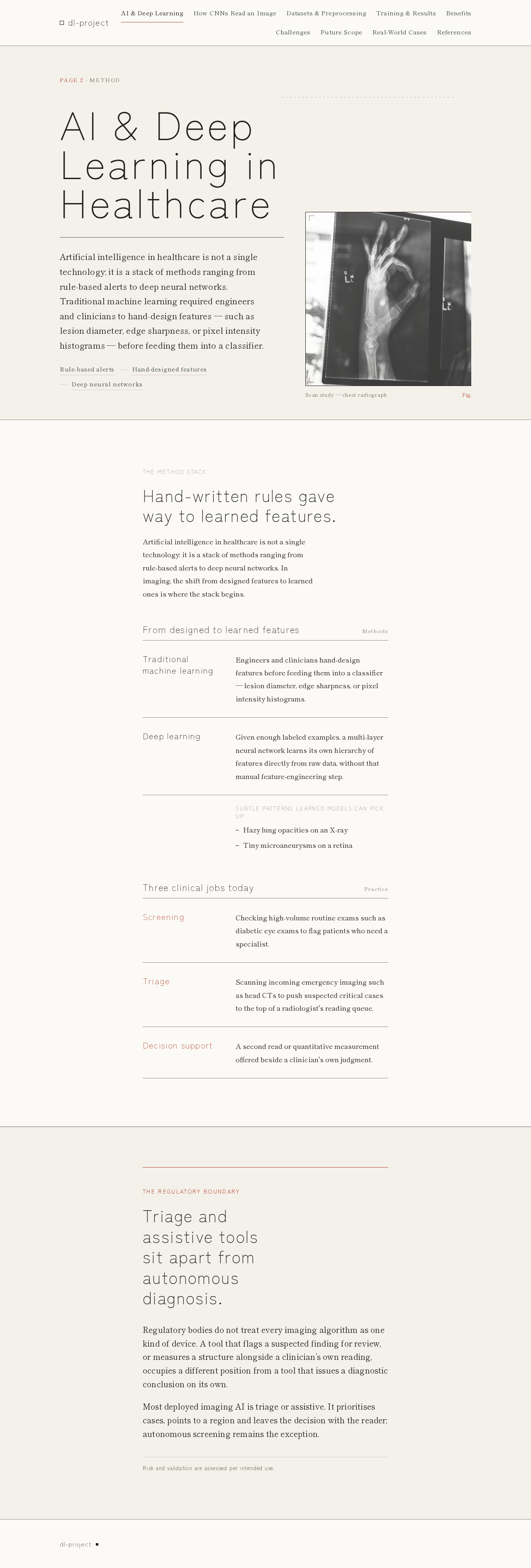
Page 2Method
Artificial intelligence in healthcare is not a single technology; it is a stack of methods ranging from rule-based alerts to deep neural networks. Traditional machine learning required engineers and clinicians to hand-design features — such as lesion diameter, edge sharpness, or pixel intensity histograms — before feeding them into a classifier.
The method stack
Artificial intelligence in healthcare is not a single technology; it is a stack of methods ranging from rule-based alerts to deep neural networks. In imaging, the shift from designed features to learned ones is where the stack begins.
Subtle patterns learned models can pick up
Regulatory bodies do not treat every imaging algorithm as one kind of device. A tool that flags a suspected finding for review, or measures a structure alongside a clinician’s own reading, occupies a different position from a tool that issues a diagnostic conclusion on its own.
Most deployed imaging AI is triage or assistive. It prioritises cases, points to a region and leaves the decision with the reader; autonomous screening remains the exception.
Risk and validation are assessed per intended use.
dl-project · Page 1 of 10 · Problem statement
Three tasks, published benchmarks, and the points where models fail.
Read the evidenceProject scope at a glance
Task 1of three
Binary classification (pneumonia vs. normal).

Task 2of three
Four-class classification (glioma, meningioma, pituitary tumor, no tumor).
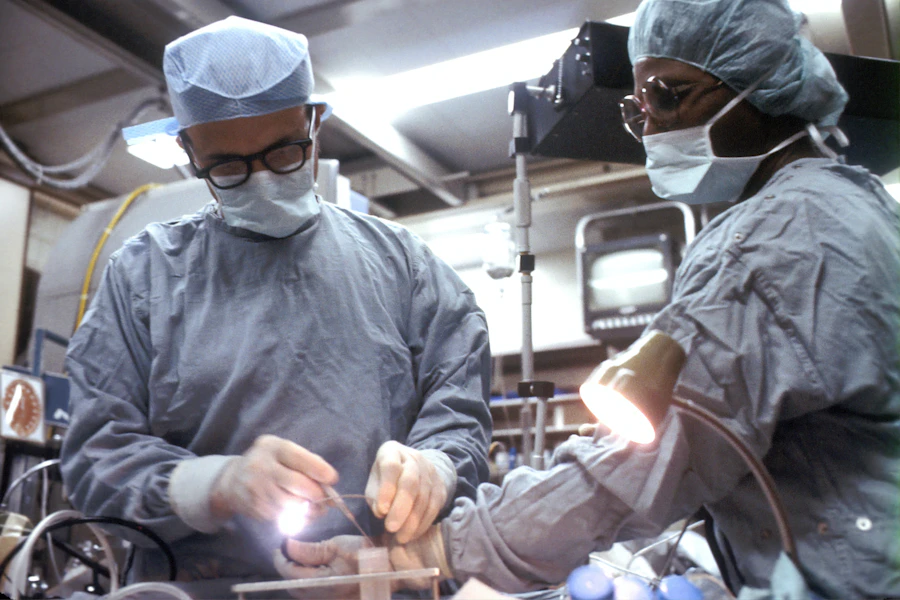
Task 3of three
Severity grading and detection of referable disease.
Rather than treating deep learning as a black box that “replaces doctors,” this site walks through the full pipeline from raw pixels to clinical deployment.
How CNNs extract visual features from the pixel grid of a scan.
How public medical datasets are prepared before any model sees them.
How our three models compare against published benchmarks.
Why real-world deployment depends as much on handling bias, privacy and false negatives as on test-set accuracy.
High internal test-set scores, even above 95%, do not guarantee clinical readiness. Models that look strong on held-out splits from the same dataset can drop sharply when tested at a new hospital.
Read the evidence
No comments yet. Be the first!