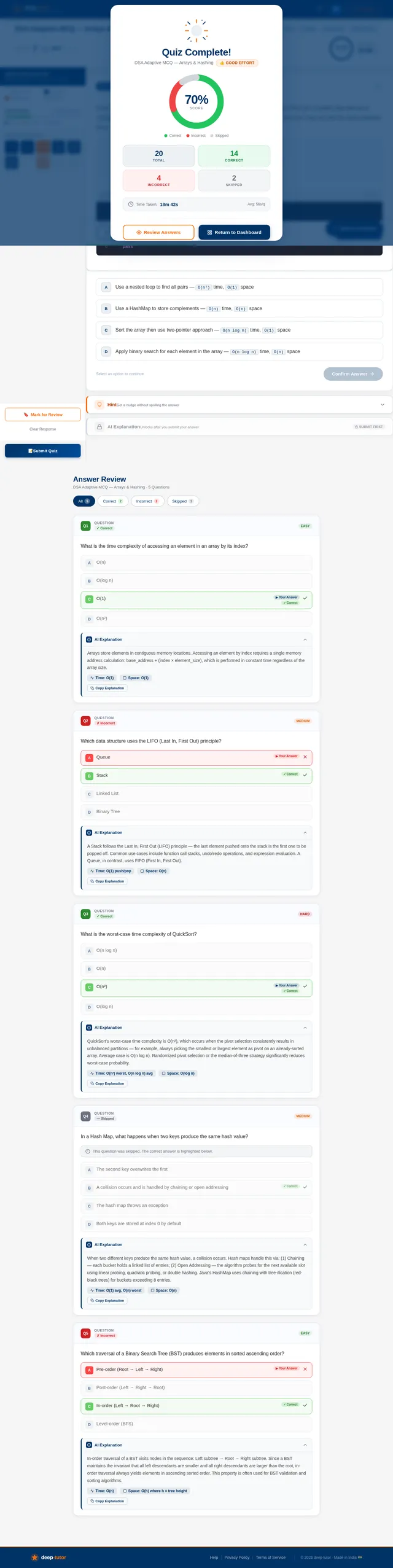
Practice Similar Problems
Coding PracticeSharpen your skills with handpicked problems that match your weak areas — Arrays, Hashing, and Sliding Window.
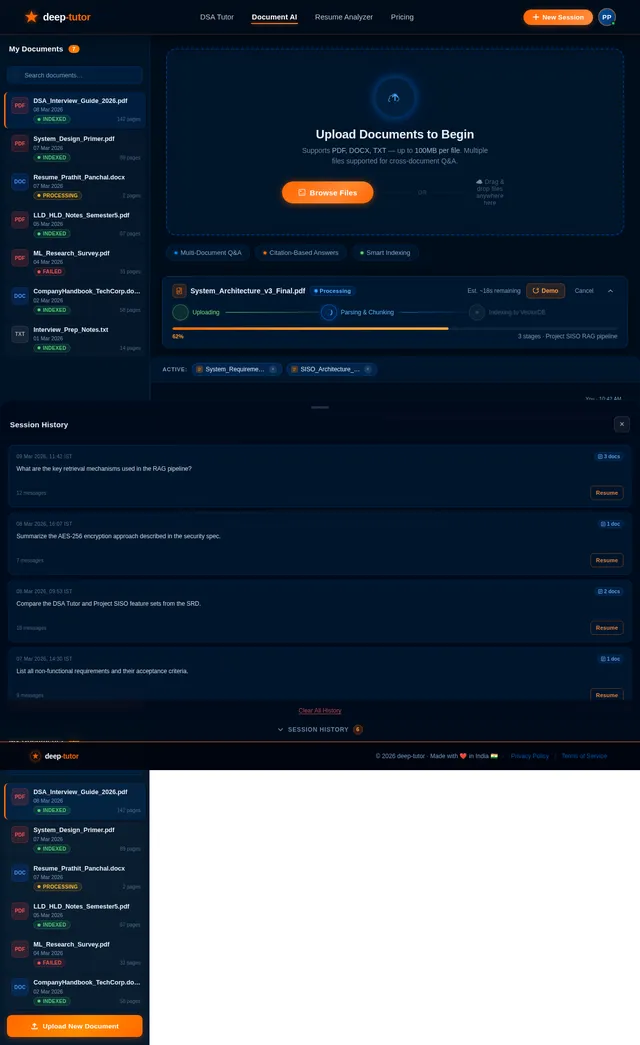
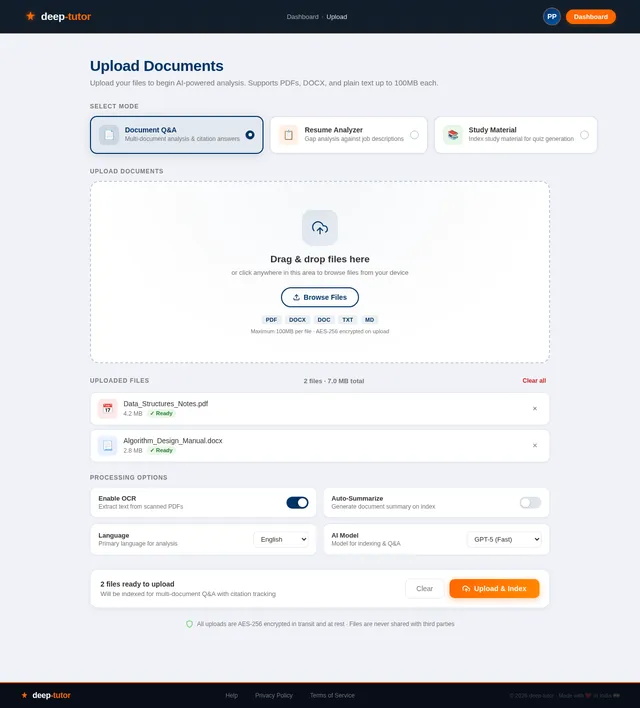
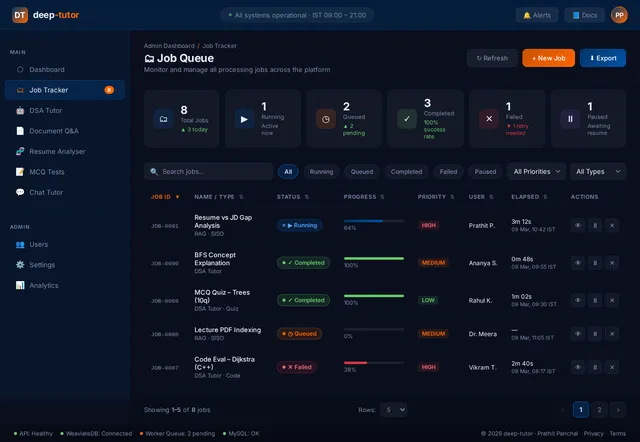
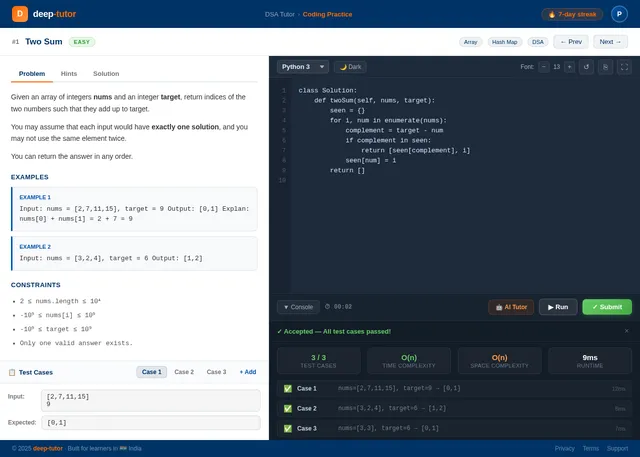
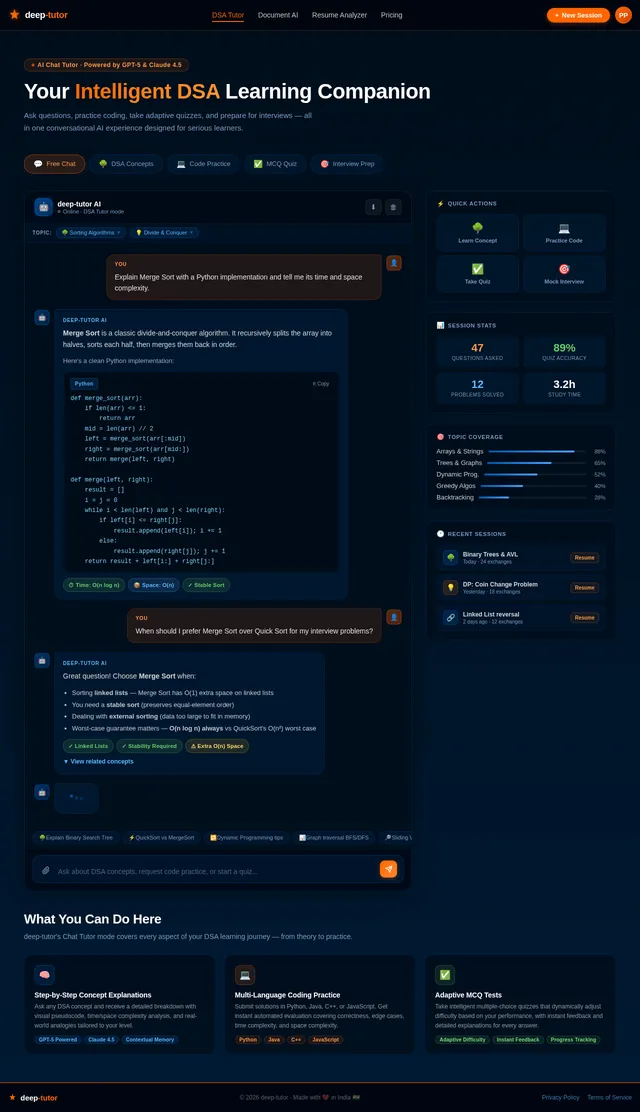
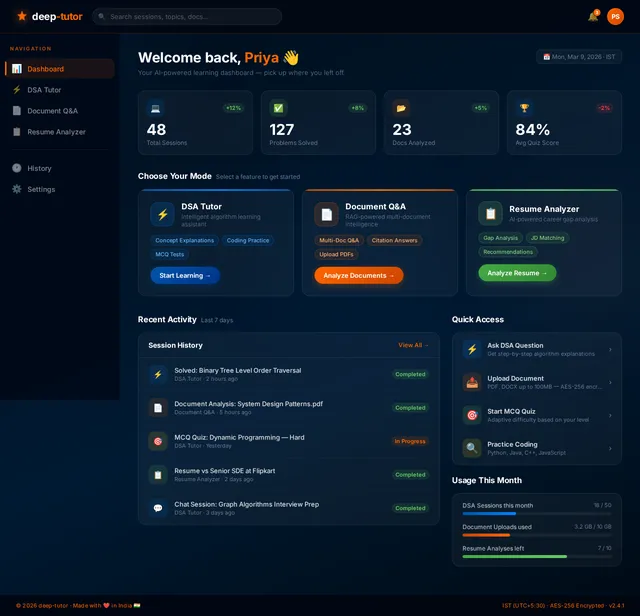
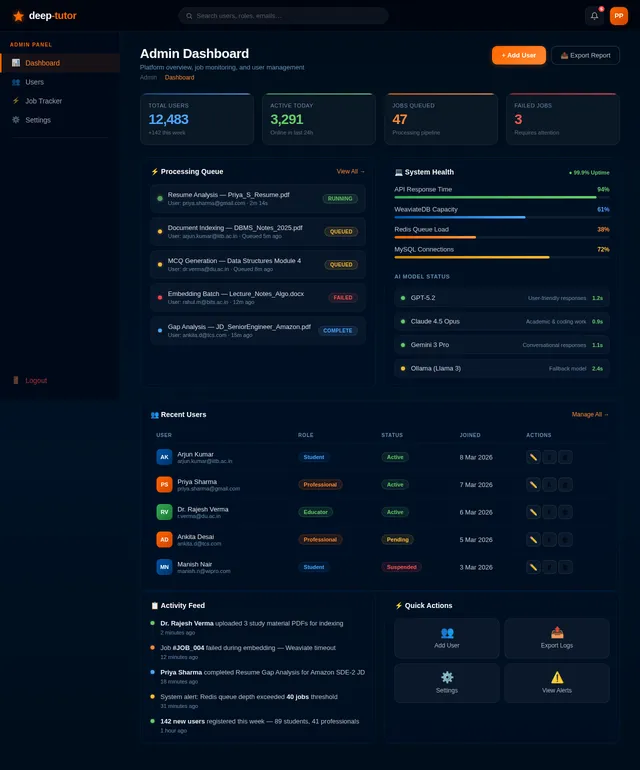
Open Coding Practicecreate a fully function AI dsa tutor with the following functionalities Your project **“AI-Powered DSA Learning & Document Analysis Platform”** combines two major systems: * **DSA Tutor (Intelligent Learning Assistant)** * **Project SISO (RAG-based Document Intelligence System)** Together they form a **multi-capability AI platform** for learning, coding practice, and document analysis. Below is a **clear, structured list of the combined functionalities**. --- # Combined Functionalities of AI Tutor + Project SiSo ## 1. Intelligent DSA Learning System Provides **concept explanations for Data Structures and Algorithms**. **Capabilities** * Step-by-step explanations * Text-based diagrams * Concept breakdown from basic → advanced * Context-aware follow-up questions **Example** User asks: *“Explain Dynamic Programming”* System provides: * Definition * Intuition * Example problems * Diagram explanation * Complexity discussion --- # 2. Coding Practice & Evaluation Engine Users can **solve coding problems and receive automated evaluation**. ### Features * Multi-language coding support * Python * Java * C++ * JavaScript * Code analysis includes: * Correctness validation * Time complexity analysis * Space complexity analysis * Optimal vs brute-force detection * Improvement suggestions **Example** User submits solution for **Two Sum** System evaluates: ``` Correctness: Passed Time Complexity: O(n²) Optimal Solution: O(n) using HashMap ``` --- # 3. MCQ Test Generation & Knowledge Assessment System can generate **adaptive quizzes for concept reinforcement.** ### Capabilities * Dynamic MCQ generation * Difficulty levels (Easy / Medium / Hard) * Instant evaluation * Explanation for correct answer * Performance feedback --- # 4. Conversational AI Tutor Acts as a **general AI assistant for learning discussions.** ### Capabilities * Free chat mode * Doubt solving * Interview preparation * Concept comparisons Example queries: * “Difference between BFS and DFS” * “Explain heap vs priority queue” --- # 5. Intelligent Intent Detection The system automatically **detects what the user wants**. ### Possible intents | User Input | System Mode | | ---------------------- | ------------- | | Explain Graphs | Learning Mode | | Solve LeetCode problem | Coding Mode | | Give MCQs on Trees | Test Mode | | General question | Chat Mode | This routing ensures **correct handler execution**. --- # 6. Multi-Document Question Answering (RAG) Project SiSo allows users to **ask questions across multiple documents.** ### Supported documents * DOCX * Study material * Notes * Resume * Job descriptions ### Process ``` Document Upload → Parsing + OCR → Chunking → Embedding generation → Weaviate indexing → Retrieval → LLM answer generation ``` --- # 7. Citation-Based Answer Generation All answers from documents include **precise citations.** Format: ``` [doc_id:page_number:chunk_index] ``` Example: ``` The transformer architecture relies on self-attention [doc1:3:2] ``` This ensures **traceability and reliability of information**. --- # 8. Resume vs Job Description Analysis The system performs **career gap analysis**. ### Features * Resume parsing * JD parsing * Skill gap identification * Improvement suggestions Example output: ``` Missing Skills: - Kubernetes - Docker - GraphQL Recommendation: Learn container orchestration and API frameworks. ``` --- # 9. Study Material Question Answering Students can upload **lecture notes or textbooks**. Capabilities: * Ask conceptual questions * Extract summaries * Generate explanations * Retrieve exact references Example: ``` Q: Explain Gradient Descent ``` Answer retrieved from uploaded lecture notes. --- # 10. High-Availability AI Architecture System ensures **reliable LLM responses**. ### Model pipeline Primary model ``` Google Gemini ``` Fallback model ``` Ollama (Local Llama 3) ``` Mechanism: ``` Gemini request → if failure → automatic fallback to Ollama ``` --- # 11. Asynchronous Processing Pipeline Heavy tasks run **as background jobs**. Architecture: ``` User Request ↓ FastAPI API ↓ Redis Queue ↓ Worker ↓ Processing ↓ Result Retrieval ``` Benefits: * Scalable * Non-blocking API * Handles large documents --- # 12. Hybrid Search Retrieval System Uses **two retrieval methods together**. | Method | Purpose | | ------------- | ---------------- | | Vector Search | semantic meaning | | BM25 | keyword matching | This hybrid search improves **retrieval accuracy**. --- # 13. Multi-Document Knowledge Indexing The system supports **grouped document search**. Metadata stored in vector database: ``` doc_id doc_group_id source_file page_number chunk_index ``` This allows: * Cross-document answers * grouped search results --- # 14. Job Status Tracking System Users can track processing progress. Endpoints: ``` POST /submit_job GET /job_status/{job_id} GET /get_result/{doc_id} ``` Example status: ``` Processing: Chunking documents Processing: Generating embeddings Completed ``` --- # 15. Interactive Frontend Workflow The UI supports **three stages**: ### 1️⃣ Input Stage * Upload documents * Enter questions ### 2️⃣ Processing Stage * Progress polling * Loading indicators ### 3️⃣ Result Stage * AI generated answers * Citation references * Analysis reports --- # Final Combined Platform Vision The system ultimately acts as a **unified AI knowledge platform** capable of: | Domain | Capability | | ------------ | --------------------- | | Learning | DSA tutor | | Coding | Practice + evaluation | | Testing | MCQ quizzes | | Conversation | AI discussion | | Documents | RAG Q&A | | Career | Resume analysis | --- ✅ **In one sentence (interview ready):** > The platform integrates an AI-driven DSA tutoring system with a Retrieval-Augmented Generation (RAG) document intelligence engine, enabling interactive algorithm learning, automated code evaluation, adaptive testing, multi-document question answering with citations, and AI-based resume-job description gap analysis within a unified scalable architecture.

Sign in to leave a comment
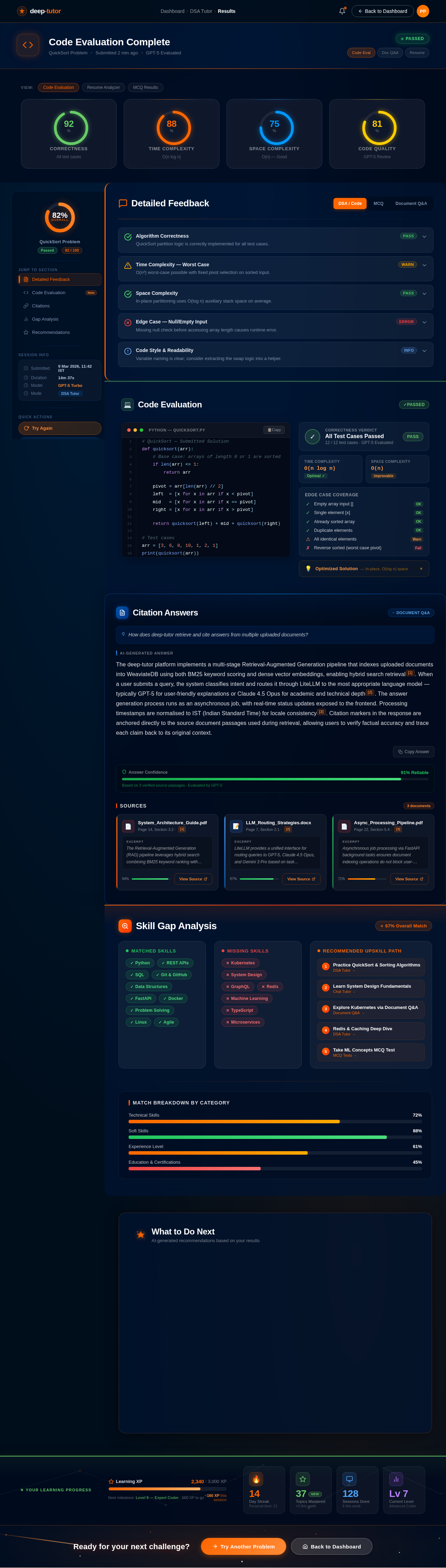
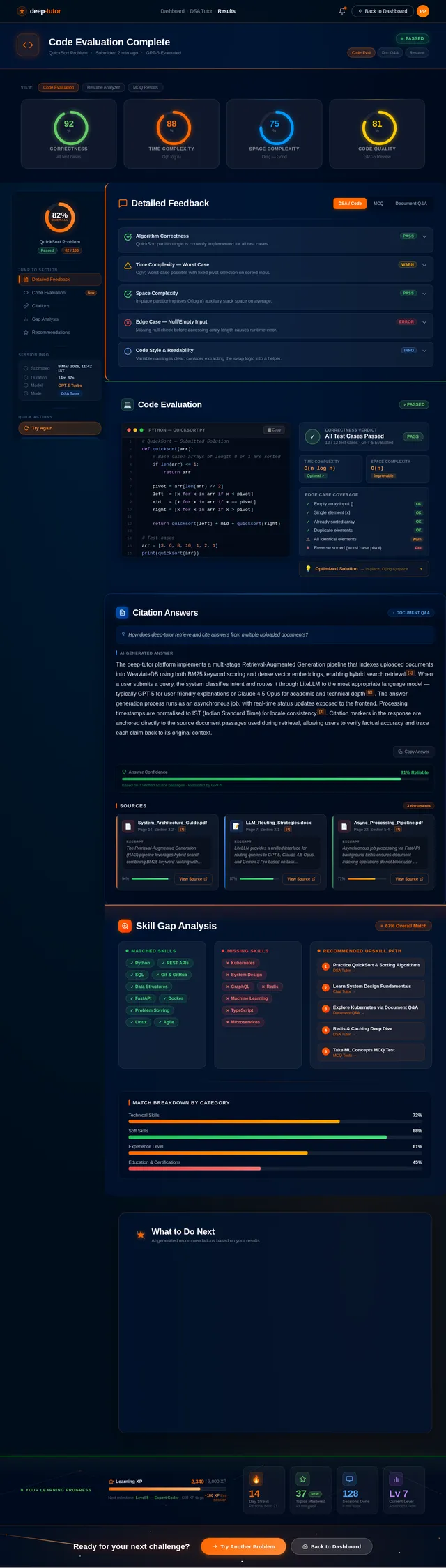
| 1 | # QuickSort — Submitted Solution |
| 2 | def quicksort(arr): |
| 3 | # Base case: arrays of length 0 or 1 are sorted |
| 4 | if len(arr) <= 1: |
| 5 | return arr |
| 6 | |
| 7 | pivot = arr[len(arr) // 2] |
| 8 | left = [x for x in arr if x < pivot] |
| 9 | mid = [x for x in arr if x == pivot] |
| 10 | right = [x for x in arr if x > pivot] |
| 11 | |
| 12 | return quicksort(left) + mid + quicksort(right) |
| 13 | |
| 14 | # Test cases |
| 15 | arr = [3, 6, 8, 10, 1, 2, 1] |
| 16 | print(quicksort(arr)) |
How does deep-tutor retrieve and cite answers from multiple uploaded documents?
The deep-tutor platform implements a multi-stage Retrieval-Augmented Generation pipeline that indexes uploaded documents into WeaviateDB using both BM25 keyword scoring and dense vector embeddings, enabling hybrid search retrieval[1]. When a user submits a query, the system classifies intent and routes it through LiteLLM to the most appropriate language model — typically GPT-5 for user-friendly explanations or Claude 4.5 Opus for academic and technical depth[2]. The answer generation process runs as an asynchronous job, with real-time status updates exposed to the frontend. Processing timestamps are normalised to IST (Indian Standard Time) for locale consistency[3]. Citation markers in the response are anchored directly to the source document passages used during retrieval, allowing users to verify factual accuracy and trace each claim back to its original context.
The Retrieval-Augmented Generation (RAG) pipeline leverages hybrid search combining BM25 keyword ranking with semantic vector similarity via WeaviateDB, enabling high-precision document retrieval even across heterogeneous corpora.
LiteLLM provides a unified interface for routing queries to GPT-5, Claude 4.5 Opus, and Gemini 3 Pro based on task classification, cost thresholds, and latency requirements, with automatic fallback on model degradation.
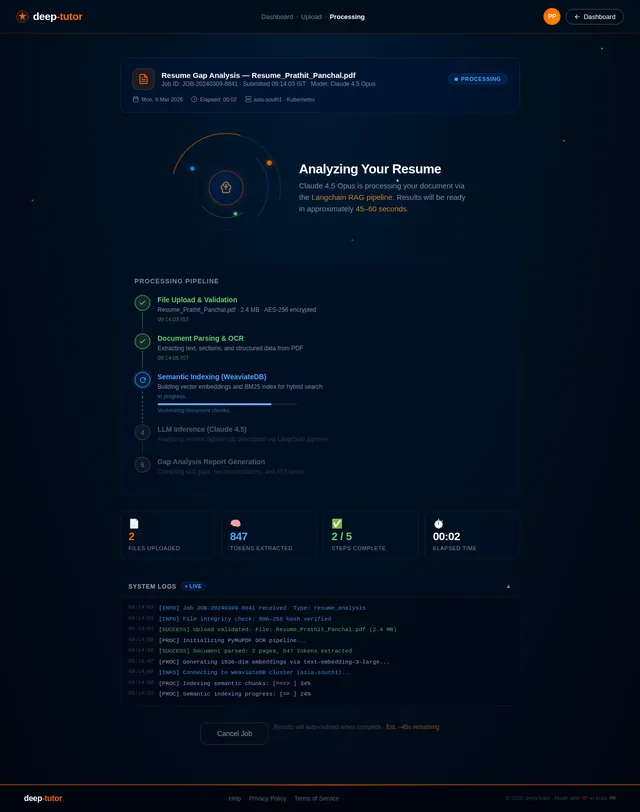
Asynchronous job processing via FastAPI background tasks ensures document indexing operations do not block user-facing API responses. Job status tracking is exposed via polling endpoints with IST-localised timestamps.
Practice QuickSort & Sorting Algorithms
DSA Tutor→Learn System Design Fundamentals
Chat Tutor→Explore Kubernetes via Document Q&A
Document Q&A→Redis & Caching Deep Dive
DSA Tutor→Take ML Concepts MCQ Test
MCQ Tests→AI-generated recommendations based on your results
Practice Similar Problems
Coding PracticeSharpen your skills with handpicked problems that match your weak areas — Arrays, Hashing, and Sliding Window.
Open Coding PracticeReview Weak Concepts
DSA TutorGet step-by-step AI explanations for Time Complexity and Dynamic Programming — your two lowest-scoring areas.
Go to DSA TutorTake an Adaptive MCQ Test
MCQ TestTest your understanding with an auto-generated adaptive quiz targeting your identified knowledge gaps.
Start MCQ TestChat with AI Tutor
AI Chat TutorHave a free-form conversation about today's results — ask follow-up questions or prep for your next interview.
Open AI ChatNext milestone: Level 8 — Expert Coder · 660 XP to go
+180 XP this session
Ready for your next challenge?
No comments yet. Be the first!