deep-tutor
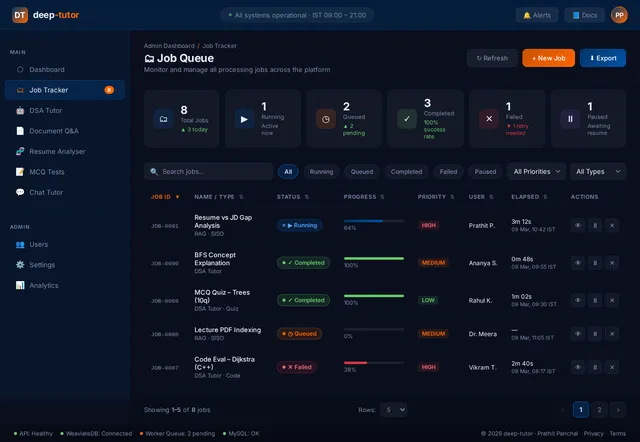
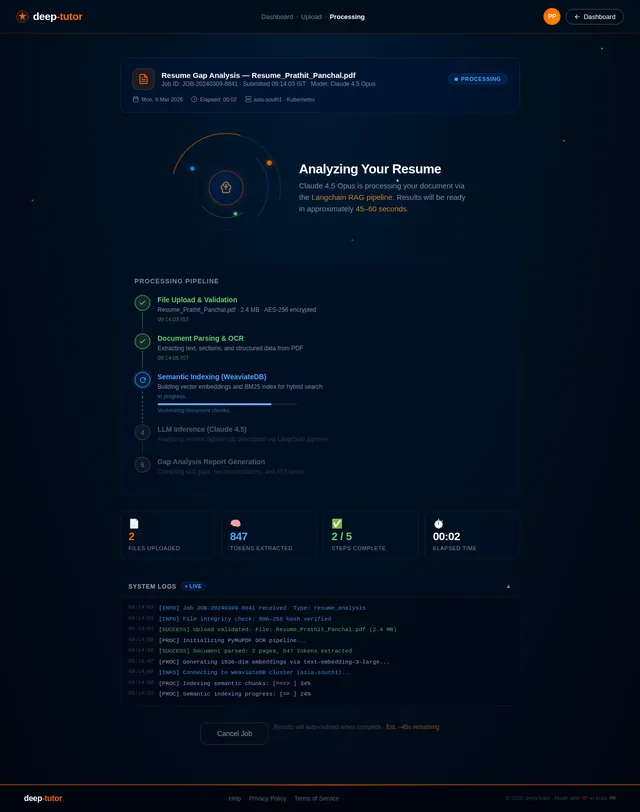
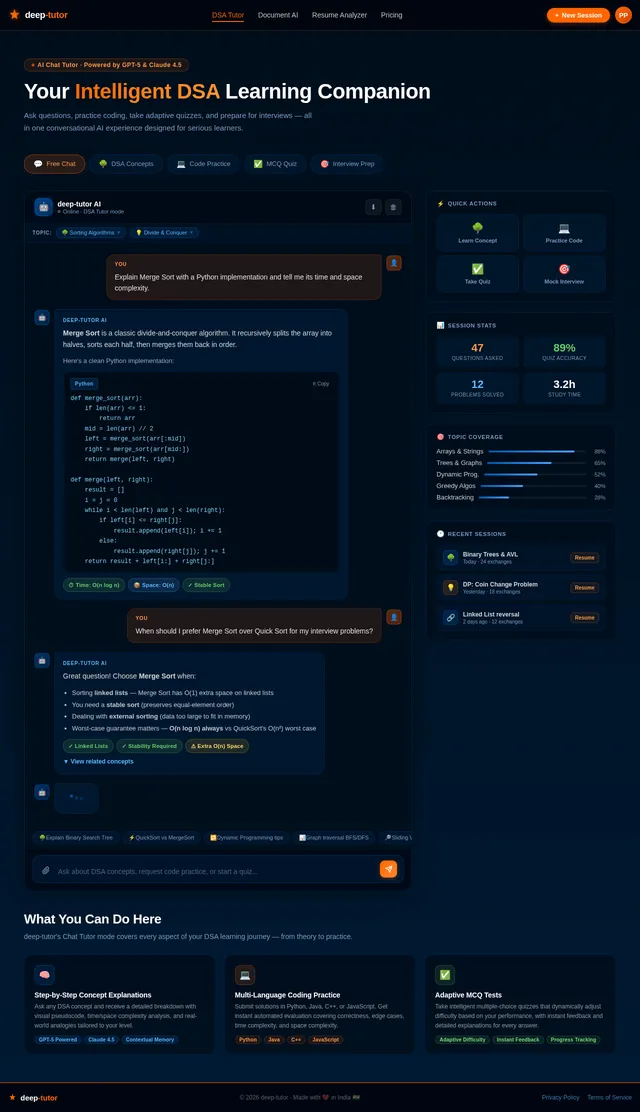
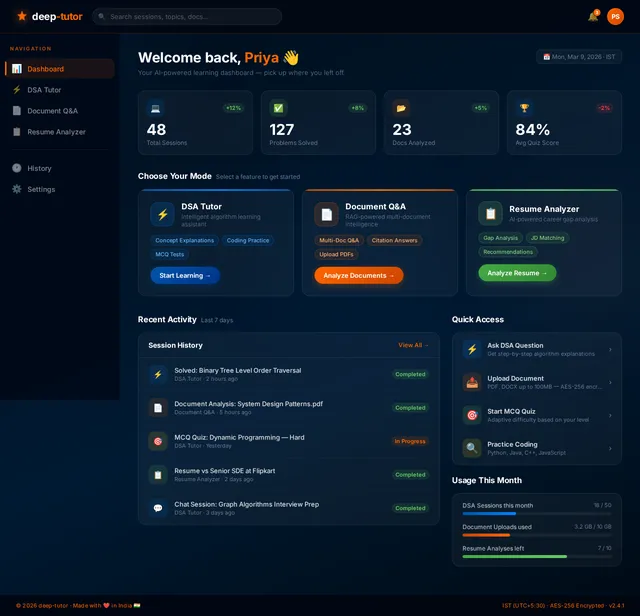
create a fully function AI dsa tutor with the following functionalities Your project **“AI-Powered DSA Learning & Document Analysis Platform”** combines two major systems: * **DSA Tutor (Intelligent Learning Assistant)** * **Project SISO (RAG-based Document Intelligence System)** Together they form a **multi-capability AI platform** for learning, coding practice, and document analysis. Below is a **clear, structured list of the combined functionalities**. --- # Combined Functionalities of AI Tutor + Project SiSo ## 1. Intelligent DSA Learning System Provides **concept explanations for Data Structures and Algorithms**. **Capabilities** * Step-by-step explanations * Text-based diagrams * Concept breakdown from basic → advanced * Context-aware follow-up questions **Example** User asks: *“Explain Dynamic Programming”* System provides: * Definition * Intuition * Example problems * Diagram explanation * Complexity discussion --- # 2. Coding Practice & Evaluation Engine Users can **solve coding problems and receive automated evaluation**. ### Features * Multi-language coding support * Python * Java * C++ * JavaScript * Code analysis includes: * Correctness validation * Time complexity analysis * Space complexity analysis * Optimal vs brute-force detection * Improvement suggestions **Example** User submits solution for **Two Sum** System evaluates: ``` Correctness: Passed Time Complexity: O(n²) Optimal Solution: O(n) using HashMap ``` --- # 3. MCQ Test Generation & Knowledge Assessment System can generate **adaptive quizzes for concept reinforcement.** ### Capabilities * Dynamic MCQ generation * Difficulty levels (Easy / Medium / Hard) * Instant evaluation * Explanation for correct answer * Performance feedback --- # 4. Conversational AI Tutor Acts as a **general AI assistant for learning discussions.** ### Capabilities * Free chat mode * Doubt solving * Interview preparation * Concept comparisons Example queries: * “Difference between BFS and DFS” * “Explain heap vs priority queue” --- # 5. Intelligent Intent Detection The system automatically **detects what the user wants**. ### Possible intents | User Input | System Mode | | ---------------------- | ------------- | | Explain Graphs | Learning Mode | | Solve LeetCode problem | Coding Mode | | Give MCQs on Trees | Test Mode | | General question | Chat Mode | This routing ensures **correct handler execution**. --- # 6. Multi-Document Question Answering (RAG) Project SiSo allows users to **ask questions across multiple documents.** ### Supported documents * DOCX * Study material * Notes * Resume * Job descriptions ### Process ``` Document Upload → Parsing + OCR → Chunking → Embedding generation → Weaviate indexing → Retrieval → LLM answer generation ``` --- # 7. Citation-Based Answer Generation All answers from documents include **precise citations.** Format: ``` [doc_id:page_number:chunk_index] ``` Example: ``` The transformer architecture relies on self-attention [doc1:3:2] ``` This ensures **traceability and reliability of information**. --- # 8. Resume vs Job Description Analysis The system performs **career gap analysis**. ### Features * Resume parsing * JD parsing * Skill gap identification * Improvement suggestions Example output: ``` Missing Skills: - Kubernetes - Docker - GraphQL Recommendation: Learn container orchestration and API frameworks. ``` --- # 9. Study Material Question Answering Students can upload **lecture notes or textbooks**. Capabilities: * Ask conceptual questions * Extract summaries * Generate explanations * Retrieve exact references Example: ``` Q: Explain Gradient Descent ``` Answer retrieved from uploaded lecture notes. --- # 10. High-Availability AI Architecture System ensures **reliable LLM responses**. ### Model pipeline Primary model ``` Google Gemini ``` Fallback model ``` Ollama (Local Llama 3) ``` Mechanism: ``` Gemini request → if failure → automatic fallback to Ollama ``` --- # 11. Asynchronous Processing Pipeline Heavy tasks run **as background jobs**. Architecture: ``` User Request ↓ FastAPI API ↓ Redis Queue ↓ Worker ↓ Processing ↓ Result Retrieval ``` Benefits: * Scalable * Non-blocking API * Handles large documents --- # 12. Hybrid Search Retrieval System Uses **two retrieval methods together**. | Method | Purpose | | ------------- | ---------------- | | Vector Search | semantic meaning | | BM25 | keyword matching | This hybrid search improves **retrieval accuracy**. --- # 13. Multi-Document Knowledge Indexing The system supports **grouped document search**. Metadata stored in vector database: ``` doc_id doc_group_id source_file page_number chunk_index ``` This allows: * Cross-document answers * grouped search results --- # 14. Job Status Tracking System Users can track processing progress. Endpoints: ``` POST /submit_job GET /job_status/{job_id} GET /get_result/{doc_id} ``` Example status: ``` Processing: Chunking documents Processing: Generating embeddings Completed ``` --- # 15. Interactive Frontend Workflow The UI supports **three stages**: ### 1️⃣ Input Stage * Upload documents * Enter questions ### 2️⃣ Processing Stage * Progress polling * Loading indicators ### 3️⃣ Result Stage * AI generated answers * Citation references * Analysis reports --- # Final Combined Platform Vision The system ultimately acts as a **unified AI knowledge platform** capable of: | Domain | Capability | | ------------ | --------------------- | | Learning | DSA tutor | | Coding | Practice + evaluation | | Testing | MCQ quizzes | | Conversation | AI discussion | | Documents | RAG Q&A | | Career | Resume analysis | --- ✅ **In one sentence (interview ready):** > The platform integrates an AI-driven DSA tutoring system with a Retrieval-Augmented Generation (RAG) document intelligence engine, enabling interactive algorithm learning, automated code evaluation, adaptive testing, multi-document question answering with citations, and AI-based resume-job description gap analysis within a unified scalable architecture.






Comments (0)
Sign in to leave a comment

DSA Adaptive MCQ — Arrays & Hashing
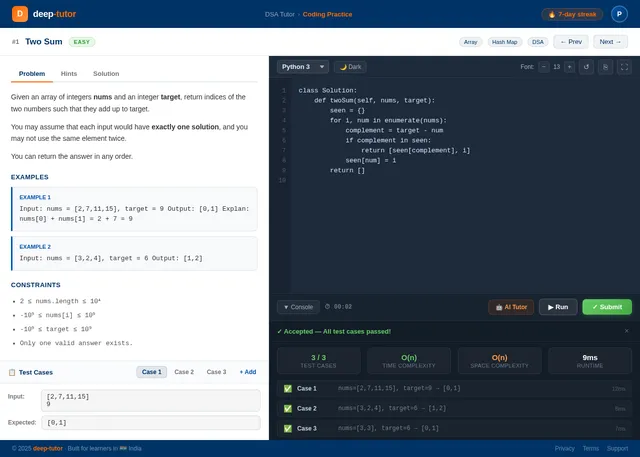
MediumGiven an array of integers nums and an integer target, return the indices of the two numbers that add up to target. You may assume that each input would have exactly one solution, and you may not use the same element twice. Return the answer in any order.
from typing import List# Complete the function belowdef two_sum(nums: List[int], target: int) -> List[int]:# Your solution herepass
Quiz Complete!
DSA Adaptive MCQ — Arrays & Hashing👍 Good Effort
Answer Review
DSA Adaptive MCQ — Arrays & Hashing · 5 Questions
What is the time complexity of accessing an element in an array by its index?
Arrays store elements in contiguous memory locations. Accessing an element by index requires a single memory address calculation: base_address + (index × element_size), which is performed in constant time regardless of the array size.
Which data structure uses the LIFO (Last In, First Out) principle?
A Stack follows the Last In, First Out (LIFO) principle — the last element pushed onto the stack is the first one to be popped off. Common use cases include function call stacks, undo/redo operations, and expression evaluation. A Queue, in contrast, uses FIFO (First In, First Out).
What is the worst-case time complexity of QuickSort?
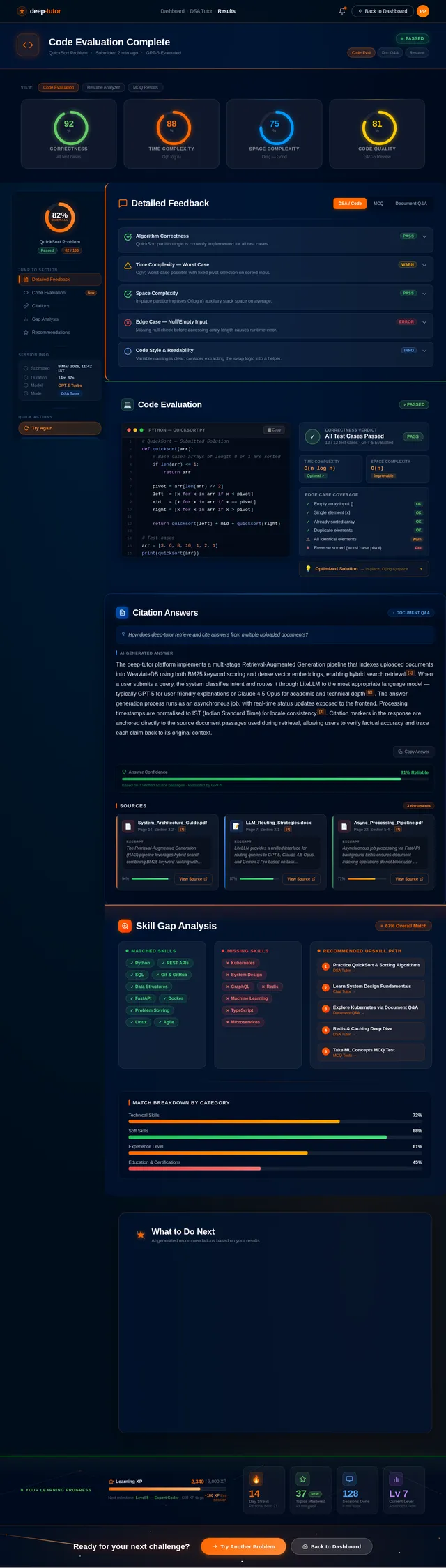
QuickSort's worst-case time complexity is O(n²), which occurs when the pivot selection consistently results in unbalanced partitions — for example, always picking the smallest or largest element as pivot on an already-sorted array. Average case is O(n log n). Randomized pivot selection or the median-of-three strategy significantly reduces worst-case probability.
In a Hash Map, what happens when two keys produce the same hash value?
When two different keys produce the same hash value, a collision occurs. Hash maps handle this via: (1) Chaining — each bucket holds a linked list of entries; (2) Open Addressing — the algorithm probes for the next available slot using linear probing, quadratic probing, or double hashing. Java's HashMap uses chaining with tree-ification (red-black trees) for buckets exceeding 8 entries.
Which traversal of a Binary Search Tree (BST) produces elements in sorted ascending order?
In-order traversal of a BST visits nodes in the sequence: Left subtree → Root → Right subtree. Since a BST maintains the invariant that all left descendants are smaller and all right descendants are larger than the root, in-order traversal always yields elements in ascending sorted order. This property is often used for BST validation and sorting algorithms.
No comments yet. Be the first!