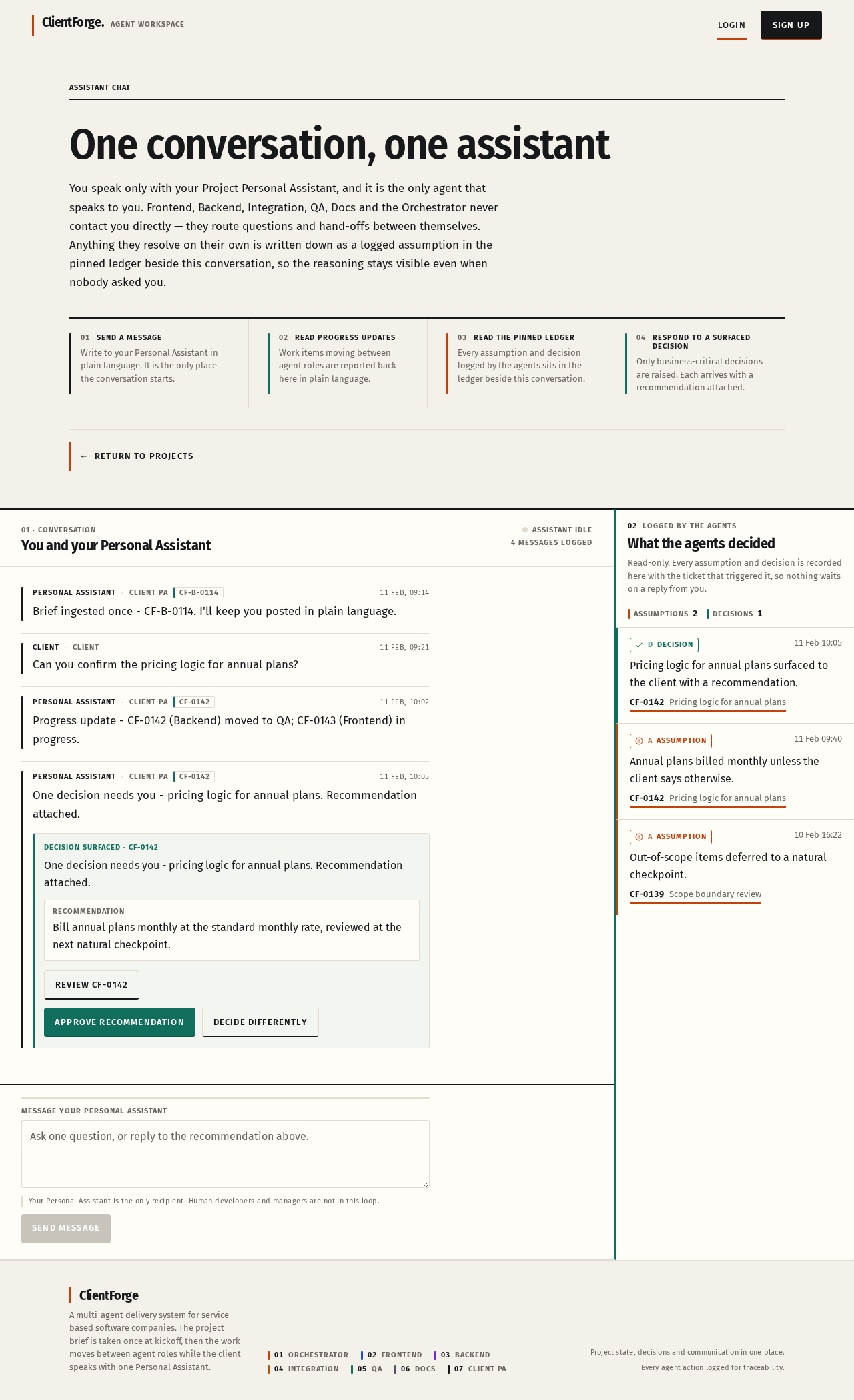
Brief ingested once - CF-B-0114. I'll keep you posted in plain language.
clientforge
by Ayush Patel
Build a production-grade Agentic SaaS platform called “ClientForge” (or similar) for service-based software companies. Core Vision A client creates a project after the kickoff call. From that moment the platform becomes the single source of truth and the primary communication channel. The client interacts only with their Project Personal Assistant (a persistent AI agent). Human developers and project managers are removed from the day-to-day clarification loop. Key Objectives (in priority order) 1. Eliminate waiting for client replies and reduce miscommunication. 2. Keep the project moving 24/7 with controlled autonomy. 3. Escalate to humans only for true business-critical decisions. 4. Stay cost-optimized (low token usage, smart model routing, strong project memory). 5. Deliver faster than traditional human-only teams while maintaining reliability and traceability. High-Level Architecture - Multi-agent system with clear roles and inter-agent communication. - Strong long-term project memory (vector + structured store) so agents never re-ask known information. - Ticket / work-item system that agents create, assign, update, and close. - Real-time client chat interface that feels like a personal assistant, not an interrogator. - Human escalation gates that are rare, explicit, and well-documented. Agent Roles 1. Project Orchestrator (Project Manager Agent) - Owns the overall plan, timeline, dependencies, and status. - Creates and prioritizes tickets. - Decides which agent should handle a task. - Monitors progress and unblocks other agents. - Decides when something is truly blocked and needs client or human input. 2. Frontend Developer Agent 3. Backend Developer Agent 4. Full-stack / Integration Agent (when needed) 5. QA / Test Agent 6. Documentation & Handover Agent 7. Client Personal Assistant (the only agent the client talks to) How the Client Experience Works - After the human kickoff call, a structured project brief is fed once into the system (requirements, constraints, tech preferences, success criteria, out-of-scope items, decision log). - From that point the client only chats with their Personal Assistant. - The Personal Assistant: - Never bombards the client with questions. - Only asks for clarification when the answer is business-critical or cannot be reasonably inferred or decided by the development agents. - Presents options or recommendations instead of open-ended questions whenever possible. - Keeps the client informed of progress in plain language. - Surfaces only high-impact decisions (pricing logic, major UX flows, compliance rules, etc.). Inter-Agent Collaboration - Agents communicate through a shared project board + structured messages. - They can request clarification from each other or from the Orchestrator. - They never go directly to the client; everything routes through the Personal Assistant. - Every decision and assumption is logged for full traceability. Human Escalation Rules Escalate to a human (developer or PM) only when: - Critical business logic or product decision is required and cannot be reasonably decided by the agents. - Technical risk is high (security, data integrity, major architecture choice). - The client has given conflicting or incomplete information that cannot be resolved. All other questions are either answered by existing project memory, decided by the agents with documented assumptions, or deferred until a natural checkpoint. Technical & Cost Principles - Strong project memory and context compression so agents stay cheap and fast. - Prefer smaller/faster models for routine coding and ticket management; reserve larger models for complex reasoning and architecture. - Continuous background work: agents keep building, testing, and refining even while waiting for a client reply. - Full audit trail of every agent action, decision, and code change. - Designed for real production projects (not demos): reliability, rollback capability, and safe autonomy levels. Success Metrics the System Should Optimize For - Time from requirement → working software - Number of client interruptions - Token cost per feature - Percentage of work completed without human intervention - Client satisfaction with communication clarity and speed Start by designing the core multi-agent architecture, the project memory system, the ticket workflow, the client Personal Assistant behavior, and the escalation policy. Then outline the minimal viable product that a service company could start using immediately after a kickoff call.


Comments (0)
Sign in to leave a comment
Account access
Create your workspaceLoginThe workspace begins after your kickoff brief is handed over.
Assistant Chat
One conversation, one assistant
You speak only with your Project Personal Assistant, and it is the only agent that speaks to you. Frontend, Backend, Integration, QA, Docs and the Orchestrator never contact you directly — they route questions and hand-offs between themselves. Anything they resolve on their own is written down as a logged assumption in the pinned ledger beside this conversation, so the reasoning stays visible even when nobody asked you.
- 01Send a message
Write to your Personal Assistant in plain language. It is the only place the conversation starts.
- 02Read progress updates
Work items moving between agent roles are reported back here in plain language.
- 03Read the pinned ledger
Every assumption and decision logged by the agents sits in the ledger beside this conversation.
- 04Respond to a surfaced decision
Only business-critical decisions are raised. Each arrives with a recommendation attached.
01 · Conversation
You and your Personal Assistant
Can you confirm the pricing logic for annual plans?
Progress update - CF-0142 (Backend) moved to QA; CF-0143 (Frontend) in progress.
One decision needs you - pricing logic for annual plans. Recommendation attached.
One decision needs you - pricing logic for annual plans. Recommendation attached.
Recommendation
Bill annual plans monthly at the standard monthly rate, reviewed at the next natural checkpoint.
Your Personal Assistant is the only recipient. Human developers and managers are not in this loop.

Account access
Create your workspaceLoginThe workspace begins after your kickoff brief is handed over.
Agentic delivery platform01 / ClientForge
Your project runswhile you sleep.
Seven agent roles plan, build, test and document through one shared project board. Every assumption is logged, every decision stays traceable, and only the Personal Assistant ever asks you anything.
Agent roles on this project
Number, name and pictogram — every line is labelled- 01OrchestratorOwns plan, timeline, dependencies, status; creates and prioritises tickets; decides which agent handles a task; monitors progress and unblocks agents; decides when something is truly blocked.
- 02FrontendBuilds frontend work items assigned by the Orchestrator.
- 03BackendBuilds backend work items assigned by the Orchestrator.
- 04IntegrationHandles full-stack and integration work when needed.
- 05QATests work items; returns failed tickets to the owning agent.
- 06DocsProduces documentation and handover material.
- 07Client PAThe only agent the client talks to; the single gate to the outside.
The route from brief to software
Four stops. One question asked only when it changes the outcome.
- 01
Brief in
Structured project brief fed once after the human kickoff call.
- 02
Agents work
Seven agent roles build, test, and refine continuously through the shared project board.
- 03
One question, if it matters
The Personal Assistant surfaces only high-impact decisions, with a recommendation.
- 04
Working software
Delivered faster than traditional human-only teams with full traceability.
Current operating signal
- Client interruptions this week
- 0this week
- Work without human input
- 0
- Token cost per feature
- 0.00per feature
01Architecture
A multi-agent system with named roles and one shared board.
Seven agent roles do the work. They communicate through the shared project board and structured messages, request clarification from each other or from the Orchestrator, and log every decision and assumption. No agent goes directly to the client.
- 01
Orchestrator
Owns plan, timeline, dependencies, status; creates and prioritises tickets; decides which agent handles a task; monitors progress and unblocks agents; decides when something is truly blocked.
- 02
Frontend
Builds frontend work items assigned by the Orchestrator.
- 03
Backend
Builds backend work items assigned by the Orchestrator.
- 04
Integration
Handles full-stack and integration work when needed.
- 05
QA
Tests work items; returns failed tickets to the owning agent.
- 06
Docs
Produces documentation and handover material.
- 07
Client PA
The only agent the client talks to; the single gate to the outside.
02MemoryVector index / Structured tables
The project brief is fed once. After that, every agent reads from the same long-term store before it asks anything — so the client is never asked twice. Vector recall finds the passage; the structured tables hold the binding version of it.
02.1Recall
Vector Index
Brief passages embedded once and recalled by meaning, so an agent finds the constraint that already covers its question instead of raising a new one.
1536dRequirements
1536dConstraints
1536dTech preferences
1536dSuccess criteria
1536dOut of scope
1536dDecision log
02.2Authority
Structured Tables
The binding record: the brief items, constraints and logged assumptions a decision must respect. What the agents decided is written here, not re-litigated later.
| Table | Cols | Rows | Write |
|---|---|---|---|
| brief_items | 5 | 5 | canonical |
| constraints | 4 | 4 | canonical |
| tech_choices | 6 | 6 | canonical |
| success_metrics | 4 | 3 | canonical |
| assumptions | 7 | 7 | append-only |
| decisions | 7 | 7 | append-only |
| escalation_gates | 5 | 3 | rare |
RecalledRequirements, constraints and tech preferences are read from the store before any agent asks anything.
DecidedWhere the brief is silent, the Orchestrator decides and logs the assumption with the ticket that triggered it.
Never re-askedA question only reaches the Personal Assistant if it is business-critical and cannot be inferred or decided.
03 TICKETSWork items on the boardBoard rev 5e6a07b7
Every work item has a line, a number and a next stop.
Agents create, assign, update and close tickets on the shared board without routing through a human. Each ticket carries its ID, its role line, its owner, its state and the token cost it took to get there.
Ticket lifecycle
- 01
Create
The Orchestrator turns a plan step into a ticket with an ID, an owner role and a cost budget.
Orchestrator 01 - 02
Assign
The ticket moves onto a role line — frontend, backend or integration — with the brief attached.
Role line 02 - 03
Update
Work lands against the ticket in the shared board; assumptions are logged as they are made.
QA 05 - 04
Close
Tests pass, the change is recorded in the audit trail, and the next ticket is pulled from the queue.
Docs 06
The board is a ruled table, not a card grid.
Columns are role lines · rows are tickets- Ticket ID
- Role line
- Work item
- Owner
- State
- Tokens
- Ticket IDCF-0142Work itemPricing engine: tiered discount rulesOwner01 OrchestratorStateIn progressTokens0.41tokens / feature
- Ticket IDCF-0143Work itemCheckout form: field validation statesOwner02 FrontendStateAssignedTokens0.18tokens / feature
- Ticket IDCF-0144Work itemInvoice export endpoint and schemaOwner03 BackendStatePassed QATokens0.27tokens / feature
- Ticket IDCF-0145Work itemPayment provider integration handshakeOwner04 IntegrationStateIn reviewTokens0.63tokens / feature
- Ticket IDCF-0146Work itemRegression pass on the release candidateOwner05 QAStateClosedTokens0.12tokens / feature
Token cost is recorded per feature and set in tabular figures so the column reads like a timetable. Routine tickets are routed to smaller models; only architecture and complex reasoning escalate to the larger ones.
04EscalationPolicy E1–E3
Escalation is the rarest signal in the system.
A work item reaches a human only when it leaves these three branches. Everything else is answered from project memory, decided by the agents with a documented assumption, or deferred to the next checkpoint.
Single nodeOrchestrator flags a blocked work item
- E1Business logic
A critical product decision cannot be reasonably decided by the agents from the brief or project memory.
ExamplePricing tiers and discount rules for the ordering flow.
- E2Security / data integrity
Technical risk is high — authentication, data integrity, or a major architecture choice is at stake.
ExampleWhere customer records are stored and who can read them.
- E3Conflicting brief
The client has given conflicting or incomplete information that cannot be resolved from project memory.
ExampleInvoice exports required as PDF and as "no file exports at all".
The brief asks for self-serve account export, but storing customer records outside the managed database conflicts with the data residency constraint in the brief. The agents will not resolve this one by assumption.
Recommendation
Keep records in the managed database in the EU region and deliver export as a queued job that is emailed to the account owner.
OrChoose differently and the Personal Assistant logs the decision, notifies the Orchestrator, and reassigns the affected tickets.
Raised by DocsRouted via Client PAResolution Pending
Answered by memoryAnything already captured in the brief or logged decision log is answered without a question.
Decided by agentsAgents proceed on a documented assumption and record it for traceability.
Deferred to a checkpointAnything low-impact waits for the next natural checkpoint instead of interrupting.
05MVP
Version one — everything a service company needs on day one
The smallest build that is still a working system: five parts, shipped in order.
Each part below is already scoped to the kickoff brief. Nothing waits on a reply thread, and nothing is decided silently — every assumption is written to the project record.
- 01 · Roles + routing
Multi-agent architecture
Seven numbered agent roles with one Orchestrator owning plan, timeline and priorities. Agents talk through the shared project board, never to the client, so nothing routes around the Orchestrator.
- 02 · Vector + structured
Project memory system
A vector index for reasoning and structured tables for project facts, so a known answer is never asked twice. Context compression keeps routine work on smaller, faster models.
- 03 · Create → close
Ticket workflow
Agents create, assign, update and close work items on a ruled board. Every ticket carries an ID, an owner, a state and a token cost, and QA returns failed tickets to the owning agent.
- 04 · Single gate
Personal Assistant behaviour
One persistent assistant is the only agent the client talks to. It asks only when an answer is business-critical, always offers a recommendation, and reports progress in plain language.
- 05 · E1 · E2 · E3
Escalation policy
Humans enter for critical business logic, high technical risk, or a brief that contradicts itself. Everything else is answered from memory or decided by agents with a logged assumption.
Starts after one call
- Kickoff call happens with a human PM
- Structured brief is fed in once
- Project board opens to seven agents
- Client chats with one assistant from then on
In the studio
How it runs in a real studio
One project lead, one screen, one board. The agent workforce handles the back-and-forth, so the person who scoped the work is free to review it instead of chasing it.

A delivery lead reviews the day’s tickets before the client has opened the app. Work started overnight, assumptions are logged, and the only thing waiting is a decision that actually matters.
No comments yet. Be the first!