MackinawiteFeS
Reduced-iron sulfide surface that binds dissolved metals and hosts early thioester-forming chemistry.
 Leo Wierny
BUILD AN EMERGENT ORIGIN-OF-LIFE SIMULATION Build a complete, interactive, scientifically grounded simulation of abiogenesis and chemical evolution. This must NOT be a traditional artificial-life simulation where organisms, metabolism, reproduction, DNA, food, predators, fitness, or species are manually scripted. The central rule is: SCRIPT THE LAWS. DO NOT SCRIPT LIFE. Begin with chemistry, matter, energy and environmental gradients. If organized systems emerge, they must emerge because the underlying physical and chemical rules make them possible. The ultimate experiment is: Can an initially nonliving chemical environment, continuously driven away from thermodynamic equilibrium by external energy, spontaneously produce persistent autocatalytic systems, compartments, heredity, competition, evolution and increasingly organism-like entities? There must never be a command equivalent to: spawnLife() There must never be: if molecule == RNA then reproduce There must never be: organism.health += energy There must never be a manually assigned evolutionary fitness score. Instead: physics → chemistry → reaction networks → self-organization → compartments → replication → variation → differential persistence → evolution if the simulated conditions allow those things to occur. ⸻ 1. FUNDAMENTAL PHILOSOPHY Treat life as a special organizational state of ordinary matter. The simulation begins with no distinction between “living” and “nonliving.” Everything consists of chemicals interacting according to the same rules. A structure only becomes organism-like because it: * maintains chemical disequilibria * captures usable free energy * acquires raw materials * catalyzes reactions * repairs or replaces components * preserves internal conditions * contains reaction networks * creates copies or descendants * transmits chemically encoded information * produces imperfect descendants * competes for limited resources * consequently undergoes natural selection Do not give any of those properties to a structure merely because it has been labeled an organism. ⸻ 2. DO NOT ATTEMPT TO ENUMERATE ALL POSSIBLE CHEMICALS A literal database containing every possible chemical is impossible. Instead create an extensible chemical grammar. Each molecular species should contain properties such as: * elemental formula * molecular graph * bond topology * molecular mass * formal charge * acid/base groups * oxidation state * polarity * hydrophobicity * solubility * diffusion coefficient * absorption spectrum * approximate heat capacity * bond energies * activation-energy estimates * membrane permeability * adsorption affinity for mineral surfaces * catalytic groups * degradation pathways * polymerization sites * stereochemistry where relevant Allow previously unseen molecular species to be constructed dynamically from valid chemical transformations. The initial library below is therefore the starting chemistry, not the universe of possible chemistry. ⸻ 3. INITIAL EARLY-EARTH CHEMICAL INVENTORY Include at minimum the following species or chemically equivalent protonation states. Solvent and acid/base chemistry H₂O H⁺ / H₃O⁺ OH⁻ Model water explicitly as the bulk solvent at the continuum level rather than rendering every water molecule. Local pH must emerge from acid/base concentrations. ⸻ Major dissolved ions Na⁺ K⁺ Mg²⁺ Ca²⁺ Fe²⁺ Fe³⁺ Ni²⁺ Zn²⁺ Mn²⁺ Cl⁻ HS⁻ S²⁻ SO₃²⁻ SO₄²⁻ HCO₃⁻ CO₃²⁻ H₂PO₄⁻ HPO₄²⁻ PO₄³⁻ Their concentrations must influence ionic strength, membrane stability, polymer folding, precipitation and reaction rates. ⸻ Atmospheric/geochemical feedstock H₂ N₂ CO₂ CO CH₄ NH₃ NH₄⁺ H₂S SO₂ Allow gas exchange between atmosphere and water according to solubility and partial pressure. ⸻ Important prebiotic carbon/nitrogen compounds HCN — hydrogen cyanide HNC — hydrogen isocyanide where appropriate NH₂CN — cyanamide HC₃N — cyanoacetylene HCONH₂ — formamide HCHO — formaldehyde CH₃CHO — acetaldehyde CH₃OH — methanol HOCH₂CHO — glycolaldehyde glyceraldehyde dihydroxyacetone glyoxal Do not treat these merely as collectible resources. They participate in kinetic reaction networks. ⸻ Simple organic acids formic acid / formate acetic acid / acetate glycolic acid lactic acid / lactate pyruvic acid / pyruvate oxalic acid / oxalate malonic acid succinic acid / succinate fumaric acid / fumarate malic acid / malate Allow additional carboxylic acids to emerge. ⸻ Amino acids At minimum: glycine alanine serine aspartic acid glutamic acid valine leucine isoleucine proline threonine cysteine methionine phenylalanine Do not assume modern protein synthesis. These are simply molecules capable of reactions including condensation into short peptides. Additional amino acids and non-biological amino-acid analogues may form. ⸻ Sugars and sugar precursors formaldehyde glycolaldehyde glyceraldehyde ribose arabinose xylose erythrose ribulose simple hexoses when reaction pathways permit Include instability and degradation. Do not make ribose artificially immortal. ⸻ Nucleobases and precursors adenine guanine cytosine uracil purine pyrimidine related prebiotic heterocycles Thymine can arise later but does not need to dominate primordial chemistry. ⸻ Nucleosides and nucleotides adenosine guanosine cytidine uridine AMP GMP CMP UMP Allow activated versions where chemically justified. ADP and ATP should be possible products of chemistry but should NOT simply be supplied as the universal primordial energy currency. Primitive systems should initially be capable of using other energetic chemistry. ⸻ Phosphorus chemistry orthophosphate pyrophosphate trimetaphosphate other condensed phosphates acetyl phosphate Include phosphate adsorption to minerals and realistic difficulty of phosphorylation. ⸻ Sulfur chemistry and energetic intermediates hydrogen sulfide bisulfide sulfide elemental sulfur where relevant thiols methanethiol simple thioesters acetyl thioesters Thioester chemistry should be capable of coupling energetically favorable and unfavorable reactions. ⸻ Amphiphiles Include families rather than a single magic lipid. fatty acids approximately C6–C18 octanoic acid decanoic acid lauric acid myristic acid palmitic acid simple fatty alcohols glycerol monoacylglycerols simple amphiphilic esters Amphiphilic properties must arise from molecular structure. Above appropriate concentrations, amphiphiles should spontaneously: form micelles form sheets form droplets form vesicles exchange molecules grow shrink fuse rupture Do not script a “cell membrane object” first. A membrane should originate from amphiphile self-assembly. For computational scalability, it is acceptable to replace fully atomistic membrane simulation with a validated coarse-grained membrane model. ⸻ 4. MINERAL WORLD Include mineral surfaces because early-Earth chemistry did not occur in an empty beaker. Include: FeS / mackinawite FeS₂ / pyrite Fe₃S₄ / greigite NiS magnetite silica serpentine minerals olivine-related minerals brucite carbonate minerals iron oxides clay minerals such as montmorillonite phosphate-bearing minerals It is watching something appear that we did not explicitly tell the program to make. I’m not gonna get to detailed but start


Sign in to leave a comment
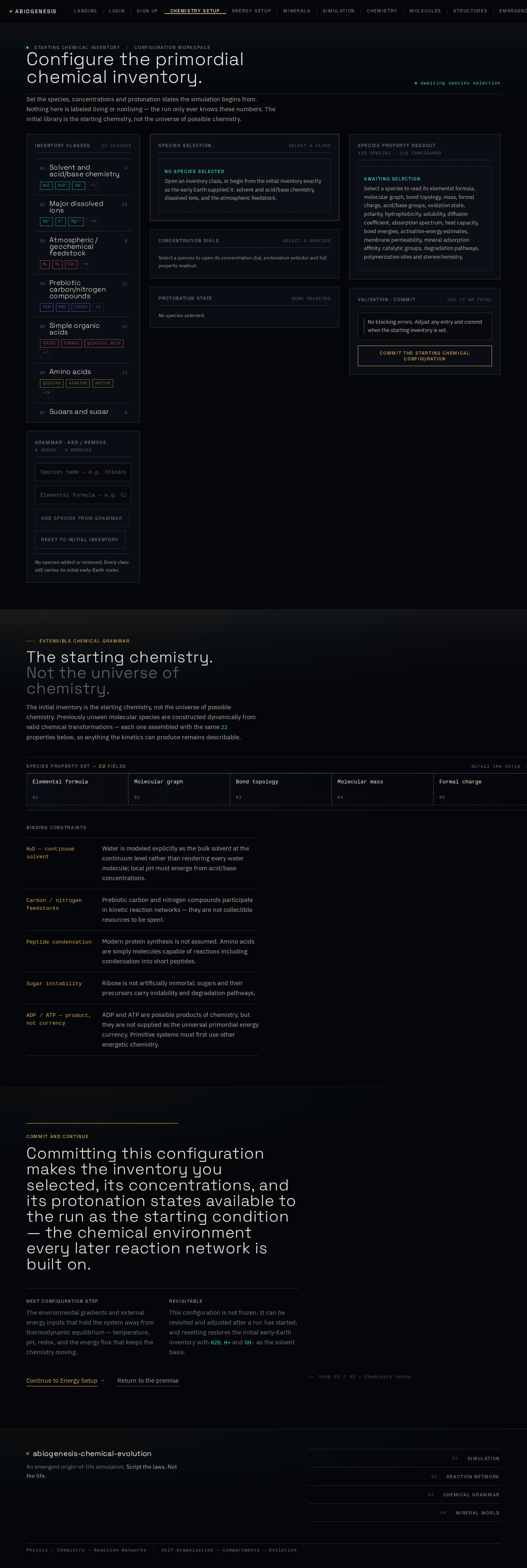
Starting chemical inventoryConfiguration workspace
Simulation state: awaiting species selection
Set the species, concentrations and protonation states the simulation begins from. Nothing here is labeled living or nonliving — the run only ever knows these numbers. The initial library is the starting chemistry, not the universe of possible chemistry.
No species added or removed. Every class still carries its initial early-Earth roster.
Select a species to open its concentration dial, protonation selector and full property readout.
No species selected.
No blocking errors. Adjust any entry and commit when the starting inventory is set.
Extensible Chemical Grammar
The initial inventory is the starting chemistry, not the universe of possible chemistry. Previously unseen molecular species are constructed dynamically from valid chemical transformations — each one assembled with the same 22 properties below, so anything the kinetics can produce remains describable.
Binding constraints
Water is modeled explicitly as the bulk solvent at the continuum level rather than rendering every water molecule; local pH must emerge from acid/base concentrations.
Prebiotic carbon and nitrogen compounds participate in kinetic reaction networks — they are not collectible resources to be spent.
Modern protein synthesis is not assumed. Amino acids are simply molecules capable of reactions including condensation into short peptides.
Ribose is not artificially immortal: sugars and their precursors carry instability and degradation pathways.
ADP and ATP are possible products of chemistry, but they are not supplied as the universal primordial energy currency. Primitive systems must first use other energetic chemistry.
Commit and continue
Committing this configuration makes the inventory you selected, its concentrations, and its protonation states available to the run as the starting condition — the chemical environment every later reaction network is built on.
Next configuration stepThe environmental gradients and external energy inputs that hold the system away from thermodynamic equilibrium — temperature, pH, redox, and the energy flux that keeps the chemistry moving.
RevisitableThis configuration is not frozen. It can be revisited and adjusted after a run has started, and resetting restores the initial early-Earth inventory with H2O, H+ and OH- as the solvent basis.

Begin with chemistry, matter, energy and environmental gradients. Organized systems appear only if the underlying physical and chemical rules make them possible.
Begin the experimentThe Ultimate Experiment
Built for the people who ask it. A laboratory instrument for
It begins with chemistry, matter, energy, and environmental gradients — and nothing else. No outcome is authored ahead of the run. The central rule governs everything downstream: Script the laws. Do not script life. A single instruction is deliberately missing from the source — spawnLife() does not exist.
Causal chain
This is the sequence the simulation is permitted to traverse. Each stage is a consequence of the one before it, computed from the rules rather than issued as an instruction.
The chain proceeds only if the simulated conditions allow those things to occur. No stage is scheduled, guaranteed, or triggered by a named life event.
Matter, energy and environmental gradients set the arena; no outcome beyond these laws is prescribed.
Bond formation and acid/base equilibria proceed from energetics and rates alone.
Coupling between reactions yields networks whose structure was never enumerated in advance.
Local order appears where flux, catalysis and surface chemistry make it favourable.
Amphiphile self-assembly produces boundaries that concentrate their own contents.
Products that catalyse further product formation can propagate when kinetics allow.
Imperfect copying and side reactions generate a spread of descendant compositions.
Whatever persists longest and multiplies fastest dominates the population by physics, not by scoring.
Composition drifts and accumulates across generations; nothing is directed toward a target form.
Physics → chemistry → reaction networks → self-organization → compartments → replication → variation → differential persistence → evolution.
Every stage after the first is written as conditional, because the laws decide.
Initial Inventory
Every species below enters the same kinetic reaction network. None of them is a collectible resource, a label for life, or a privileged ancestor — they are simply matter and energy under the same rules as everything that follows.
13 classes126 species
Water is modelled as the bulk solvent at the continuum level; local pH emerges from acid/base concentrations. Individual water molecules are not rendered.
Concentrations feed ionic strength, membrane stability, polymer folding, precipitation and reaction rates.
Gas exchange between atmosphere and water follows solubility and partial pressure.
Kinetic network participants, not collectible resources.
Additional carboxylic acids may emerge from valid transformations.
Condensation into short peptides only — no modern protein synthesis is assumed.
Instability and degradation are included; ribose is not immortal.
Thymine may arise later but need not dominate primordial chemistry.
ADP and ATP are possible products of chemistry, never supplied as a universal primordial energy currency.
Phosphate adsorption to minerals and the realistic difficulty of phosphorylation are modelled.
Thioester chemistry couples energetically favourable and unfavourable reactions.
Amphiphilic behaviour arises from molecular structure — above threshold concentration these species self-assemble.
Surfaces enter here as inventory only; adsorption, catalysis and phosphate binding are treated in the mineral band.
Starting chemistry, not the universe
This library is the starting chemistry, not the universe of possible chemistry. Species that were never listed are constructed dynamically from valid chemical transformations, each new molecule carrying the same grammar of properties as the ones above.
The mineral world13 surfaces
Every reaction below runs against a mineral interface. Each surface contributes a distinct physical role — adsorption, catalysis, phosphate retention, redox mediation — and the same ledger governs both the dissolved species and the surfaces they touch.
Reduced-iron sulfide surface that binds dissolved metals and hosts early thioester-forming chemistry.
Persistent sulfide mineral whose surface couples electron transfer and drives reductive carbon fixation.
Mixed-valence sulfide offering both electron donors and acceptors at the same interface.
Nickel sulfide surface that adsorbs cyanide species and catalyses their condensation.
Mixed ferrous–ferric oxide that adsorbs organics and mediates redox gradients.
Mineral framework providing high-surface-area scaffolding for concentrating dilute organics.
Hydration product of olivine; its formation releases hydrogen and drives alkaline vent chemistry.
Primary mantle silicate whose aqueous alteration supplies the reducing power of serpentinizing systems.
Alkaline hydroxide layer that buffers local pH and stabilises anionic intermediates.
Precipitating carbonate phases that fix dissolved CO₂ and regulate alkalinity.
Ferric oxide phases that adsorb phosphate and anionic species onto their surfaces.
Swelling clay whose interlayer cations adsorb nucleotides and template polymer condensation.
Phosphate-bearing surfaces that adsorb orthophosphate and make phosphorylation energetically reachable.
Boundary condition
No mineral surface here is granted behaviour the chemistry does not give it — the surfaces are laws, not actors.
Adsorption affinities, catalytic groups and phosphate binding are properties of the mineral, evaluated per collision like every dissolved species. Nothing is placed by hand at the interface.
Above the concentration where packing beats dissolution, amphiphiles assemble the same way the bulk solvent pushes them to — into micelles, sheets, droplets and vesicles. No cell membrane object is scripted first: a membrane is a consequence of molecular structure and local concentration, and it keeps changing for as long as the chemistry around it does.
C8–C18 amphiphile aggregate
Above the critical aggregate concentration, amphiphile tails sequester from water and heads face the bulk solvent, closing into a spherical aggregate with no interior volume.
spherical aggregateplanar bilayer lamella
At lower curvature the same molecules pack into extended lamellae. Sheets stack, slide against one another and expose mineral surfaces to a two-dimensional reaction field.
extended bilayersurfactant-stabilised organic phase
A sparingly soluble organic phase is stabilised by an adsorbed amphiphile monolayer, creating a bounded interior without any pre-declared boundary object.
soft interfaceclosed bilayer compartment
When a sheet closes on itself it encloses a volume of bulk solution. The boundary is a thin refractive shell a few nanometres thick, assembled entirely by the packing of its amphiphiles.
closed aqueous compartmentAmphiphiles exchange from solution into an existing boundary faster than they leave it, so the structure gains area.
When the local amphiphile concentration falls below equilibrium, the reverse flux dominates and the structure loses molecules.
Two boundaries that meet can merge into a single larger structure, combining their enclosed volumes and contents.
A destabilised boundary fails, releases its contents to the bulk solution, and its amphiphiles return to the free pool.
There is no cell membrane object in the model. No compartment is declared, labelled, or given a lifetime by the program — a boundary exists only while amphiphile flux keeps it closed.
A membrane originates from amphiphile self-assembly. Compartments appear only where the simulated concentration, temperature and ionic conditions make closure favourable, and they persist only while that remains true.
Each category below is an outcome the model is permitted to reach, never an instruction it is given. Nothing was explicitly told the program to make. Every marker on this axis is a chemical consequence of the laws set upstream, not a run history. Outcomes can be inspected in the Emergence and Structures surfaces.
Possible outcome
conditional on chemistry
Autocatalytic networks may persist
Persistence · 01
reaction cycles sustained while the gradient holds
Possible outcome
conditional on chemistry
Compartments may self-assemble
Persistence · 02
boundaries persist while amphiphile supply continues
Possible outcome
conditional on chemistry
Templated copying appears
Persistence · 03
copy lineages persist only as long as their chemistry is resupplied
Possible outcome
conditional on chemistry
Imperfect descendants accumulate
Persistence · 04
variant populations persist where their kinetics permit
Possible outcome
conditional on chemistry
Some lineages outlast others
Persistence · 05
persisting lineages outlast non-persisting ones
Nothing was told to appear
There is no spawn command in this model, and no branch that rewards one molecule over another. A structure held together here because its chemistry let it hold together — a marker on the axis is a consequence, not an event trigger.
Where to watch it happen
The same quantities tracked along this axis resolve into the Emergence surface, where autocatalytic sets and compartments can be tracked if they form, and into the Structures surface, which holds the assembled forms and their persistence over simulated time.
No comments yet. Be the first!