Early Salary Loan System
 Milan Ajudiya
Early Salary Loan (Phase 1) AI Model Design Principles All classification models across this engagement follow the same architectural pattern: • Algorithm: Random Forest / Gradient Boosting Decision Tree (GBDT) • Output: Continuous probability score in [0, 1] range — not a binary label • Threshold system: Double-threshold (approve / uncertain / reject zones) • Accuracy metric: AUC-ROC (Area Under the Receiver Operating Characteristic Curve) • Uncertainty quantification: Configurable uncertain band between two thresholds Double-Threshold Decision Framework Every model outputs a score S ∈ [0, 1]. Two configurable thresholds (T_low and T_high) divide outcomes into three zones: Zone Score Range Decision Action AUTO-APPROVE S ≥ T_high Automatically approved Loan disbursed without human review UNCERTAIN T_low ≤ S < T_high Escalate to admin Human reviews and makes final call AUTO-REJECT S < T_low Automatically rejected Loan declined; notification sent Admin Control Panel — Features A web-based admin panel is delivered across all products with the following controls: • Real-time score distribution histogram — shows how many applicants fall in each zone • Adjustable T_low and T_high sliders with live AUC / expected repayment-rate preview • Daily/monthly budget caps with configurable auto vs. manual split • Warning banner when threshold changes significantly alter projected repayment rate • Audit log of all threshold changes with timestamp and admin identity 2A.1 Background & Objective This is a new greenfield product. The concept — commonly known as Earned Wage Access or Early Salary — enables salaried employees to borrow against their upcoming salary when they face a cash shortfall before payday. Key characteristics: • Target borrowers: salaried individuals who run out of funds before salary credit (typically 25th–30th of month) • Loan amount: up to 100% of monthly salary • Repayment: auto-deducted from incoming salary upon credit (typically 5th–10th of next month) • Revenue model: interest-based (unlike the hospital product) • The client will use the same CRM (new account/module) for case management Objective: Build the complete product from scratch — user-facing portal, ML-powered approval model with interest rate prediction, and admin dashboard. 2A.2 Scope of Work 2A.2.1 User-Facing Application Portal (Frontend) • Responsive web application (mobile-first) for loan applications • Application form fields (minimum required; extensible): ◦ Full name, mobile number, email ◦ Employer name, employment type (permanent / contractual), designation ◦ Monthly net salary, salary credit date ◦ Bank account details (for disbursement and auto-debit setup) ◦ Loan amount requested and purpose ◦ CIBIL score (self-declared; verified separately) ◦ Bank statement upload (last 3 months, PDF) ◦ Aadhaar / PAN for KYC • Real-time form validation and document upload with virus scanning • Application status tracker (submitted / under review / approved / rejected) • Loan agreement display and e-sign integration (DigiLocker or similar) • Disbursement status and repayment schedule view 2A.2.2 ML Approval & Interest Rate Model • Data sources: application form fields, CIBIL score, bank statement analysis, salary verification • Bank statement parser: extract monthly credits, debits, EMI patterns, minimum balance trends, bounce history • Feature engineering: debt-to-income ratio, salary consistency score, loan-to-salary ratio, employment tenure proxy • Model 1 — Approval Classifier: Random Forest / GBDT outputting probability score [0,1] with double-threshold framework • Model 2 — Interest Rate Regressor: Gradient Boosting Regressor predicting optimal interest rate (%) conditional on approval; rate higher for riskier profiles • Both models trained on synthetic seed data initially; retrained when live data accumulates • AUC-ROC curve stored per model version; admin panel shows repayment-rate projection at any threshold • Uncertainty quantification: cases in uncertain band surfaced to human reviewer with model confidence score 2A.2.3 CRM Integration • New CRM module / account setup for Early Salary product • Application data from portal flows into CRM on submission • AI service writes approval score, interest rate recommendation, and decision (auto/uncertain/reject) back to CRM • Approved cases: trigger disbursement workflow in CRM • Auto-debit mandate registration workflow (NACH/eNACH) triggered post-approval 2A.2.4 Admin Dashboard • All features from shared architecture (threshold controls, budget caps, score distribution, AUC preview, audit log) • Additional panels specific to Early Salary: ◦ Interest rate distribution chart across approved cases ◦ Salary verification status tracker ◦ Repayment schedule calendar with expected inflows ◦ Early warning list: borrowers with salary credit overdue by >2 days 2A.2.5 Testing & Deployment • Backend API unit + integration tests • Frontend cross-browser and mobile UAT • Model validation report (AUC, precision-recall, feature importance) • Security review: OWASP top-10 checklist for financial application • Production deployment with CI/CD pipeline • Monitoring: model performance dashboards, API uptime, error rate alerting 2A.3 Deliverables # Deliverable Format When 1 Product Requirements Document (PRD) PDF End of Week 2 2 UI/UX Wireframes & Prototype Figma / PDF End of Week 4 3 User Application Portal (Frontend) Web application End of Week 9 4 Bank Statement Parser Module Python service + docs End of Week 8 5 Approval Classifier Model + Model Card Artefact + PDF End of Week 10 6 Interest Rate Regressor Model + Card Artefact + PDF End of Week 10 7 AI Inference Service Deployed microservice End of Week 11 8 CRM Integration Layer Source code + deployment End of Week 12 9 Admin Dashboard Web application End of Week 13 10 Security Review Report PDF End of Week 14 11 Production Deployment & Runbook Live system + docs End of Week 16 2A.4 Timeline & Milestones Phase Activity Duration Phase 1 Requirements Gathering & PRD Weeks 1–2 (10 working days) Phase 2 UI/UX Design & Wireframing Weeks 3–4 (10 working days) Phase 3 Frontend Development (Application Portal) Weeks 5–9 (25 working days) Phase 4 Bank Statement Parser + Feature Engineering Weeks 5–8 (concurrent, 20 days) Phase 5 ML Model Development (Approval + Interest Rate) Weeks 9–10 (10 working days) Phase 6 AI Service + CRM Integration Weeks 11–12 (10 working days) Phase 7 Admin Dashboard Development Weeks 12–13 (10 working days) Phase 8 QA, Security Review, UAT Weeks 14–15 (10 working days) Phase 9 Production Deployment & Handover Week 16 (5 working days) TOTAL End-to-end Phase 1 delivery 16 Weeks (~80 working days) 2A.5 Assumptions & Dependencies • Client provides CRM credentials and API access in Week 1 • Client confirms preferred KYC/e-sign vendor (DigiLocker, Aadhaar eKYC, etc.) by Week 2 • NACH/eNACH mandate registration partner identified and integrated by client by Week 10 • Seed/synthetic dataset for initial model training approved by client • CIBIL API access (if required for live score fetch) procured by client • Cloud hosting, domain, and SSL provisioned by client 2A.6 Out of Scope • Native iOS / Android mobile application • Payroll system integration with employer HR software • Collection / recovery workflows (covered in Phase 2) • Regulatory compliance filing (RBI NBFC guidelines compliance is client's responsibility)


Comments (0)
Sign in to leave a comment
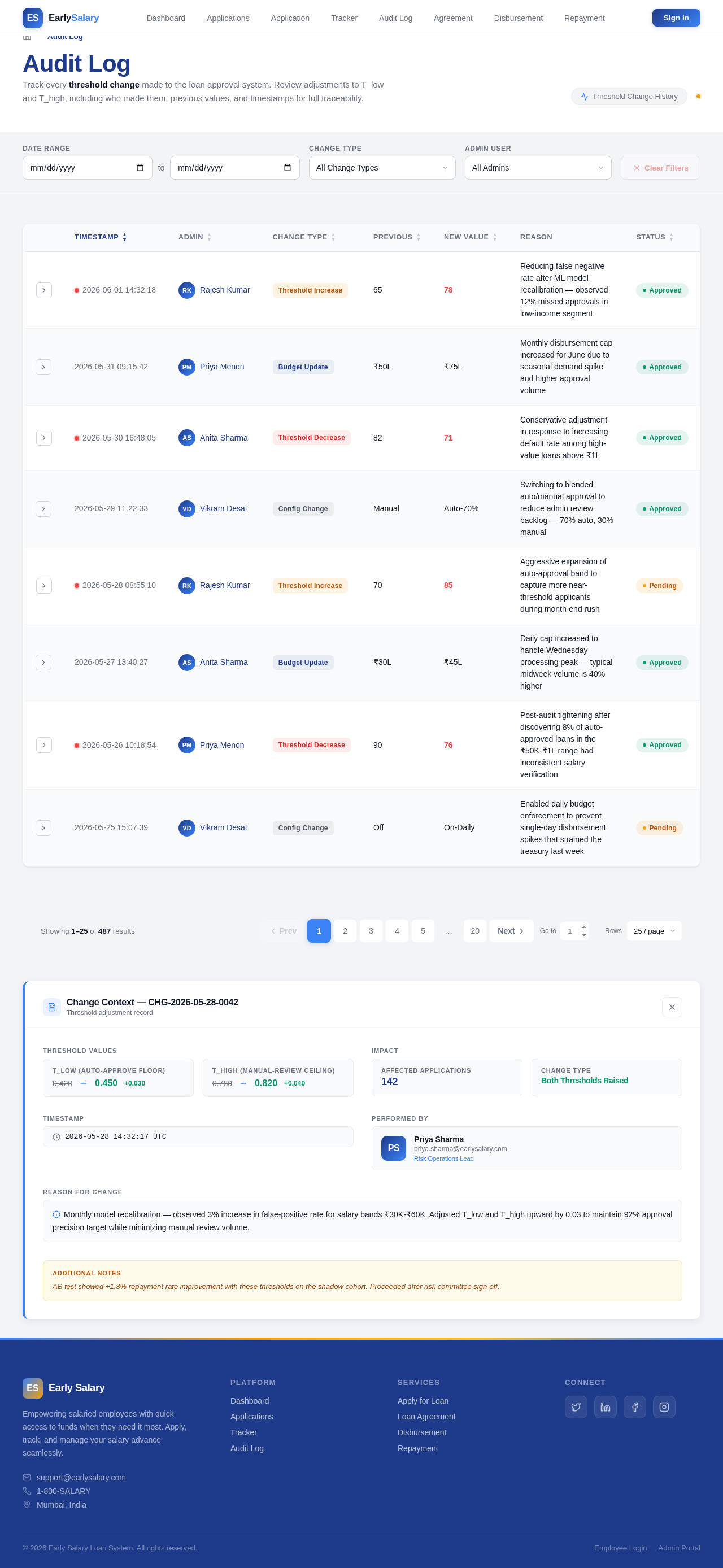
Audit Log
Track every threshold change made to the loan approval system. Review adjustments to T_low and T_high, including who made them, previous values, and timestamps for full traceability.
| Timestamp | Admin | Change Type | Previous | New Value | Reason | Status | |
|---|---|---|---|---|---|---|---|
| 2026-06-01 14:32:18 | RKRajesh Kumar | Threshold Increase | 65 | 78 | Reducing false negative rate after ML model recalibration — observed 12% missed approvals in low-income segment | Approved | |
| 2026-05-31 09:15:42 | PMPriya Menon | Budget Update | ₹50L | ₹75L | Monthly disbursement cap increased for June due to seasonal demand spike and higher approval volume | Approved | |
| 2026-05-30 16:48:05 | ASAnita Sharma | Threshold Decrease | 82 | 71 | Conservative adjustment in response to increasing default rate among high-value loans above ₹1L | Approved | |
| 2026-05-29 11:22:33 | VDVikram Desai | Config Change | Manual | Auto-70% | Switching to blended auto/manual approval to reduce admin review backlog — 70% auto, 30% manual | Approved | |
| 2026-05-28 08:55:10 | RKRajesh Kumar | Threshold Increase | 70 | 85 | Aggressive expansion of auto-approval band to capture more near-threshold applicants during month-end rush | Pending | |
| 2026-05-27 13:40:27 | ASAnita Sharma | Budget Update | ₹30L | ₹45L | Daily cap increased to handle Wednesday processing peak — typical midweek volume is 40% higher | Approved | |
| 2026-05-26 10:18:54 | PMPriya Menon | Threshold Decrease | 90 | 76 | Post-audit tightening after discovering 8% of auto-approved loans in the ₹50K-₹1L range had inconsistent salary verification | Approved | |
| 2026-05-25 15:07:39 | VDVikram Desai | Config Change | Off | On-Daily | Enabled daily budget enforcement to prevent single-day disbursement spikes that strained the treasury last week | Pending |
No comments yet. Be the first!